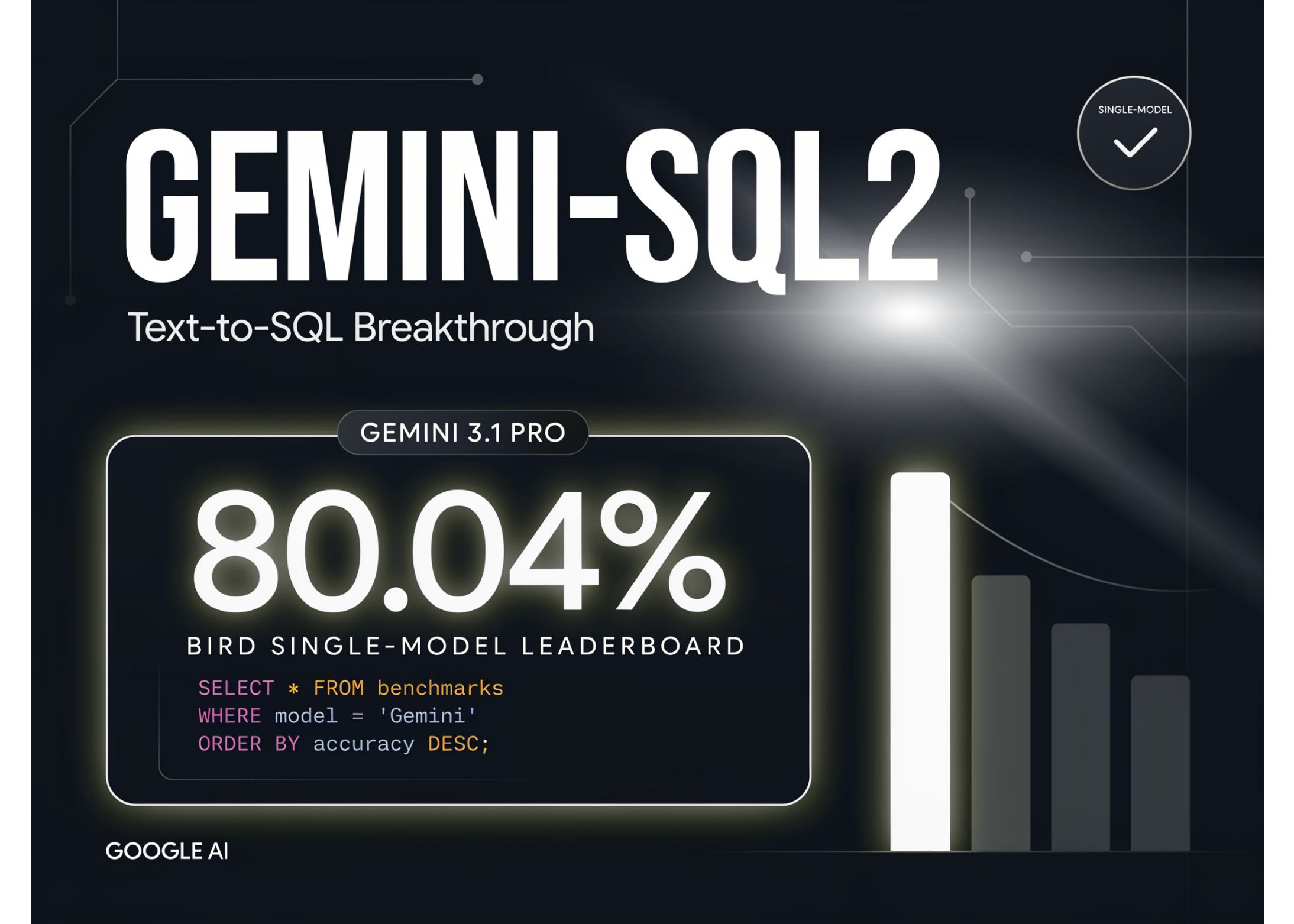
Google DeepMind's release of Gemini 3.1 Pro on February 19th represents more than just another model update—it signals a potential inflection point in how artificial intelligence approaches complex reasoning tasks. According to analysis from Artificial Analysis's Intelligence Index, Gemini 3.1 Pro now sits at #1 with a score of 57, surpassing Claude Opus 4.6 (53) and GPT-5.2 (51) while leading on 12 of 18 tracked benchmarks.
The Abstract Reasoning Breakthrough
The most dramatic improvement appears in abstract reasoning capabilities. On the ARC-AGI-2 benchmark, which has become a proxy for novel problem-solving, Gemini 3.1 Pro scored 77.1%—more than doubling Gemini 3 Pro's 31.1% from just three months ago and pulling nearly 10 points clear of Opus 4.6 (68.8%). This acceleration is remarkable when viewed historically: last July, Grok 4 made headlines by hitting 16.0% on the same benchmark. Six months later, Gemini 3 Pro reached 31.1%. Now, 77.1%.
This exponential trajectory suggests that latent reasoning architectures—where models generate hidden chains of thought before producing output—are yielding compounding returns specifically on abstract logic tasks. The architecture appears to be unlocking capabilities that were previously bottlenecked by more direct reasoning approaches.
Comprehensive Performance Dominance
The broader benchmark results reinforce Gemini 3.1 Pro's technical superiority across multiple domains:
- GPQA Diamond: Scored 94.3% on doctoral-level science questions versus Opus 4.6's 91.3% and GPT-5.2's 92.4%
- Terminal-Bench 2.0: Achieved 68.5% for agentic terminal workflows compared to Opus 4.6's 65.4% and GPT-5.2's 54.0%
- LMSYS Chatbot Arena: Now sits in a statistical dead heat with Opus 4.6 at the top of the overall text leaderboard (1500 vs. 1505 Elo) and comfortably ahead of GPT-5.2 (1478)
- Vision Category: Gemini models hold the top three spots outright, demonstrating continued strength in multimodal capabilities
The Hallucination Reduction Revolution
Perhaps the most underappreciated improvement is in hallucination resistance. On Artificial Analysis's AA-Omniscience benchmark, Gemini 3.1 Pro reduced its hallucination rate by 38 percentage points compared to Gemini 3 Pro Preview, dropping from 88% to 50%. This represents a fundamental improvement in reliability that could accelerate enterprise adoption, particularly in fields where factual accuracy is paramount.
The Tools Race Challenge
Despite these impressive technical achievements, questions remain about Gemini 3.1 Pro's position in what industry observers call "the tools race." Benchmark supremacy doesn't automatically translate into developer adoption or ecosystem integration. While Google has demonstrated remarkable progress in core model capabilities, the practical implementation through APIs, developer tools, and integration frameworks remains a separate battlefield where competitors have established significant leads.
Competitive Landscape Implications
The benchmark results create a new competitive dynamic. Claude Opus 4.6, released by Anthropic in February 2024, now finds itself in second position after enjoying several months at the top. OpenAI's GPT-5.2, while still competitive, shows a widening gap in specific reasoning domains. This three-way competition is driving rapid innovation, with each company now forced to respond to Google's latest advance.
Architectural Insights and Future Trajectories
The dramatic improvement in abstract reasoning suggests Google may have unlocked architectural efficiencies that scale particularly well with increased parameters and training data. The latent reasoning approach appears to create a virtuous cycle where better reasoning enables more efficient learning, which in turn enables even better reasoning. If this pattern holds, we might see similar exponential improvements in other cognitive domains in coming months.
Practical Applications and Limitations
While benchmark performance is impressive, the real test will be how these improvements translate to practical applications. Abstract reasoning capabilities could revolutionize fields like scientific research, complex system analysis, and strategic planning. However, the model still needs to prove itself in real-world workflows where factors like cost, speed, and integration ease often outweigh raw capability metrics.
Industry Context and Broader Developments
This release occurs alongside other significant AI developments, including Claude Sonnet 4.6, Google Lyria 3, Qwen 3.5, Zyphra ZUNA, and NVIDIA DreamDojo. The simultaneous advancement across multiple fronts suggests we're entering a period of accelerated innovation where breakthroughs in one area rapidly influence others.
Looking Forward: The Next Frontier
Gemini 3.1 Pro's performance suggests we may be approaching a threshold where AI systems can reliably handle abstract reasoning tasks that previously required human intelligence. The next challenge will be integrating these capabilities into practical tools that developers and businesses can easily adopt. Google's success will ultimately be measured not by benchmark scores alone, but by how effectively it can translate technical superiority into ecosystem dominance.
Source: Based on analysis from Towards AI's coverage of Gemini 3.1 Pro benchmark results and competitive landscape.