Key Takeaways
- eMarketer's report reveals enterprise GenAI adoption hit 62%, with retail at 38%.
- Barriers include privacy and integration, but use cases like personalized marketing and inventory management are emerging.
What Happened
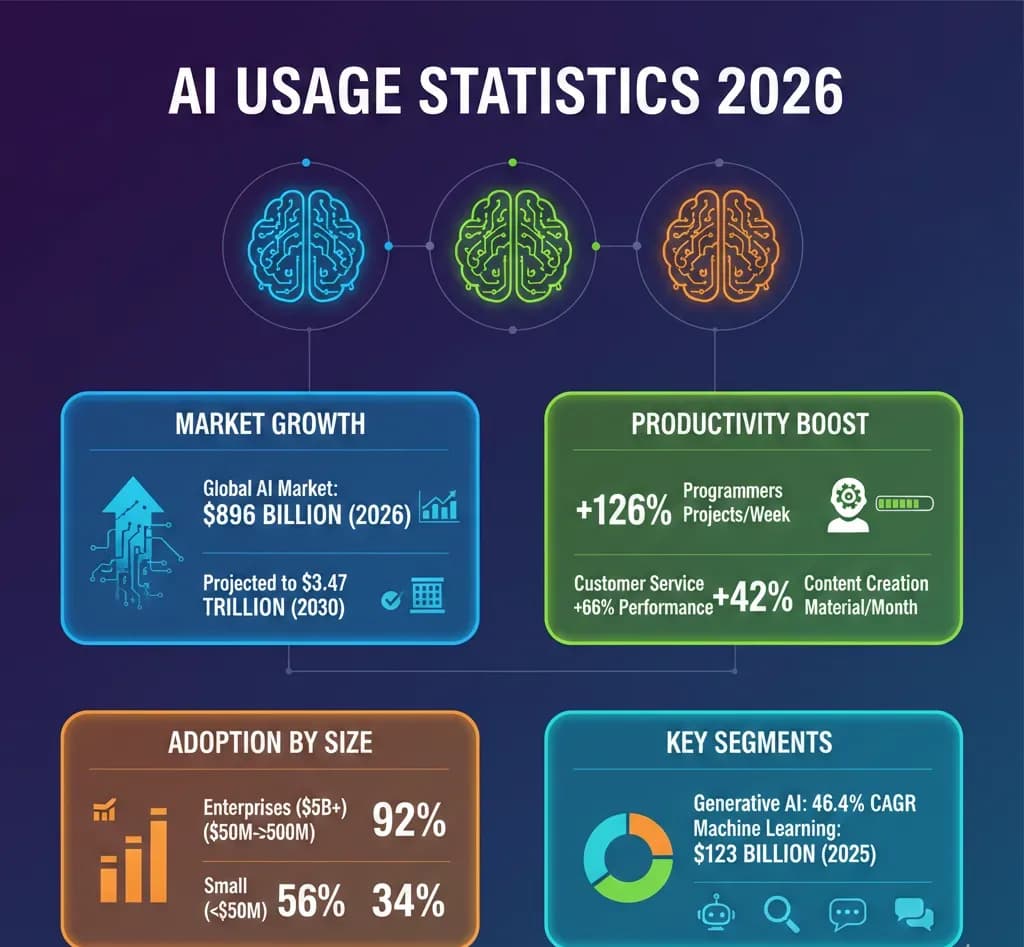
eMarketer released its latest report on generative AI usage trends and statistics, surveying over 1,000 enterprises across multiple industries. The data reveals that overall enterprise adoption of generative AI tools has surged to 62%, up from 43% in the previous year, representing a 45% year-over-year increase.
Adoption by Industry
The report breaks down adoption rates by sector:
- Technology: 78% adoption
- Financial Services: 65% adoption
- Healthcare: 52% adoption
- Retail: 38% adoption
- Manufacturing: 35% adoption
- Education: 30% adoption
Retail's 38% adoption rate places it in the middle of the pack, but notably behind the leading sectors. The report identifies key barriers specific to retail: data privacy concerns around customer information, integration challenges with legacy point-of-sale and inventory systems, and a shortage of AI-skilled talent.
Key Use Cases in Retail
Despite lower adoption, the report highlights emerging GenAI use cases in retail:
- Personalized Marketing: 45% of retail adopters use GenAI for dynamic content generation
- Inventory Management: 32% use it for demand forecasting
- Customer Service: 28% deploy AI chatbots for after-sales support
- Product Descriptions: 25% generate catalog copy
Business Impact
Among retail adopters, 67% report measurable improvements in customer engagement metrics, and 52% cite cost savings in content production. However, only 23% have seen direct revenue lift—suggesting the technology is still early in its ROI journey for the sector.
Retail & Luxury Implications
For luxury and premium retail, where brand voice and data privacy are paramount, the 38% adoption rate reflects cautious experimentation. Houses like Kering and Richemont are likely to focus on controlled deployments—such as using GenAI for internal design inspiration or personalized clienteling—rather than customer-facing chatbots. The report aligns with our recent coverage of Kering's AI-powered sustainable sourcing assistant on Google Cloud, showing that even early adopters prioritize governance.
Implementation Approach
For retail leaders, the report suggests a phased approach:
- Start with low-risk internal use cases: content generation, data analysis
- Build data governance frameworks: address privacy before scaling
- Pilot customer-facing tools: limited rollouts with human oversight
- Invest in talent: either upskill or hire AI specialists
The complexity is moderate, but the governance overhead for luxury brands is higher due to strict brand guidelines and data regulations (GDPR, CCPA).
Governance & Risk Assessment
- Data Privacy: High risk—customer data must be anonymized
- Brand Consistency: Medium risk—GenAI outputs require review
- Bias: Low to medium—retail applications are less sensitive than healthcare
- Maturity Level: Early—most retail use cases are still experimental
The report does not provide quantified ROI for retail specifically, so leaders should budget for pilot phases before full-scale deployment.
Source: news.google.com