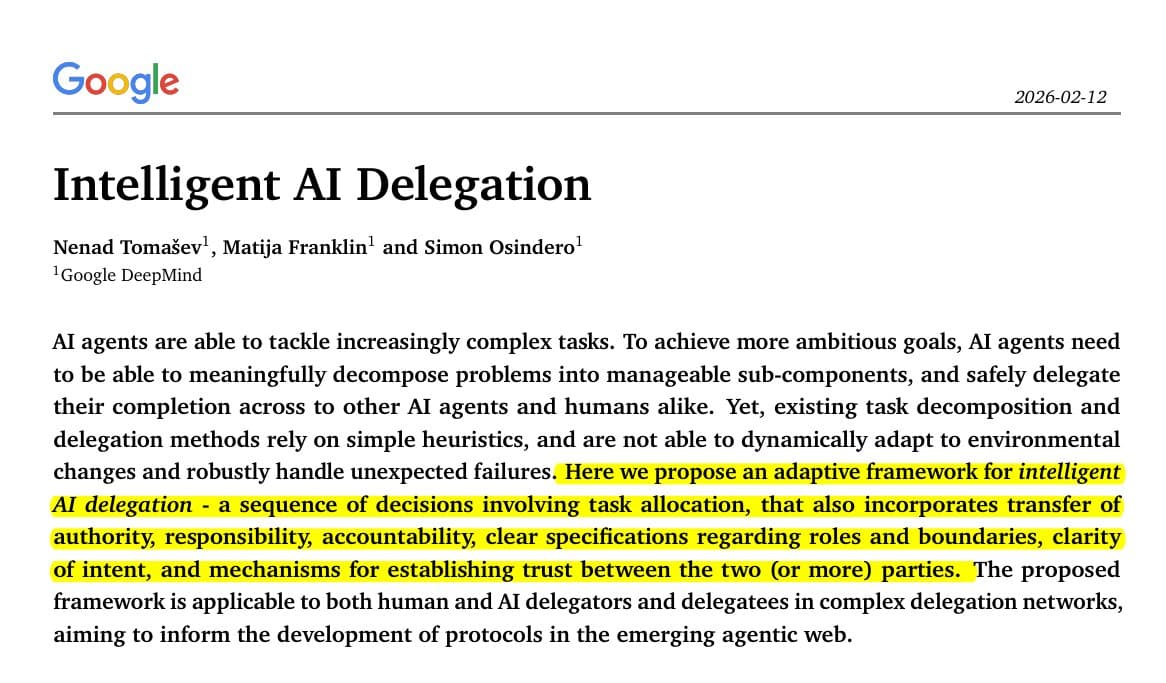
Google DeepMind researchers have published a paper, "Intelligent AI Delegation," outlining a formal framework for how tasks should be delegated to AI systems. The work moves beyond simple instruction-giving to model delegation as a structured sequence of decisions involving when to delegate, how to specify the task, and how to verify the output.
What the Framework Proposes
The core argument is that current human-AI or AI-AI interaction often relies on rigid, brittle rules that fail when unexpected problems arise. The proposed framework treats delegation as a dynamic, adaptive process. It is built to handle shifting authority and responsibility in real-time, managing failures to prevent cascading errors in a larger workflow.
A key component is the introduction of formal trust models. These models assess task difficulty against an agent's proven capabilities to prevent both over-delegation (giving an agent a task it cannot handle) and under-delegation (failing to utilize an agent that could competently perform the work).
How It Works: Delegation as a Market with Verification
The paper suggests implementing this framework through a dynamic market structure. In this model, AI agents would bid on tasks using smart contracts. This requires strict monitoring and the use of cryptographic proofs or verifiable digital certificates to guarantee work is completed correctly without leaking private data. This moves beyond simple reputation scores to cryptographically verifiable claims about an agent's specific skills.
For validation, the framework establishes rules for when to accept an agent's output based on its confidence and includes pre-defined contingency plans for when a task fails. This is designed for real-world operations where blind trust in an AI's output could lead to significant error accumulation.
The framework also explicitly covers AI-to-AI delegation, ensuring the system tracks accountability and that proper authority is transferred through a chain of agents so responsibility isn't lost in a network.
The Goal: Structured Safety for Integration
The step-by-step, structured approach aims to ensure an AI's contribution aligns with the overarching goal. The researchers posit that by formalizing the delegation process in this way, it becomes safer for organizations to integrate AI into daily operations, mitigating the risk of persistent mistakes from poorly managed task handoffs.
Paper: "Intelligent AI Delegation" (arXiv:2602.11865)