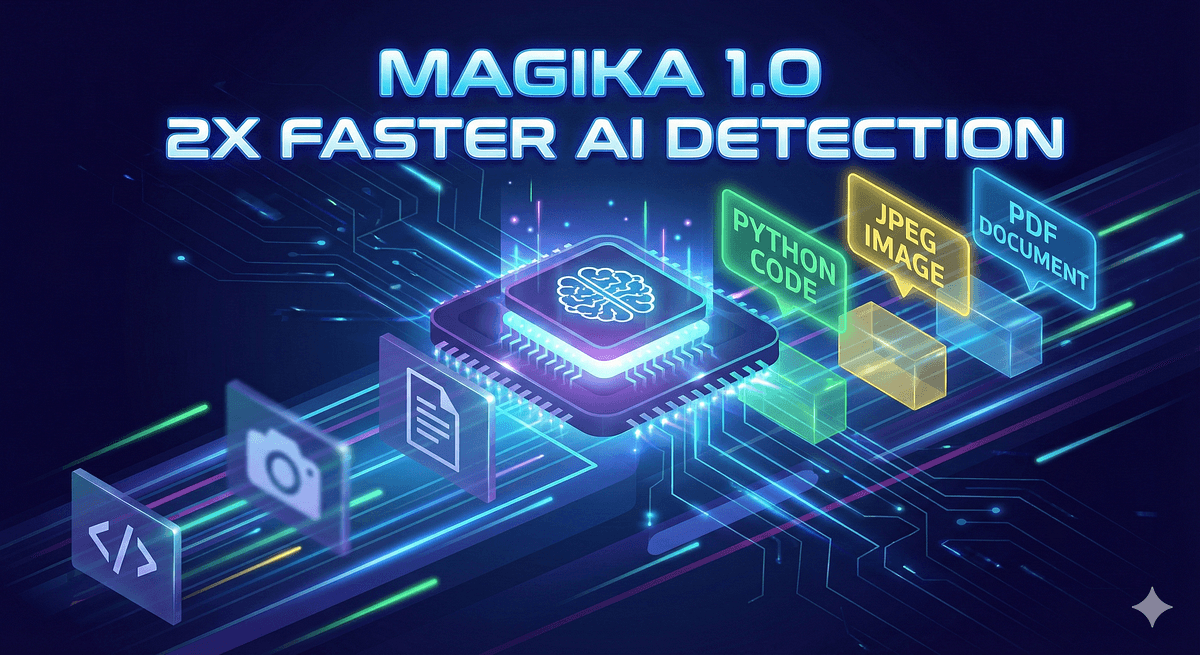
Google has open-sourced Magika, a deep learning-powered file type detection system it has used internally for years to protect products like Gmail, Drive, and Safe Browsing. The tool, which the company describes as a "secret weapon," analyzes hundreds of billions of files every week to determine a file's true content type, regardless of its extension.
Magika is now publicly available via a simple pip install magika command, putting the same detection engine that secures Google's billions of users into the hands of developers and security teams.
Key Takeaways
- Google released Magika, an AI model trained on 100M files to identify over 200 content types with 99% accuracy in 5ms.
- It was Google's internal 'secret weapon' for years, now available via pip install.
What Magika Does
At its core, Magika solves a fundamental security problem: file extensions lie. Attackers routinely disguise malware as benign files—renaming a .exe to .pdf, embedding a script within an image file, or using double extensions like resume.pdf.exe. Traditional detection methods that rely on file signatures ("magic bytes") or extensions are easily fooled.
Magika uses a custom, highly optimized deep neural network to examine the actual content of a file. It returns a prediction of the file's true type, a confidence score, and a MIME type. The system is designed for massive scale and speed, processing files in about 5 milliseconds on a CPU and 1 millisecond on a GPU.
Technical Details and Performance
Google trained Magika on a dataset of 100 million files representing over 200 different content types, including documents, scripts, archives, images, and videos. The model is a custom, compact neural network architecture built with Keras, designed for minimal latency and high throughput.
According to Google's accompanying blog post, Magika achieves 99% accuracy on a broad evaluation dataset, significantly outperforming other existing file identification tools. For particularly critical file types—like identifying a PDF file that is actually executable content—accuracy exceeds 99.5%.
Key Performance Metrics
Accuracy 99% overall, >99.5% on critical types Inference Speed (CPU) ~5 ms per file Inference Speed (GPU) ~1 ms per file Training Dataset 100 million files Supported Content Types 200+ Model Size ~1 MBHow It Works
Magika's pipeline is straightforward:
- Input: A file of any type.
- Chunking: The system reads the first few chunks of the file (typically the first 1KB is sufficient).
- AI Inference: The custom neural network analyzes the byte sequences.
- Output: Returns the predicted file type (e.g.,
Python script,PDF document), a confidence score, and the corresponding MIME type.
The model is small (~1MB) and can be run locally, making it suitable for integration into client-side applications, web servers, email scanners, or data processing pipelines without requiring a call to a cloud API.
Why Google Open-Sourced It
Google states that releasing Magika aims to improve ecosystem security. By providing a more reliable way to identify file types, the company hopes to help developers build safer software, improve spam and malware filters, and enhance data processing systems. Widespread adoption could raise the baseline cost of attack for threat actors who rely on file disguise techniques.
Magika has been battle-tested at Google scale for years, scanning the files uploaded to Gmail and Drive and those checked by the Safe Browsing service. This open-source release is a direct transfer of internal security tooling to the public domain.
How to Use It
Installation and basic usage are simple:
pip install magika
from magika import Magika
m = Magika()
prediction = m.identify_path("suspicious_file.dat")
print(f"True Type: {prediction.output.ct_label}")
print(f"Confidence: {prediction.output.score}")
print(f"MIME Type: {prediction.output.mime_type}")
The tool also includes a command-line interface: magika suspicious_file.dat.
gentic.news Analysis
Google's release of Magika is a significant move in the ongoing industrialization of AI for cybersecurity. It follows a clear trend of major cloud providers (Google, Microsoft, Amazon) converting internal, scale-proven AI systems into commercial or open-source offerings. This pattern, which we noted in our coverage of Microsoft's release of its Security Copilot framework, turns proprietary defensive tools into ecosystem standards, simultaneously improving general security while strategically positioning the releasing company.
Technically, Magika's value lies in its specific optimization for a single, high-stakes task. While large language models (LLMs) like GPT-4 can analyze file content, they are orders of magnitude slower and more expensive. Magika demonstrates the enduring power of a small, purpose-built model that is faster, cheaper, and more reliable for its dedicated function than a giant, generalist AI. This is a crucial lesson for practitioners: not every problem requires an LLM.
From a security landscape perspective, this release directly challenges legacy file detection libraries like libmagic (the engine behind the Unix file command), which rely on handcrafted byte signatures. Magika's AI-driven approach is more robust to obfuscation and evasion. Its release will likely force rapid evolution in both defensive tooling and offensive tradecraft, as attackers adapt to a world where file disguise is harder. This cat-and-mouse dynamic is central to the AI security trend we highlighted in our analysis of the use of generative AI for polymorphic malware.
Frequently Asked Questions
How is Magika different from the Unix file command?
The traditional file command uses libmagic, a library of hand-written rules and byte signatures to identify files. Magika uses a deep learning model trained on millions of files. This allows it to be more accurate, especially with obfuscated, truncated, or novel file formats, and more resilient to adversarial tricks that change a file's header bytes.
Is Magika a replacement for antivirus software?
No. Magika is specifically a file type identification tool. It tells you what a file really is. It does not scan for viruses or malware within that file. However, its accurate identification is a critical first step in a security pipeline—correctly flagging an executable disguised as a document allows an antivirus or next-generation EDR system to then analyze it with the appropriate scrutiny.
Can Magika be run offline and on-premises?
Yes. The entire Magika package, including the ~1MB pre-trained model, is installed locally via pip. It does not require an internet connection or an API call to Google Cloud to function. This makes it suitable for air-gapped environments, edge devices, or high-volume processing where latency and privacy are concerns.
What are the main limitations of Magika?
Like any AI model, Magika's performance is bounded by its training data. It may be less accurate on extremely rare or proprietary file formats not well-represented in its 100-million-file training corpus. Furthermore, while highly accurate, it is not infallible; a determined adversary with white-box knowledge of the model could potentially craft adversarial examples. Its primary role is as a highly reliable filter, not an absolute guarantor of truth.