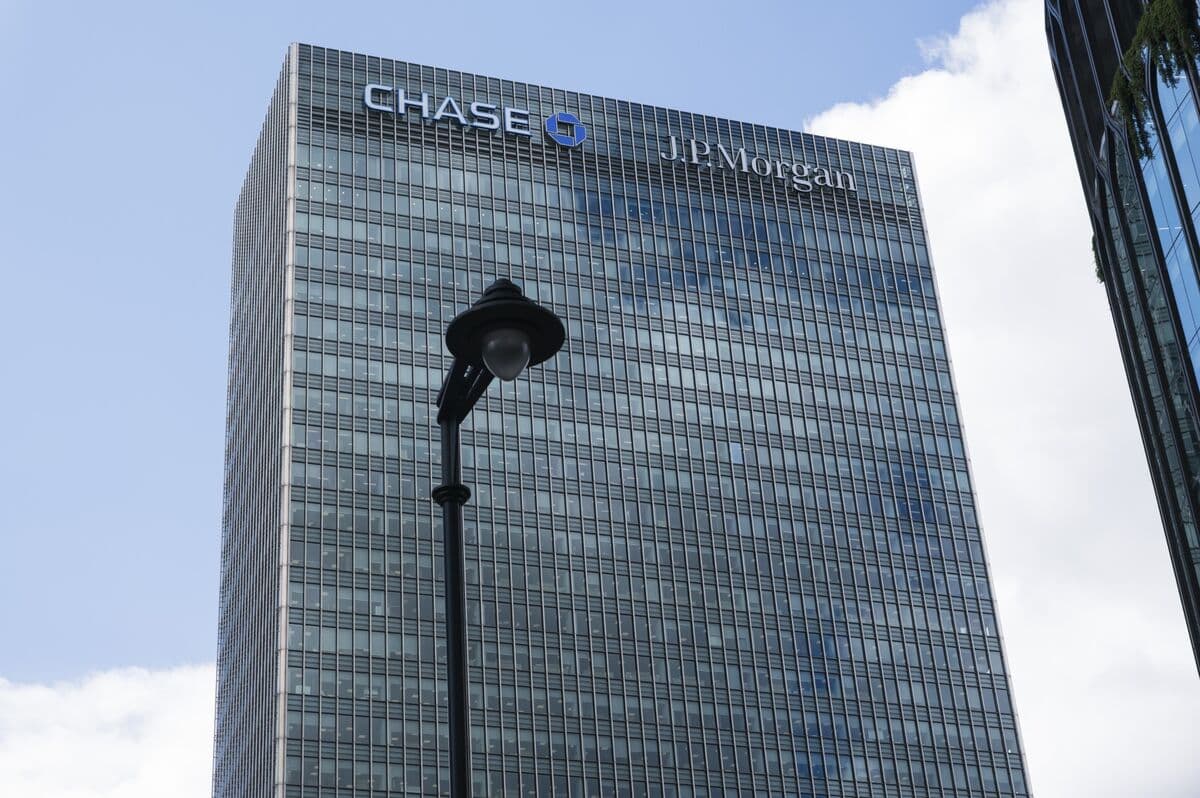
JPMorgan Chase built AI agents that beat the classic 60/40 portfolio in backtests. The bank tested whether large language models could autonomously allocate money across assets.
Key facts
- JPMorgan tested AI agents for autonomous asset allocation
- Agents beat the classic 60/40 stock-bond portfolio in backtests
- Bank did not disclose model architecture or backtest period
- AI agents use large language models to make decisions
- Test signals push toward autonomous portfolio management
JPMorgan Chase & Co. has been testing whether AI agents can do something more ambitious than stock picking or risk management: allocate money itself. According to Bloomberg, the bank's AI agents outperformed the classic 60/40 stock-bond portfolio in backtests, signaling a push toward autonomous asset allocation by major financial institutions.
AI agents are autonomous software systems that use large language models to perceive their environment, make decisions, and take actions to accomplish goals. They can use tools, browse the web, and write code. JPMorgan's test represents a significant step in applying these systems to core financial operations.
The 60/40 portfolio — 60% stocks, 40% bonds — has been a standard benchmark for decades, offering a simple but effective risk-return balance. The AI agents' ability to beat this model in backtests suggests that machine learning can capture market dynamics that static allocation strategies miss.
Why This Matters

The test comes amid a broader trend of financial institutions adopting AI agents for complex tasks. ByteDance recently found that AI agents double learning speed every three months, per a July 3 report. The UK's AISI warned that fixed compute budgets underestimate AI agents by 60%, indicating rapid capability growth.
JPMorgan's results challenge the assumption that portfolio allocation requires human judgment. If AI agents can consistently beat benchmarks, the role of human portfolio managers could shift from decision-making to oversight and strategy.
How the Test Worked
The bank did not disclose the specific model architecture, training data, or backtest period. It also did not reveal the exact performance delta over the 60/40 benchmark. The lack of transparency makes it difficult to assess whether the results generalize to live markets.
AI agents in this context likely used reinforcement learning or supervised fine-tuning on historical market data. The agents would have made allocation decisions based on real-time or simulated market conditions, learning from outcomes to improve future decisions.
Limitations and Risks
Backtests can overfit to historical patterns that don't repeat. The 60/40 benchmark itself has underperformed in recent years due to low bond yields and high inflation. JPMorgan's agents may have exploited specific market conditions rather than discovering generalizable strategies.
Regulatory hurdles also remain. Autonomous portfolio management by AI agents would require approval from the SEC and other regulators, who have yet to establish clear guidelines for such systems.
What to Watch
Watch for JPMorgan to release details on the backtest period, performance metrics, and whether the agents are deployed in live trading. Also watch for competitors like Goldman Sachs and Morgan Stanley to announce similar tests, and for SEC guidance on autonomous portfolio management.
Source: bloomberg.com