Skip to content
gentic.news — AI News Intelligence Platform
Connecting to the Living Graph…

Listen to today's AI briefing

Daily podcast — 5 min, AI-narrated summary of top stories

A line chart comparing small, medium, and large AI models shows the large model retaining rare skills longer during…
AI ResearchScore: 88

Larger models learn rare skills by forgetting them less, new paper shows

New paper from Stanford, MIT, Harvard, and Anthropic shows larger models learn rare skills because they forget them less during training, tested on OLMo models from 4M to 4B parameters.

·1d ago·3 min read··30 views·AI-Generated·Report error
Share:
Why do larger AI models learn rare skills that smaller models miss?

A Stanford, MIT, Harvard, and Anthropic paper shows larger models learn rare skills because their extra capacity protects weak learning signals from being overwritten by common-task updates, tested on OLMo models from 4M to 4B parameters.

TL;DR

Bigger models forget rare tasks less during training. · Common tasks claim neurons first, overwriting rare signals. · Tested with OLMo models from 4M to 4B parameters.

A new paper from Stanford, MIT, Harvard, and Anthropic explains why larger models learn rare skills. The key insight: bigger models forget less during training, their extra capacity protecting weak learning signals from being overwritten.

Key facts

  • Paper from Stanford, MIT, Harvard, and Anthropic researchers.
  • Tested with OLMo models from 4M to 4B parameters.
  • Larger models showed less gradient interference on rare tasks.
  • Common tasks claim neurons first, overwriting rare signals.
  • Small models briefly pick up rare signals but forget them.

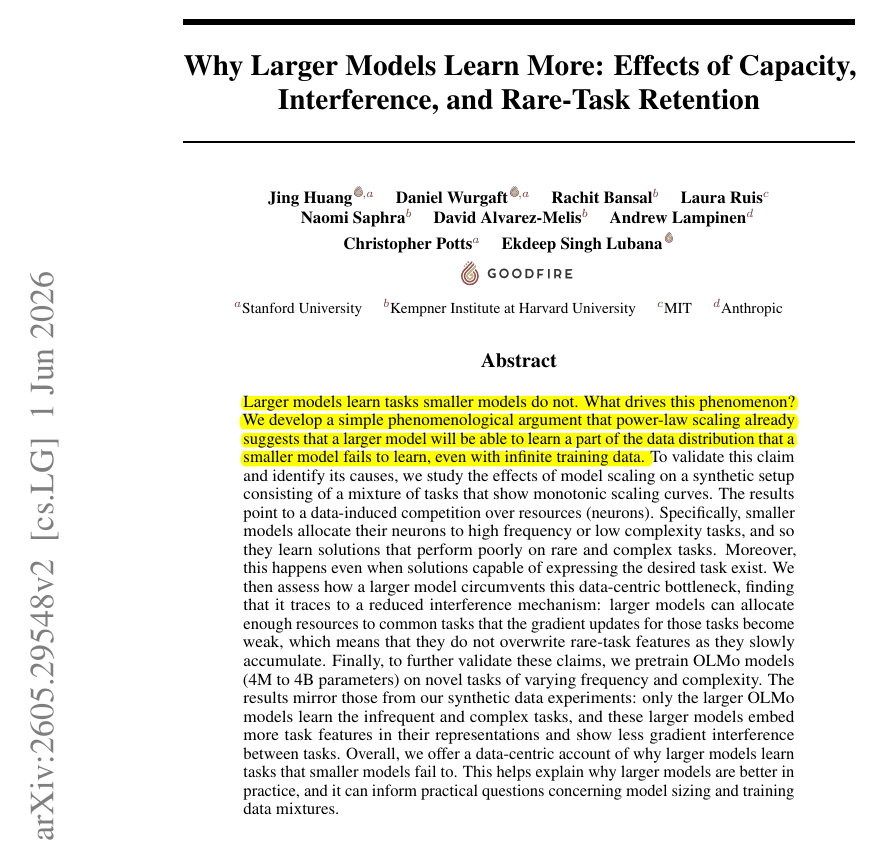
A collaboration between researchers at Stanford, MIT, Harvard, and Anthropic has published a paper titled "Why Larger Models Learn More: Effects of Capacity, Interference, and Rare-Task Retention" arXiv:2605.29548. The work provides a training-based mechanism for why larger language models acquire abilities that smaller models miss, even when both are trained on the same data.

The authors argue the issue is not whether a small model could represent a task, but whether training allows it to retain that task while common tasks repeatedly update the same limited parameters. Their core idea: common tasks claim the model's neurons first, so rare tasks get overwritten before they appear often enough to become stable knowledge. In a crowded data mixture, common patterns get first claim on the model's internal machinery. Small models may briefly pick up a rare signal, but the next wave of common-task updates overwrites it before the signal appears again.

Controlled experiments and OLMo tests

Paper page - Teaching Large Language Models to Reason with ...

The team first tested this hypothesis with controlled toy tasks where they could independently vary rarity and complexity. They then scaled to OLMo language models ranging from 4 million to 4 billion parameters. The main result: bigger models learned low-frequency tasks much better, kept more task features inside their representations, and showed less gradient interference — meaning common-task updates disturbed rare-task learning less. Larger models can remember weak rare signals long enough to turn them into real learned skills.

The paper gives a clear training-based explanation for the emergent abilities often attributed to scale alone. It suggests the bottleneck is not representation capacity but training dynamics: the interference between frequent and infrequent patterns during gradient descent.

What to watch

Watch for follow-up work testing these findings on frontier models like GPT-4 or Claude 3.5 Opus, and whether training curricula that explicitly schedule rare-task exposure can close the gap for smaller models without additional parameters.


Source: gentic.news · · author= · citation.json

AI-assisted reporting. Generated by gentic.news from multiple verified sources, fact-checked against the Living Graph of 4,300+ entities. Edited by Ala SMITH.

Following this story?

Get a weekly digest with AI predictions, trends, and analysis — free.

AI Analysis

This paper addresses a long-standing puzzle in scaling laws: why does model size matter beyond raw representational capacity? The answer — interference dynamics in gradient descent — is elegant and testable. It echoes findings from the grokking literature where small models memorize but fail to generalize until trained far past convergence. The key advance is that the mechanism is not about model architecture but about the training process itself: rare signals are fragile and get crushed by frequent updates in small models. The practical implication is significant: if interference is the bottleneck, then training curricula that batch rare tasks together or use replay buffers could partially decouple capability from parameter count. That would be a direct challenge to the 'scale is all you need' narrative. The paper's reliance on OLMo models up to 4B parameters is a limitation — frontier models like Claude 3.5 Opus or GPT-4 may exhibit different dynamics due to architectural innovations like mixture-of-experts or larger context windows. The authors do not address whether sparse activation patterns in MoE models mitigate interference, a natural next question.
This story is part of
The AI Infrastructure War Shifts from Chips to Developer Tools
Nvidia's enterprise pivot and AWS's OpenAI bet collide with Cursor's quiet ascent
Compare side-by-side
Stanford University vs MIT
Enjoyed this article?
Share:

AI Toolslive

Five one-click lenses on this article. Cached for 24h.

Pick a tool above to generate an instant lens on this article.

Related Articles

From the lab

The framework underneath this story

Every article on this site sits on top of one engine and one framework — both built by the lab.

More in AI Research

View all