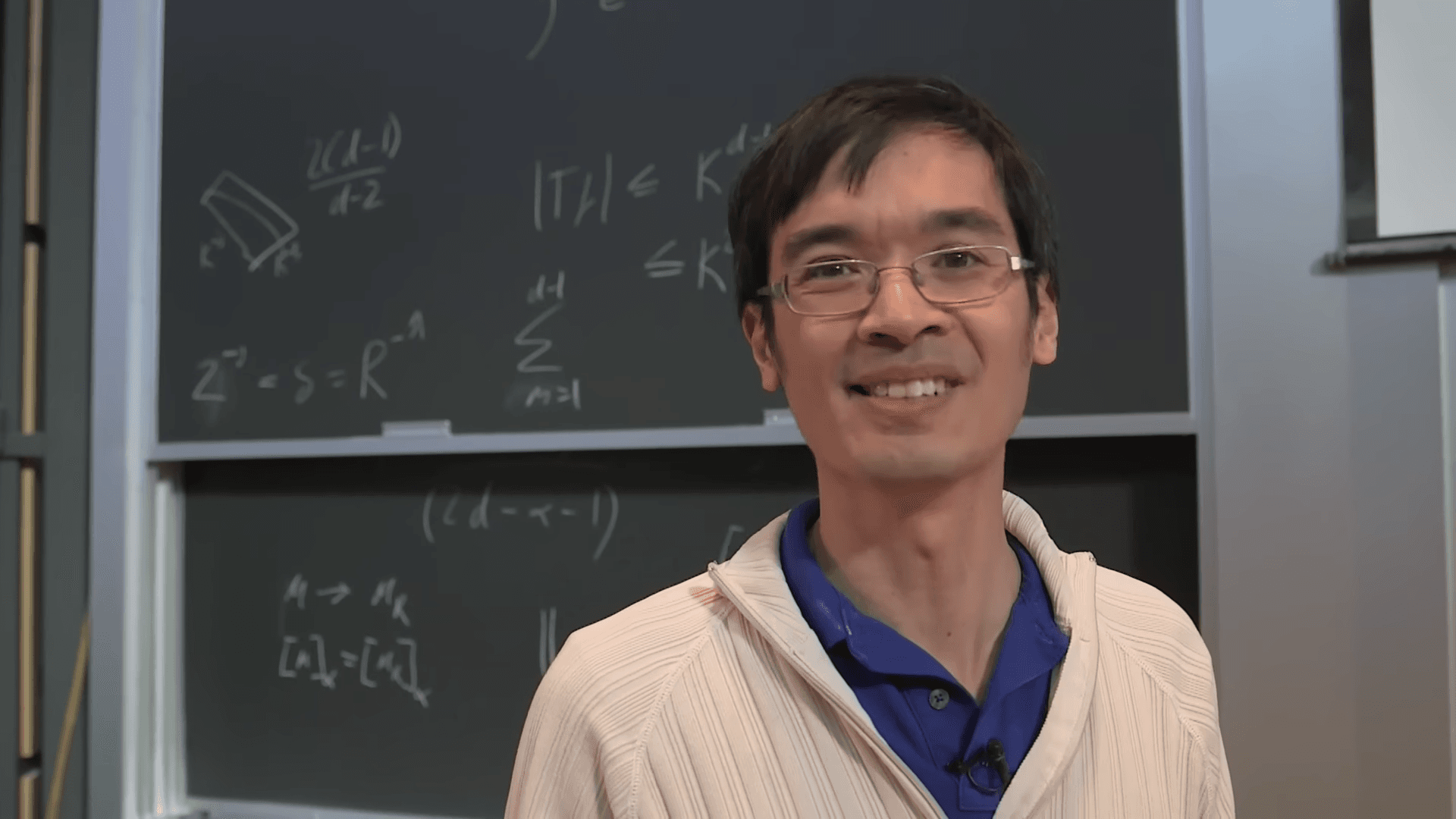
In a statement that signals a watershed moment for both artificial intelligence and pure mathematics, Fields Medalist Terence Tao has declared that AI is "not hype anymore" in mathematical discovery. The renowned mathematician, often described as one of the greatest living mathematical minds, has publicly shifted his position on AI's role in research, urging the academic community to take these tools seriously if they haven't already.
The Turning Point in Mathematical Research
Terence Tao's endorsement represents more than just a personal opinion—it's a validation of years of quiet progress at the intersection of machine learning and abstract reasoning. For decades, mathematics has been considered the ultimate test of human intelligence, requiring intuition, creativity, and deep conceptual understanding that seemed uniquely human. While AI has excelled at pattern recognition in data-rich environments, pure mathematics—with its emphasis on proof, abstraction, and logical rigor—remained a bastion of human exceptionalism.
That barrier is now crumbling. Tao's statement, shared via social media, references growing evidence that AI systems can contribute meaningfully to mathematical discovery rather than merely performing calculations or verifying existing results. This shift suggests AI has developed capabilities for symbolic reasoning, conjecture generation, and even proof assistance that were previously thought to be decades away.
How AI Is Transforming Mathematical Practice
Recent breakthroughs demonstrate how AI is moving from assistant to collaborator in mathematics. Systems like DeepMind's AlphaGeometry have shown they can solve complex geometry problems at International Mathematical Olympiad levels, generating human-readable proofs without direct human guidance. Other AI tools are helping mathematicians discover patterns in algebraic structures, suggest novel approaches to longstanding conjectures, and explore mathematical spaces too vast for human intuition alone.
What makes Tao's declaration particularly significant is his emphasis on practical utility rather than theoretical potential. He's not describing speculative future technology but tools that are already changing how mathematicians work today. Researchers report using AI to generate conjectures that they then prove, discover unexpected connections between different mathematical areas, and explore counterexamples that would take months to find manually.
The Changing Role of Human Mathematicians
This development doesn't signal the end of human mathematics but rather its transformation. Just as calculators didn't eliminate arithmetic but changed how we approach it, AI mathematical tools are becoming extensions of mathematical intuition. The most productive approach appears to be collaborative—human mathematicians providing direction, context, and conceptual understanding while AI systems handle pattern recognition, computation, and exploration of possibility spaces.
Tao himself has experimented with AI tools in his work, and his public statement suggests he's found them sufficiently valuable to recommend to the broader community. This endorsement from someone with his credentials carries particular weight in a field known for its skepticism toward technological solutions to fundamentally intellectual problems.
Implications for Mathematical Education and Discovery
The integration of AI into mathematical research will inevitably reshape how mathematics is taught and practiced. Future mathematicians may need training in both traditional proof techniques and AI collaboration methods. The very nature of mathematical discovery could evolve, with more time spent on high-level conceptual work and less on exhaustive exploration or tedious verification.
This development also has implications for mathematics' relationship with other sciences. If AI can accelerate progress in pure mathematics—often considered the most abstract and least data-driven scientific discipline—its potential in physics, chemistry, and biology becomes even more compelling. The techniques developed for mathematical AI may transfer to other domains requiring abstract reasoning and logical deduction.
Challenges and Ethical Considerations
Despite the excitement, significant challenges remain. The "black box" problem—understanding why AI systems reach particular mathematical conclusions—is particularly acute in a field built on transparent reasoning. There are also questions about attribution, credit, and what constitutes genuine mathematical discovery when AI plays a substantial role.
Mathematicians will need to develop new standards for AI-assisted proofs and discoveries, ensuring the field maintains its rigorous standards while embracing new tools. There's also the risk of over-reliance on AI, potentially diminishing the development of human intuition and problem-solving skills that have driven mathematics for millennia.
The Future of AI in Mathematics
Terence Tao's declaration that AI is "not hype anymore" marks a turning point in the acceptance of artificial intelligence as a legitimate tool for fundamental research. As more mathematicians follow his lead and incorporate AI into their work, we can expect accelerated progress on problems that have resisted solution for decades or even centuries.
The most exciting possibility is that AI might help reveal connections and patterns across different mathematical domains that human minds have overlooked due to cognitive limitations or disciplinary boundaries. This could lead to a new golden age of mathematical discovery, with AI serving as a catalyst for human creativity rather than a replacement for it.
Source: Terence Tao via @kimmonismus on Twitter/X