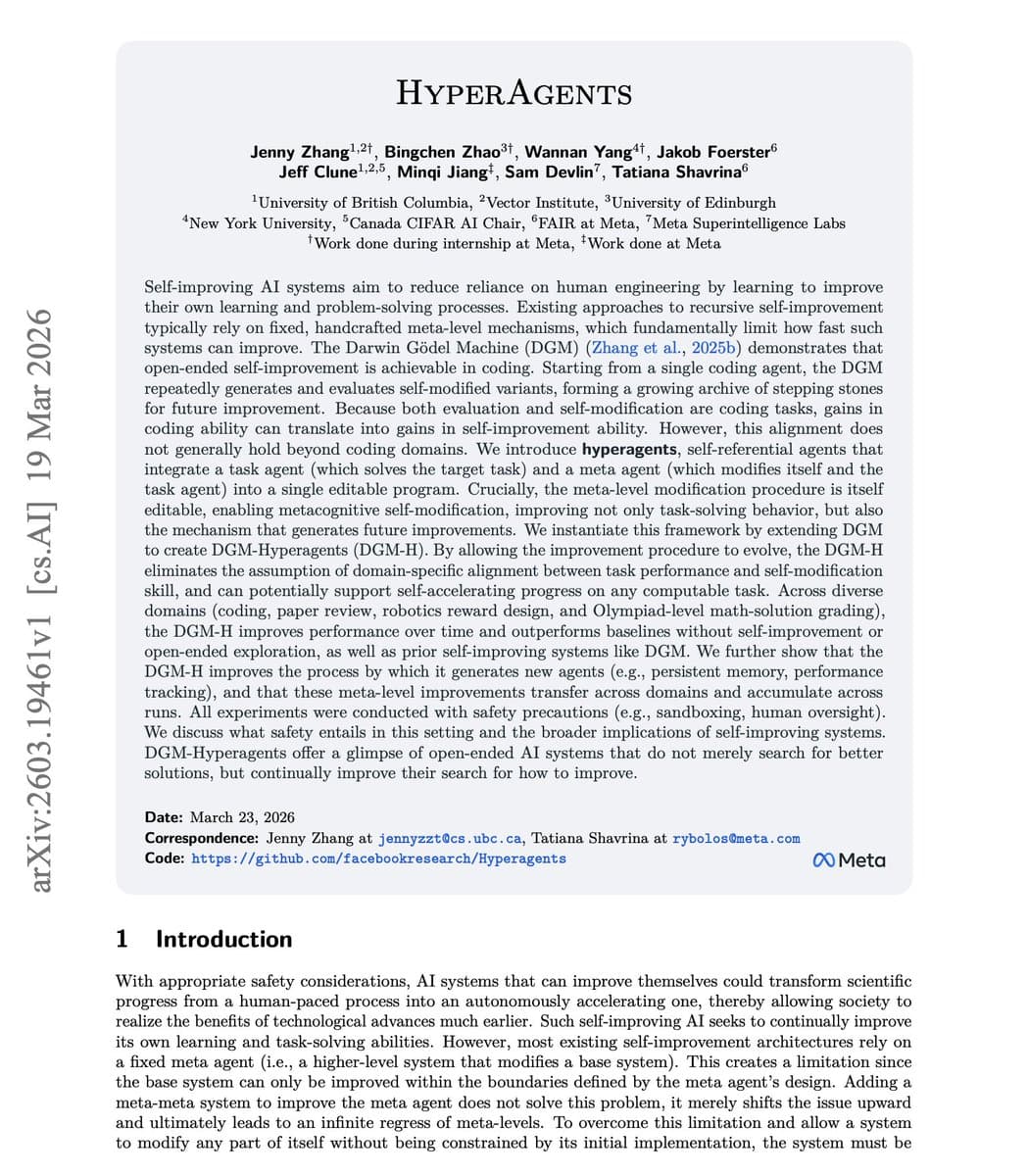
Most AI agent systems that claim to "self-improve" operate with a fundamental constraint: the algorithm that governs their improvement is static. While the agent might optimize its performance on specific tasks, the meta-process—the how of improvement—remains frozen. A new paper from Meta AI and collaborators introduces Hyperagents, a framework where the self-improvement process itself becomes an editable, optimizable component of the system.
The core innovation, termed DGM-Hyperagent (Differentiable Game Model Hyperagent), collapses the traditional separation between a task-level agent and a fixed meta-controller. Instead, it formulates both as parts of a single, differentiable computational graph. This architecture allows the system to perform metacognitive self-modification—it can learn to edit the very code or parameters that define how it searches for and implements improvements.
What the Researchers Built
The team formalized the self-improvement problem as a differentiable game between two components within the same model: a task policy (the actor performing the primary objective) and a meta-policy (the actor that modifies the task policy). Crucially, the parameters governing the meta-policy's behavior are also situated within the differentiable graph. This creates a self-referential loop: the output of the meta-policy (an edit to the task policy) influences future states, which include the state of the meta-policy itself, allowing gradients to flow through and optimize the improvement mechanism.
In practice, the DGM-Hyperagent is implemented as a modifiable program. The system is given a base objective (e.g., "review academic papers accurately") and an initial, simple algorithm for attempting that task. Through interaction with an environment, it can propose edits to its own source code or parameters. These edits are then evaluated, and successful modifications are reinforced.
Key Results
The paper demonstrates Hyperagents across three distinct domains, showing that meta-improvements can both compound (lead to progressively better performance over multiple rounds) and transfer (discoveries in one domain apply to another).
Paper Review (Predict accept/reject) 0.0 (Random) 0.710 Test Accuracy Implemented a persistent memory buffer to track reviewer tendencies and paper similarities. Robotics Reward Design (Design reward for a simulated robot) 0.060 (Normalized return) 0.372 Normalized Return Created an internal performance-tracking subroutine to credit past actions more effectively. Math Olympiad Grading (Transfer Task) Not trained in-domain 0.630 Accuracy Successfully applied the persistent memory mechanism learned during paper review to a novel, complex grading task.The transfer result is particularly notable. A "transfer hyperagent," which had self-improved on the paper review task, was directly applied to grade solutions to Olympiad-level math problems—a domain it never trained on. By leveraging the persistent memory innovation it had previously discovered, it achieved 0.630 accuracy without any domain-specific fine-tuning.
How It Works: The Technical Core
The DGM framework models the self-improvement process as a two-player game with a twist: both players are part of the same model. The Task Player (π_θ) takes actions in the environment to complete a goal. The Editor Player (π_φ) takes actions that modify the parameters θ of the Task Player. The state of the game includes the current task parameters and the editor parameters.
The differentiability is key. When the Task Player executes an action leading to a reward, that reward signal can be backpropagated not only to update θ but also, through the computational graph that includes the editor's modification step, to update φ. This allows the system to learn which kinds of edits lead to better long-term task performance. The edits aren't random search; they become learned, gradient-informed operations.
The training uses a reinforcement learning objective within this differentiable game. The system explores edit operations (e.g., "add a memory module," "adjust the learning rate schedule," "introduce a checkpointing subroutine"). Successful edits that lead to measurable performance increases are reinforced, shaping a meta-policy that becomes increasingly adept at improving the underlying agent.
Why It Matters
This work moves beyond the paradigm of agents that simply optimize within a fixed learning algorithm. The Hyperagent's ability to edit its own improvement mechanism opens a path toward open-ended, cumulative meta-learning. The demonstrated transfer of meta-cognitive innovations (like persistent memory) suggests that such systems could develop generally useful "reasoning tools" that apply across problems.
For practitioners building autonomous AI systems, this research provides a formal, trainable framework for meta-cognition. The bottleneck is no longer just data or compute for the primary task, but also the environment and reward signal for the meta-learning game. The results, while early-stage, show a clear quantitative leap in self-improvement efficacy on the tested benchmarks, moving from near-zero to strong performance solely through learned self-modification.
gentic.news Analysis
This research from Meta fits directly into the escalating trend of recursive self-improvement as a central goal in AI agent development. It follows Meta's prior investments in agent foundations, such as the CICERO diplomacy agent and the Habitat embodied AI platform, but shifts focus from task proficiency to the plasticity of the learning process itself. The concept of a differentiable self-modification game is a formal answer to a long-standing theoretical question in AI: how can an system improve the optimizer that is improving it?
The transfer learning result—applying a paper-review agent's discovered memory mechanism to math grading—resonates with findings from other labs exploring meta-learning for reasoning. For instance, our coverage of Google's "Self-Discover" prompting framework showed LLMs could induce reusable reasoning structures. Hyperagents operationalize a similar principle at the architectural level, making the reasoning structure an editable, learnable component of the agent's code.
This work also implicitly raises the bar for evaluating AI agents. A simple benchmark score is insufficient; the meta-capacity—the rate and quality of self-improvement from a cold start—becomes a critical new metric. As the field progresses, we may see a bifurcation between static agents (highly optimized for a fixed task) and hyperagents (moderately capable but with high meta-gradients, designed to rapidly adapt and improve). The long-term trajectory suggested here aligns with predictions from researchers like David Dalrymple and John Carmack, who have emphasized recursive improvement as the key pathway to more general, robust machine intelligence.
Frequently Asked Questions
What is a Hyperagent in AI?
A Hyperagent is an AI system where the process it uses to improve its own performance (the meta-learning algorithm) is itself editable and optimizable. Unlike standard self-improving systems that use a fixed update rule, a Hyperagent can learn to change how it learns, creating a self-referential loop of improvement.
How does Meta's DGM-Hyperagent actually modify itself?
The DGM-Hyperagent implements self-modification within a differentiable computational graph. It contains a "meta-policy" that outputs edits (e.g., code changes, parameter adjustments) to its main "task policy." Because the entire process is differentiable, the system can use gradient-based learning to discover which types of edits lead to better long-term task performance, effectively learning how to improve itself more effectively.
What are the practical applications of self-referential AI?
The most immediate applications are in domains requiring rapid, autonomous adaptation where human engineers cannot pre-specify all rules. This includes complex simulation environments (e.g., robotics reward shaping), dynamic content moderation systems, and automated scientific discovery pipelines. The ability to transfer learned meta-skills, like persistent memory, between domains could reduce the need for extensive retraining for each new task.
What are the main limitations of the Hyperagent approach shown in this paper?
The current framework requires the self-modification process to be formalized within a differentiable game, which can be computationally intensive and complex to set up. The "edit space"—the set of possible modifications the agent can make—must be carefully designed by humans. Truly open-ended code generation or architectural search is not yet demonstrated. Furthermore, all experiments are conducted in constrained simulated environments; scaling to noisy, real-world tasks with delayed and sparse rewards remains a significant challenge.