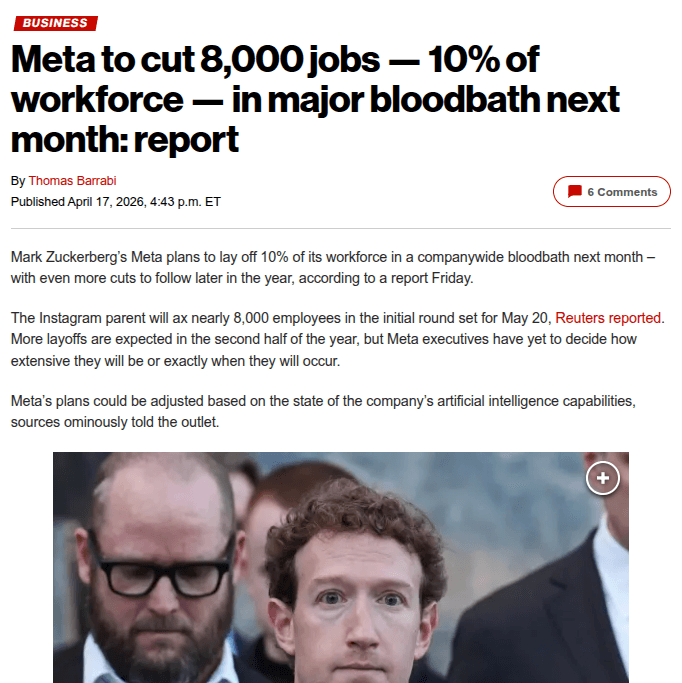
According to a report from the New York Post, Meta is preparing for significant layoffs this year, with the first round in May expected to cut approximately 8,000 employees. This represents roughly 10% of the company's workforce. The cuts are framed as a strategic capital shift, where funding previously allocated to broad-based teams is being redirected toward artificial intelligence infrastructure, including semiconductors, data centers, and large-scale model training.
The report, citing sources familiar with the matter, indicates this is part of a broader effort to "push harder into AI." The layoffs are not presented as a cost-cutting measure in isolation but as a reallocation of resources to compete more aggressively in the AI arena, where compute and infrastructure are primary bottlenecks.
Key Takeaways
- Meta is reportedly planning to lay off 8,000 employees in May, the first round of major cuts this year.
- The move signals a capital shift from general operations to concentrated investment in AI infrastructure like chips and data centers.
The Strategic Pivot to AI Infrastructure

The planned layoffs underscore a fundamental strategic realignment at Meta. The company is moving capital from human resources across various departments to physical and computational resources dedicated to AI. This typically means investments in:
- Custom AI Chips: Developing or procuring next-generation semiconductors (like its MTIA accelerators) to reduce reliance on external vendors like Nvidia and control training costs.
- Data Center Expansion: Building out massive, specialized data centers to house these chips and support the immense computational demands of training frontier models like Llama.
- Model Training & Research: Funding the expensive process of training increasingly large and capable AI models, which requires sustained, billion-dollar investments in compute.
This "capital shift" narrative suggests Meta is prioritizing raw AI capability and infrastructure scalability over maintaining a wider array of non-core product teams or experimental divisions. The 8,000 figure for May points to a substantial and rapid restructuring.
Context of Meta's AI Ambitions
This reported move follows a period of intense investment and activity in AI from Meta. The company has open-sourced its Llama family of large language models, aggressively competed for AI research talent, and signaled its intent to be a leader in the foundational model space. However, this ambition requires a war chest largely spent on compute, an area where competitors like Microsoft (with Azure and OpenAI), Google, and Amazon have significant existing infrastructure advantages.
Layoffs of this scale, if confirmed, would mark one of the most significant workforce reductions since Meta's "Year of Efficiency" in 2022-2023, when it cut over 21,000 jobs. The framing as a direct reallocation to AI makes this a distinct phase: not just general belt-tightening, but a targeted surgical shift of resources to a single strategic priority.
gentic.news Analysis

This reported restructuring is a stark, logical escalation of the capital-intensive AI arms race. It moves beyond the narrative of "increased AI spending" to one of explicit capital reallocation—taking budget directly from other parts of the organization to fuel the AI engine. This is a pattern we may see other integrated tech giants (like Google or Apple) follow if they determine that competing in frontier AI requires a similar concentration of resources.
The move aligns with our previous coverage on the industry-wide scramble for Nvidia H100/GH200 GPUs and the rising strategic value of proprietary AI silicon. Meta's own MTIA chip project becomes even more critical in this context. If successful, shifting capital from salaries to in-house silicon could create a long-term cost and control advantage, but it carries significant execution risk. The layoffs also follow a trend of major tech firms consolidating around core AI bets post the initial generative AI explosion, a trend we noted in our analysis of Microsoft's restructuring of its Azure AI and research teams last quarter.
For the AI ecosystem, this signals that Meta's leadership is willing to make severe organizational changes to stay competitive in model development. It reinforces that the primary barrier to entry in the frontier model race is no longer just talent or algorithms, but capital—specifically, capital that can be converted into compute. This could pressure smaller, well-funded AI labs (like Anthropic or xAI) to similarly demonstrate extreme capital efficiency, as they compete against giants willing to redirect tens of thousands of salaries into server racks.
Frequently Asked Questions
How many jobs is Meta cutting?
Meta is reportedly planning to cut approximately 8,000 jobs in May 2026, which constitutes about 10% of its total workforce. This is expected to be the first round of layoffs for the year.
Why is Meta laying off employees?
According to the report, the layoffs are part of a strategic "capital shift." Funds that previously supported a broad range of teams and projects are being redirected to invest heavily in AI-specific infrastructure, including custom AI chips (semiconductors), data centers, and large-scale model training operations.
What does this mean for Meta's AI division?
This indicates an all-in prioritization of AI within Meta. The restructuring suggests that AI infrastructure and model development will receive a massive influx of capital and internal focus, likely accelerating projects like the Llama model series and the Meta Training and Inference Accelerator (MTIA) chip program. However, it may also lead to the deprioritization or shutdown of non-core projects.
Has Meta done large layoffs before?
Yes. Meta conducted a major "Year of Efficiency" in 2022-2023, during which it eliminated over 21,000 positions. The reported 2026 layoffs would be the largest single round since that period, but uniquely framed as a direct reallocation of resources to fund AI ambitions.