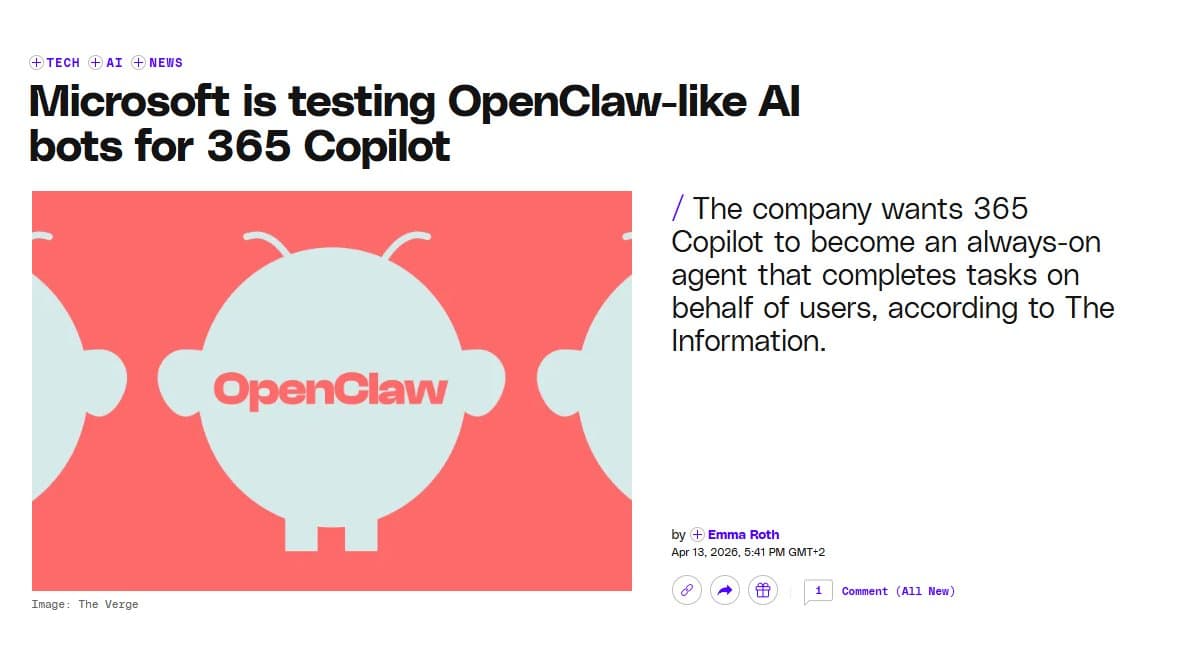
Microsoft is experimenting with a significant architectural shift for its flagship productivity AI, Microsoft 365 Copilot. According to a report, the company is testing OpenClaw-style AI agents to evolve Copilot from a reactive, prompt-based tool into an always-on, autonomous assistant. The goal is to enable the AI to handle complex, multi-step tasks—like managing emails, calendars, and daily workflows—without requiring constant user instruction.
Key Takeaways
- Microsoft is reportedly testing OpenClaw-style AI agents to evolve Microsoft 365 Copilot into an always-on, autonomous assistant.
- This move aims to directly handle complex, multi-step tasks like email triage and calendar management without constant user prompting.
What's New: From Copilot to Autonomous Agent
The core change under test is a move from a command-driven copilot to a proactive, autonomous agent. Currently, Microsoft 365 Copilot operates primarily within applications like Outlook or Word, executing specific tasks ("summarize this email," "draft a reply") in response to user prompts. The new agentic approach, inspired by the OpenClaw project, would allow the AI to operate continuously in the background, making decisions and taking actions across the Microsoft 365 ecosystem.
Reported capabilities being tested include:
- Autonomous Email Management: Triaging incoming mail, drafting responses, and filing messages based on learned priorities and context.
- Intelligent Calendar Orchestration: Proactively scheduling, rescheduling, and preparing for meetings by analyzing email content, participant availability, and project timelines.
- End-to-End Workflow Handling: Connecting tasks across applications—for example, creating a Teams channel and a SharePoint site based on a project brief discussed in an email, then notifying relevant team members.
Technical Context: What is "OpenClaw-Style"?
The term "OpenClaw-style" refers to a research direction focused on creating generalist, tool-using AI agents. While specific details of Microsoft's internal project are not public, the concept aligns with a broader industry push toward agents that can:
- Plan multi-step tasks by breaking down high-level goals.
- Use Tools by calling APIs and interacting with software interfaces (like clicking buttons in a web app or sending an email via SMTP).
- Operate Autonomously over extended periods, with some capacity for self-correction and learning from feedback.
This represents a more complex AI paradigm than the current large language model (LLM) completion tasks that power most of today's Copilot features. It likely involves a layered architecture where a planning LLM orchestrates a series of actions executed by specialized modules or by calling the existing Microsoft Graph APIs that Copilot already uses.
The Competitive Push for Agentic AI
This development is part of a heated race to build the first widely adopted AI agent for knowledge work. Microsoft's main competitors are on a similar path:
- Google is integrating its Gemini models deeply into Workspace, with early agentic features like "Help me write" that suggest content proactively.
- OpenAI has been aggressively pursuing agent capabilities, with rumors and research pointing toward models that can perform complex, multi-step computer tasks.
- Startups like Cognition AI (with its Devin coding agent) and Adept AI are building models trained specifically for action and workflow automation.
Microsoft's immense advantage is its entrenched enterprise ecosystem. An always-on agent integrated into the daily flow of hundreds of millions of workers using Outlook, Teams, and Office documents has a potential adoption floor that pure-play AI startups cannot match. The challenge is execution: delivering reliable, secure, and trustworthy autonomy at scale.
What to Watch: The Practical Hurdles
The leap to autonomy introduces significant technical and product challenges that Microsoft must solve:
- Reliability & Hallucination: An agent that drafts and sends an email autonomously must be exceptionally accurate. Hallucinated meeting times or incorrect email recipients could cause serious business disruption.
- User Trust & Control: How much autonomy will users cede? Effective agent design will require sophisticated user preference learning and clear, override-able transparency about what actions the AI is taking.
- Security & Compliance: An always-on agent with access to corporate email and documents becomes a high-value attack surface. Microsoft will need to demonstrate robust security auditing, data governance, and compliance frameworks (like GDPR, HIPAA) for autonomous actions.
Early testing likely focuses on controlled environments or opt-in user groups. A full rollout would be phased, starting with semi-autonomous suggestions ("I can draft a reply to this—send it?") before moving to full automation for low-risk tasks.
gentic.news Analysis
This testing signals Microsoft's strategic response to the industry's clear pivot toward agentic AI as the next platform shift. While Copilot has achieved notable adoption, its utility is bounded by the need for constant user prompting—the "last-mile" problem of AI productivity. Transforming it into an autonomous agent addresses this directly, aiming to deliver the elusive "time saved" metric that truly justifies enterprise AI spend.
This move is a direct escalation in the Microsoft vs. Google Workspace AI war. Both are leveraging their dominant productivity suites as the foundational "operating system" for AI agents. Microsoft's deep integration with the Microsoft Graph—the API layer that connects all 365 services—gives it a structural advantage for building a cohesive cross-application agent. Google's strength lies in its unified Gemini model across consumer and enterprise products. The battleground is now which company can first ship a competent, generalist workplace agent that users actually trust to work autonomously.
Technically, the reference to "OpenClaw-style" is telling. It suggests Microsoft's research org is moving beyond pure LLM scaling and is investing heavily in the planning, tool-use, and memory architectures required for sustained autonomy. This aligns with broader trends we've covered, like the rise of AI agent frameworks (AutoGPT, LangChain) and research into reinforcement learning for human feedback (RLHF) on actions, not just text. The success of this evolution for Copilot will depend less on raw model capability and more on the robustness of these surrounding agentic systems.
Frequently Asked Questions
What is an OpenClaw-style AI agent?
OpenClaw-style refers to AI systems designed as generalist agents that can plan multi-step tasks, use software tools via APIs or interfaces, and operate with a degree of autonomy. The goal is to move beyond chatbots that respond to prompts, to create assistants that can accomplish complex objectives—like "prepare the quarterly review presentation"—by breaking them down and executing the steps across different applications.
How is this different from the current Microsoft 365 Copilot?
Today's Copilot is primarily a reactive assistant. You give it a command in a specific app ("summarize these meeting notes in Teams"), and it performs that single task. The agentic version under testing would be proactive and autonomous. It could run continuously, monitor your workflow, and take actions like organizing your inbox or scheduling follow-up meetings without being explicitly asked for each step.
When will this autonomous Copilot be available?
There is no official release date. The report indicates Microsoft is in the testing phase. Given the complexity and potential risks of autonomous agents handling business communications, a broad public rollout is likely months away, if not longer. We expect a gradual release, starting with limited previews and highly constrained autonomous features.
Is this secure? Can the AI agent access all my data?
Security and privacy will be the paramount concerns for Microsoft. Any autonomous agent would operate within the same permissions and compliance boundaries as the current Copilot and the user it's acting on behalf of. Microsoft would need to implement rigorous audit logs, user confirmation steps for sensitive actions, and clear controls over what the agent can and cannot do. Enterprise administrators will likely have granular policies to disable or limit autonomous features.