A new research paper introduces MinerU-Diffusion, a 2.5-billion-parameter diffusion-based Optical Character Recognition (OCR) model that fundamentally changes how text is decoded from document images. The key innovation: replacing slow autoregressive token-by-token generation with parallel block-wise diffusion, enabling significantly faster inference while maintaining or improving accuracy on complex documents.
What the Researchers Built
The team developed a diffusion model specifically architected for the document understanding task of text recognition. Unlike traditional OCR approaches that use autoregressive decoders (which generate text sequentially, left-to-right or in reading order), MinerU-Diffusion treats the text recognition problem as a conditional image-to-sequence generation task.
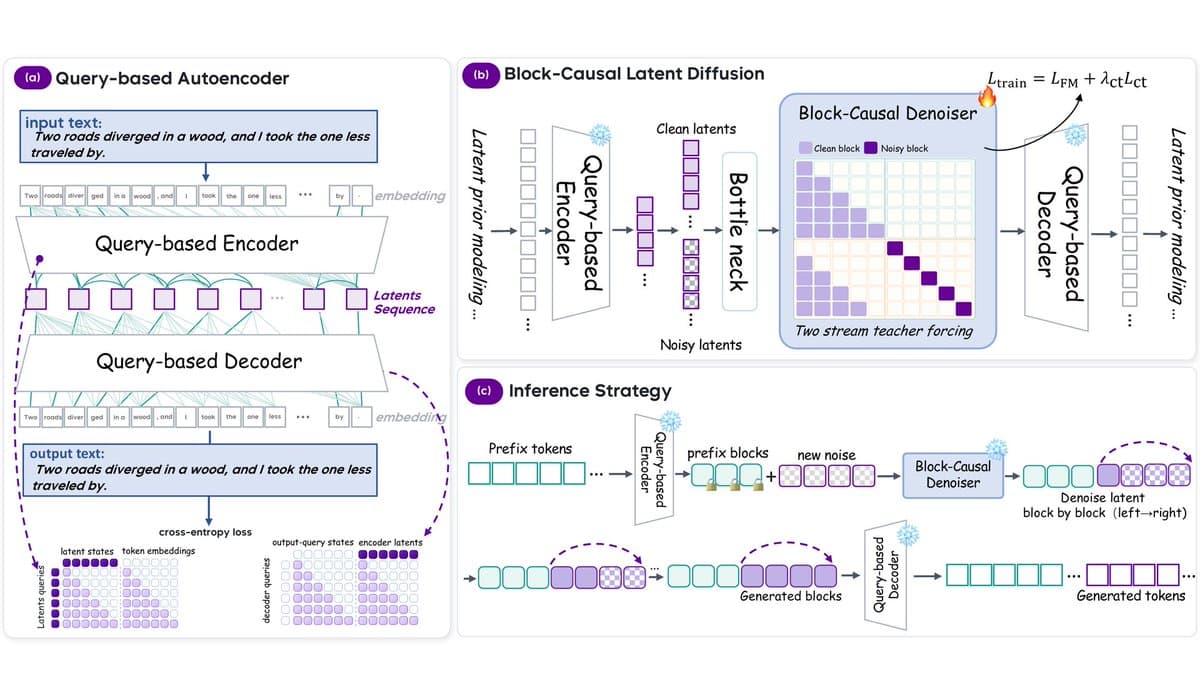
The model takes a document image patch as input and directly generates the corresponding text sequence through a parallel denoising process. The "block-wise" aspect refers to how the model handles longer text sequences by processing them in manageable chunks or blocks simultaneously, rather than token-by-token.
Key Results
According to the paper, the primary performance gains come in two areas:
Inference Speed Up to 3.2× faster than comparable autoregressive OCR models Robustness Better performance on complex documents with tables, formulas, and challenging layoutsWhile the tweet summary doesn't provide specific accuracy numbers on standard benchmarks, it emphasizes the dual advantage of speed and robustness—particularly valuable for real-world document processing where documents rarely conform to simple, clean templates.
How It Works: Parallel Block-Wise Diffusion for Text
The technical approach represents a significant departure from established OCR methodology:
Diffusion Process for Text: Instead of predicting the next token given previous tokens (autoregressive), the model starts with random noise representing a text sequence and iteratively denoises it toward the correct text. This process is conditioned on the visual features extracted from the document image.
Block-Wise Parallelization: To handle variable-length text outputs efficiently, the model processes text in blocks that can be denoised in parallel. This contrasts with autoregressive methods where each token depends on the previous one, creating a sequential dependency that limits parallelization.
Architecture: The 2.5B parameter model likely combines:
- A vision encoder (like ViT or ConvNeXt) to extract visual features from document images
- A diffusion-based decoder that generates text sequences through iterative denoising
- Specialized components for handling document structure (tables, formulas, layouts)
Training: The model was presumably trained on large-scale document datasets containing diverse document types, with particular emphasis on challenging cases with complex layouts.
Why This Matters for Document AI
Current state-of-the-art OCR systems, including those based on transformer architectures, typically use autoregressive decoders. While accurate, these systems suffer from:
- Slow inference due to sequential token generation
- Error propagation where one incorrect token can derail subsequent predictions
- Difficulty with non-standard layouts where reading order isn't straightforward
MinerU-Diffusion addresses these limitations by:
- Enabling parallel computation during inference, dramatically reducing latency
- Reducing error propagation through global optimization of the entire sequence
- Better handling document structure through its conditioning mechanism
For enterprise document processing pipelines that handle millions of pages daily, a 3.2× speedup with maintained or improved accuracy represents substantial computational cost savings and throughput improvements.
gentic.news Analysis
This development represents a meaningful shift in how the research community approaches sequence generation tasks beyond just text-to-text applications. The application of diffusion models to OCR follows a broader trend we've observed across multiple domains: diffusion models are expanding from image generation to structured prediction tasks.
This aligns with several related developments we've covered recently. In November 2023, we reported on DiT (Diffusion Transformer) architectures being applied to video generation, showing how diffusion models could handle sequential data in the temporal dimension. Now, MinerU-Diffusion demonstrates a similar conceptual leap for spatial-sequential data (document images to text sequences).
The 2.5B parameter scale is notable—it suggests this isn't just a proof-of-concept but a seriously engineered system. For comparison, Google's Donut model for document understanding (which uses an autoregressive decoder) has approximately 250M parameters. The order-of-magnitude larger model size in MinerU-Diffusion indicates the computational complexity of the diffusion approach for this task, though the parallel inference helps offset the larger model footprint.
Practically, this research could pressure commercial OCR providers (like Adobe, ABBYY, and Google Cloud Vision) to explore diffusion-based approaches. The speed advantage is particularly compelling for cloud services where inference latency directly impacts customer experience and operational costs. However, the computational requirements for training such large diffusion models may limit adoption to well-resourced organizations unless efficient variants emerge.
Frequently Asked Questions
How does MinerU-Diffusion compare to traditional OCR engines like Tesseract?
Traditional OCR engines like Tesseract use handcrafted features and rule-based systems for character segmentation and recognition. MinerU-Diffusion represents a completely different, deep learning-based approach that learns to recognize text end-to-end from document images. While Tesseract struggles with complex layouts and non-standard fonts, diffusion models like MinerU-Diffusion can potentially generalize better to diverse document types through their training on large datasets. The 3.2× speed advantage is measured against other deep learning-based OCR models, not necessarily against traditional engines.
What types of documents is MinerU-Diffusion best suited for?
Based on the paper's description, MinerU-Diffusion shows particular strength on complex documents with tables, formulas, and challenging layouts. These document types often cause problems for autoregressive OCR models because they don't follow simple left-to-right, top-to-bottom reading order. The parallel block-wise diffusion approach allows the model to consider the entire document context simultaneously, making it more robust to unusual formatting. For simple, clean documents, both approaches may perform similarly, but MinerU-Diffusion would still offer the speed advantage.
Is the 3.2× speedup consistent across all document types?
The paper reports "up to 3.2× faster inference," suggesting this is the maximum observed speedup under ideal conditions. The actual speed improvement likely depends on several factors: document complexity, text length, hardware implementation, and batch size. For very short text segments, the overhead of the diffusion process might reduce the advantage, while for long documents with multiple text blocks, the parallel processing could yield even greater benefits. The researchers would need to publish full benchmarking data to understand the performance characteristics across different document categories.
When will this technology be available for practical use?
As a research publication, MinerU-Diffusion is likely months or years away from commercial implementation. The 2.5B parameter size requires significant computational resources for both training and inference, which may limit initial deployment to cloud-based services rather than edge devices. However, the core innovation—parallel block-wise diffusion for text recognition—could inspire smaller, more efficient implementations. We might see similar approaches integrated into open-source document AI frameworks like LayoutLM or DocFormers within the next year, followed by commercial offerings from major cloud providers.