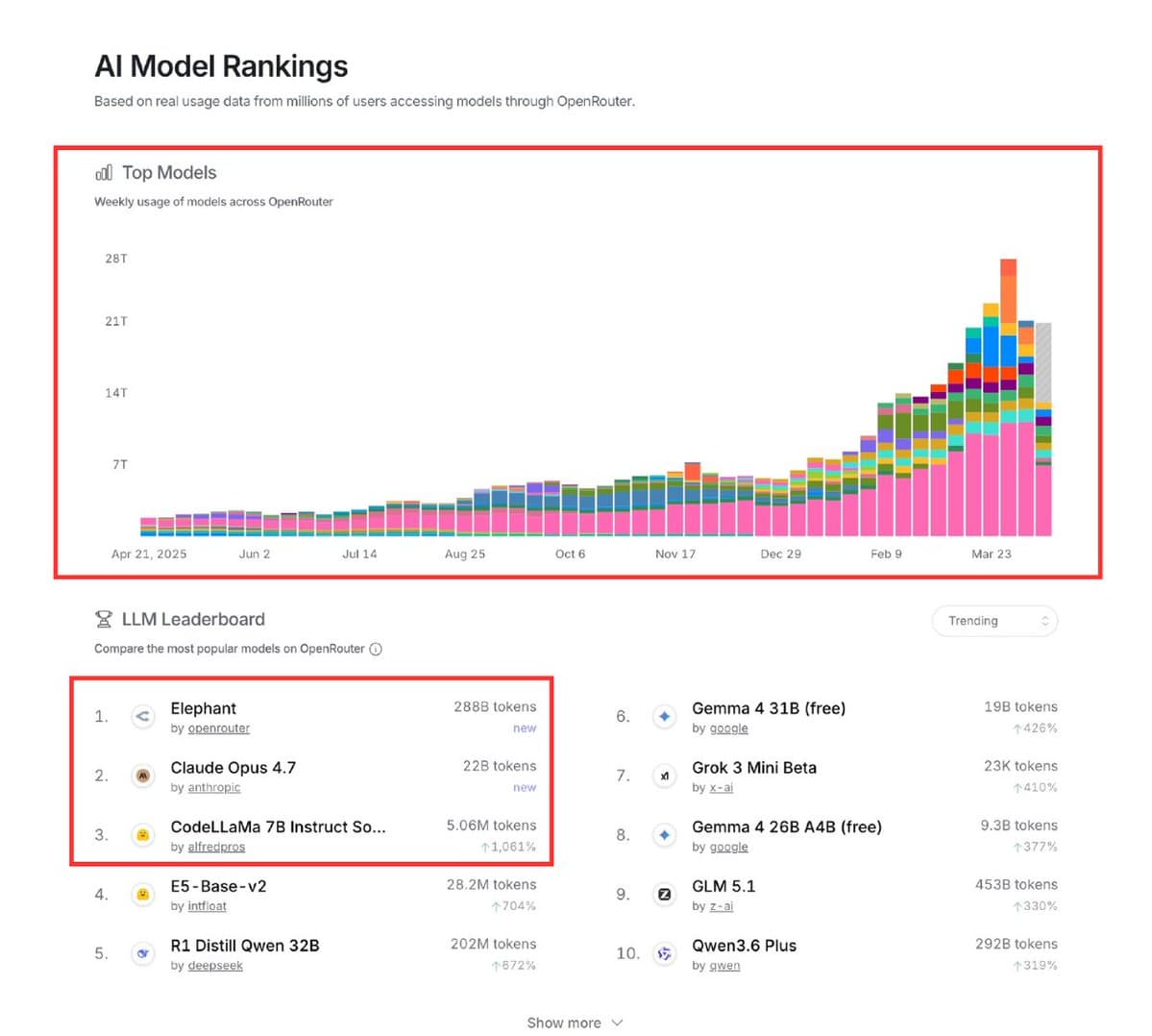
A large, unannounced language model has suddenly appeared as a top performer on the model aggregation platform OpenRouter, sparking immediate speculation within the AI community. The model, named "Elephant Alpha," is listed as having approximately 100 billion parameters and, despite having no public model card, documentation, or attributed lab, is already ranking highly on the platform's performance leaderboard.
What Happened

On April 11, 2026, users and observers of OpenRouter—a platform that provides a unified API for accessing dozens of different AI models—noticed a new entry at the top of its leaderboard. The model, elephant-alpha, had no linked announcement, research paper, or company affiliation. Its model card page was blank. Despite this complete lack of context, its aggregated performance scores placed it above several well-known, commercially available models.
OpenRouter's leaderboard ranks models based on a weighted average of scores from several popular benchmarks, including MT-Bench (for instruction-following and chat) and IFEval (for instruction fidelity). According to the snapshot shared, Elephant Alpha's performance was competitive with or superior to models like Anthropic's Claude 3.5 Sonnet and Google's Gemini 1.5 Pro on the platform's aggregate score.
Context & Speculation
The sudden appearance of a high-performing, large-scale model from an unknown source is highly unusual. The standard practice for major AI labs—including OpenAI, Anthropic, Google DeepMind, Meta, and Cohere—is to accompany a significant model release with a research paper, technical report, or detailed blog post. The "stealth" release of Elephant Alpha breaks this pattern entirely.
This has led to several theories within the community:
- A Leaked or Internal Model: It could be an internal model from a major lab that was accidentally or intentionally made accessible via the OpenRouter API before its official launch.
- A New, Stealthy Entrant: It might be the first public move by a well-funded but secretive new AI research lab or a consortium choosing an unconventional launch strategy.
- An Orchestrated Test: Some speculate it could be a stress test or marketing stunt by OpenRouter itself, though the platform has not claimed responsibility.
The name "Elephant Alpha" itself offers few clues. It does not align with the naming conventions of any known major AI lab.
What This Means for Practitioners

For developers and companies using OpenRouter's API, the model is—for the moment—a functional option. It can be selected and queried like any other model on the platform. However, the complete lack of documentation presents significant risks:
- Unknown Capabilities & Limitations: Without a model card, users have no guidance on the model's strengths, weaknesses, or potential biases.
- Uncertain Availability & Pricing: Its long-term availability and pricing stability are completely unknown. It could disappear or change terms at any time.
- Lack of Legal & Safety Frameworks: There are no published usage policies, safety mitigations, or terms of service, creating potential liability for commercial use.
Its strong performance on the leaderboard suggests it is a genuinely capable model, making its mysterious provenance all the more intriguing.
gentic.news Analysis
This incident highlights two accelerating trends in the AI industry. First, it underscores the growing role of model aggregation platforms like OpenRouter, Together AI, and Replicate as the new discovery layer for AI capabilities. These platforms are becoming the de facto app stores for foundation models, where performance on standardized benchmarks can immediately drive developer adoption, regardless of the branding or marketing behind the model. This democratizes access but also commoditizes model performance.
Second, Elephant Alpha's appearance follows a pattern of increasingly opaque releases. While Meta's Llama series popularized the "leak-then-release" strategy, and startups like Mistral AI have used cryptic social media hints, a complete silent launch is a new extreme. This could be a competitive tactic by a well-funded entity—potentially a sovereign AI initiative or a major corporation outside the traditional tech sphere—to gain real-world usage data and market validation before engaging in public discourse about safety or capability. The 100B parameter scale suggests significant computational resources, ruling out most hobbyist or academic efforts.
The mystery also puts OpenRouter in a unique position. The platform's credibility is based on providing reliable access to models. Hosting a "ghost model" boosts short-term intrigue but introduces ecosystem risk if the model vanishes or behaves unpredictably. How OpenRouter vets and onboards models will now be under greater scrutiny.
Frequently Asked Questions
What is Elephant Alpha?
Elephant Alpha is a large language model with roughly 100 billion parameters that appeared without warning or documentation on the OpenRouter platform on April 11, 2026. It shows strong performance on the platform's aggregated benchmarks but has no attributed creator.
Who created the Elephant Alpha model?
As of now, no individual, research lab, or company has claimed responsibility for creating or releasing the Elephant Alpha model. Its origin is completely unknown, which is the core of the mystery surrounding it.
Can I use Elephant Alpha in my application?
Technically, yes, if you use the OpenRouter API. However, it is highly risky for any production application due to the complete lack of documentation, usage policies, and long-term availability guarantees. The model could be altered, removed, or restricted at any time.
How does Elephant Alpha perform compared to GPT-4 or Claude 3.5?
Based on the OpenRouter leaderboard snapshot from its appearance, Elephant Alpha's aggregated score placed it in the top tier, competitive with or exceeding models like Claude 3.5 Sonnet and Gemini 1.5 Pro. However, without independent, comprehensive benchmarking, a full and fair comparison to the latest versions of GPT-4 or other top models is not possible.