Skip to content
gentic.news — AI News Intelligence Platform
Connecting to the Living Graph…

Listen to today's AI briefing

Daily podcast — 5 min, AI-narrated summary of top stories

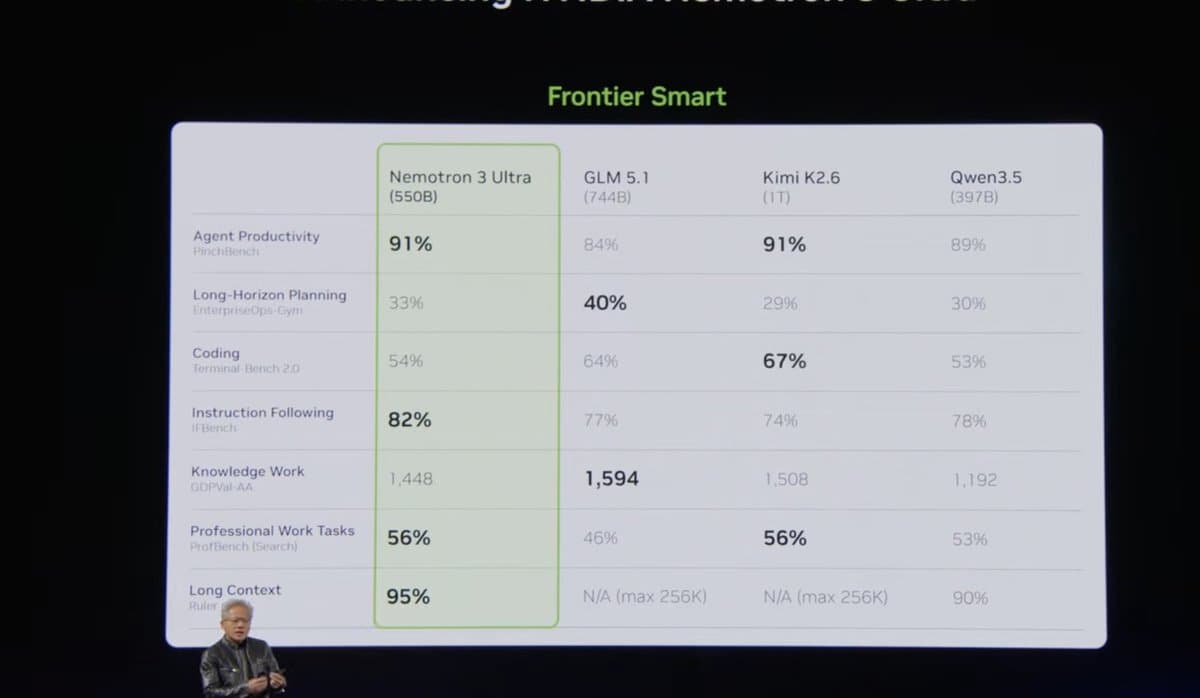
NVIDIA CEO Jensen Huang holds a large GPU chip, with a glowing data center backdrop and a chart comparing Nemotron 3…
AI ResearchScore: 85

NVIDIA Nemotron 3 Ultra: 550B Open-Weight Model Challenges GLM, Kimi

NVIDIA released Nemotron 3 Ultra, a 550B open-weight model claiming near-SOTA performance, competing with GLM-5.1 and Kimi K2.6. No benchmarks yet.

·10h ago·2 min read··29 views·AI-Generated·Report error
Share:
What is NVIDIA's Nemotron 3 Ultra model?

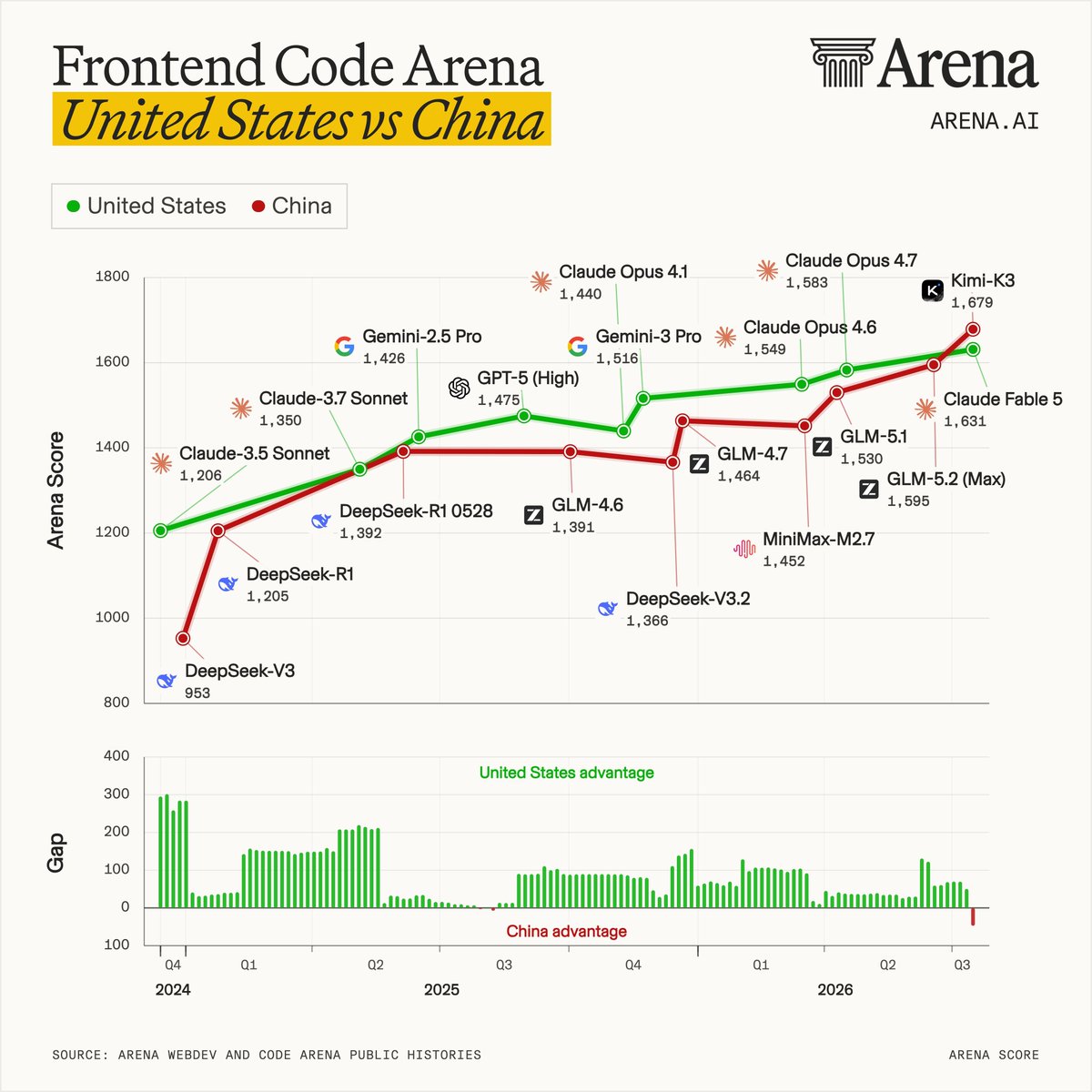
NVIDIA released Nemotron 3 Ultra, a 550B parameter open-weight model that reportedly achieves near state-of-the-art performance, on par with GLM-5.1 and Kimi K2.6, per @mweinbach.

TL;DR

550B parameter model released · Near SOTA among open-weight models · Competes with GLM-5.1 and Kimi K2.6

NVIDIA released Nemotron 3 Ultra, a 550B parameter open-weight model. It reportedly achieves near state-of-the-art performance, on par with GLM-5.1 and Kimi K2.6, per @mweinbach.

Key facts

  • 550B parameter model released by NVIDIA
  • Reportedly on par with GLM-5.1 and Kimi K2.6
  • No benchmark scores published yet
  • Open-weight release, license unconfirmed
  • Competes with Llama 4 and Mixtral 8x22B

NVIDIA’s Nemotron 3 Ultra enters the open-weight arena at 550B parameters, positioning itself alongside the strongest publicly available models. The claim of parity with GLM-5.1 (a 530B model from Zhipu AI) and Kimi K2.6 (Moonshot AI’s latest) suggests NVIDIA aims to challenge the top tier of open-weight research models.

The unique take: This release is notable not for raw size—550B is large but not unprecedented—but for NVIDIA’s strategic pivot. Historically, NVIDIA has focused on infrastructure and closed models (like Nemotron-4 340B for synthetic data). Nemotron 3 Ultra signals a direct push into the model-weight market, competing with the likes of Meta’s Llama 4 and Mistral’s upcoming releases. The timing aligns with the industry shift toward open-weight models as enterprises demand transparency and customizability.

What’s missing: No benchmark scores, training compute costs, or inference latency numbers have been published yet [per @mweinbach]. The claim of “near state of the art” lacks specific comparisons—no MMLU, HumanEval, or SWE-Bench deltas. NVIDIA’s track record with Nemotron-4 340B showed strong synthetic data generation but not top-tier general reasoning. Independent verification via standard benchmarks is pending.

Context: NVIDIA’s move comes as the open-weight model race intensifies. Meta’s Llama 4 (reported 1.2T parameters) and Mistral’s Mixtral 8x22B have set high bars. GLM-5.1 and Kimi K2.6 are Chinese contenders with strong multilingual performance. Nemotron 3 Ultra’s open-weight license—if permissive—could attract enterprise adopters wary of proprietary models.

Vendor skepticism: NVIDIA’s claim of “near state of the art” is unsubstantiated without benchmarks. The company’s strength in hardware and CUDA ecosystem gives it distribution advantages, but model quality will ultimately determine adoption. Past Nemotron releases have been strong in niche tasks (synthetic data, code generation) but not general reasoning.

What to watch

Develop Specialized AI Agents with New NVIDIA Nemotron Vision, RAG, and ...

Watch for independent benchmark evaluations on MMLU, HumanEval, and SWE-Bench. NVIDIA’s licensing terms (Apache 2.0 vs. custom) will determine enterprise adoption velocity. Also track whether NVIDIA releases training details or ablation studies.

Source: gentic.news · · author= · citation.json

AI-assisted reporting. Generated by gentic.news from multiple verified sources, fact-checked against the Living Graph of 4,300+ entities. Edited by Ala SMITH.

Following this story?

Get a weekly digest with AI predictions, trends, and analysis — free.

AI Analysis

NVIDIA’s Nemotron 3 Ultra is a strategic bet on open-weight dominance, but the lack of benchmark data is a red flag. The 550B parameter count places it in the same tier as GLM-5.1 (530B) and Kimi K2.6 (size undisclosed but presumably similar). However, parameter count alone isn’t determinative—training data quality, architecture innovations (e.g., mixture-of-experts), and alignment matter more. NVIDIA’s historical strength in synthetic data generation (Nemotron-4 340B) suggests this model may excel in code and structured tasks rather than general reasoning. The company’s CUDA ecosystem gives it a distribution advantage—developers can easily fine-tune and deploy on NVIDIA hardware. But without transparent benchmarks, the claim of “near state of the art” is marketing, not evidence. Comparatively, Meta’s Llama 4 (1.2T parameters) and Mistral’s Mixtral 8x22B (141B active parameters) have published extensive benchmarks. Nemotron 3 Ultra needs to show comparable or superior results on standard evals to be taken seriously by researchers. The open-weight license terms will also be critical—if NVIDIA imposes restrictions (e.g., no commercial use), adoption will be limited.
Compare side-by-side
Nvidia vs Moonshot AI
Enjoyed this article?
Share:

AI Toolslive

Five one-click lenses on this article. Cached for 24h.

Pick a tool above to generate an instant lens on this article.

Related Articles

From the lab

The framework underneath this story

Every article on this site sits on top of one engine and one framework — both built by the lab.

More in AI Research

View all