Skip to content
gentic.news — AI News Intelligence Platform
Connecting to the Living Graph…

Listen to today's AI briefing

Daily podcast — 5 min, AI-narrated summary of top stories

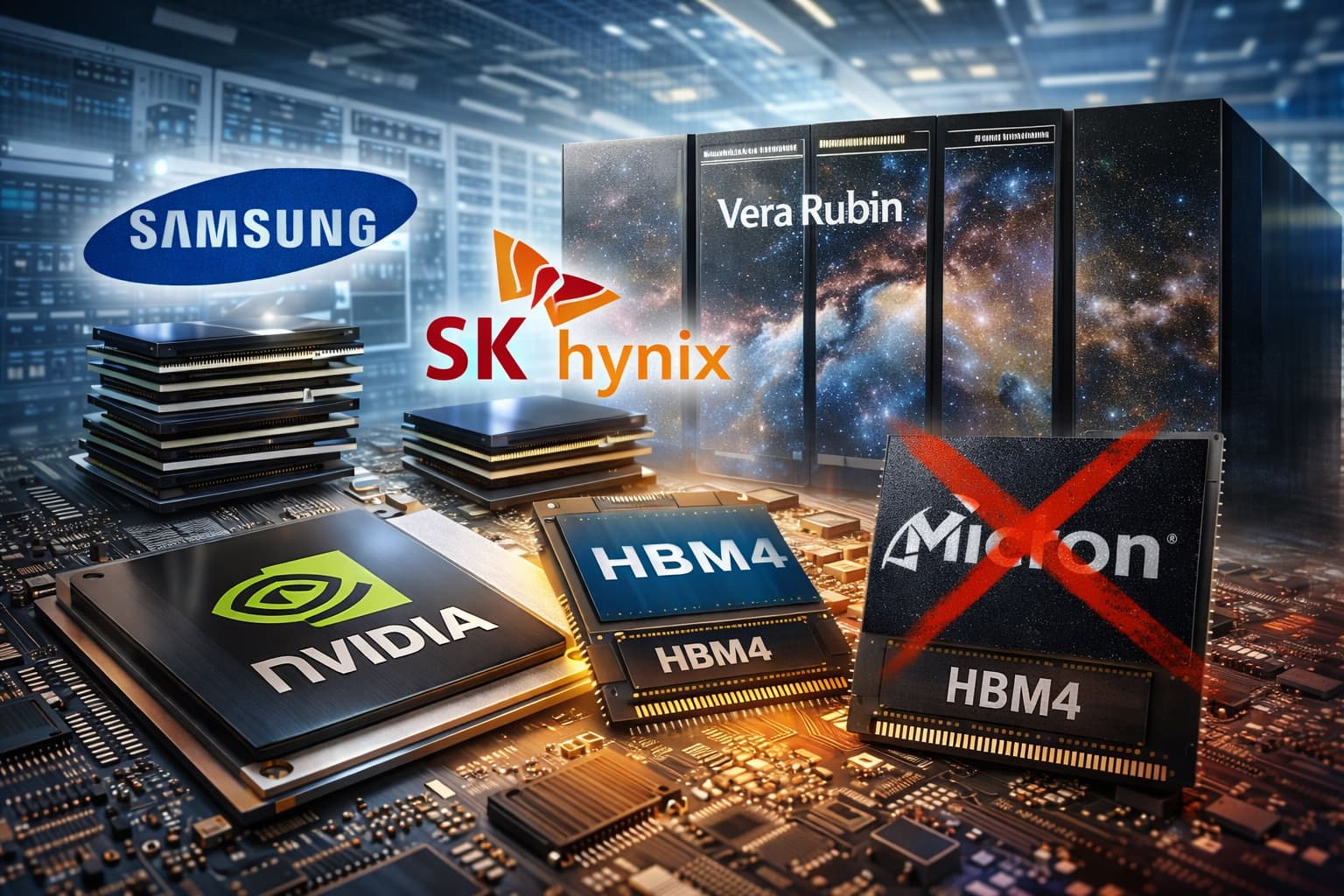
Three memory chip stacks labeled HBM4 on a circuit board near an Nvidia Vera Rubin GPU, with logos for SK Hynix…

Nvidia Qualifies HBM4 for Vera Rubin, SK Hynix Gets 60-70% Share

Nvidia qualified HBM4 from all three DRAM suppliers for Vera Rubin, with SK Hynix taking 60-70% share, clearing a key bottleneck for 2026 production.

·1d ago·3 min read··65 views·AI-Generated·Report error
Share:
Which memory suppliers did Nvidia qualify for HBM4 on Vera Rubin?

Nvidia qualified HBM4 from Samsung, SK Hynix, and Micron for Vera Rubin, moving those parts into full production. SK Hynix secured 60-70% of the initial allocation, Samsung 25-30%, and Micron the remainder.

TL;DR

Nvidia qualified HBM4 for Vera Rubin. · SK Hynix gets 60-70% of orders. · Samsung gets 25-30%, Micron the rest.

Nvidia qualified HBM4 from Samsung, SK Hynix, and Micron for Vera Rubin, moving those parts into full production. SK Hynix secured 60–70% of the initial allocation, Samsung 25–30%, and Micron the remainder.

Key facts

  • Nvidia qualified HBM4 from Samsung, SK Hynix, and Micron.
  • SK Hynix secured 60-70% of Vera Rubin HBM4 allocation.
  • Samsung received 25-30% of the allocation.
  • Micron took the remainder.
  • HBM4 qualification is a gating factor for Vera Rubin's 2026 ramp.

Nvidia has cleared a critical supply-chain bottleneck for its next-generation Vera Rubin architecture by qualifying HBM4 memory from all three major DRAM suppliers. According to @rohanpaul_ai, Samsung, SK Hynix, and Micron have all passed qualification and those parts have been moved into full production.

HBM4 qualification is the single largest gating factor for Vera Rubin's 2026 ramp. Each Vera Rubin rack will demand roughly 1.5–2 TB of high-bandwidth memory, and HBM4's per-stack bandwidth is expected to exceed 2 TB/s — roughly double HBM3e. Without all three suppliers producing qualified parts, Nvidia risked a repeat of the HBM3 supply crunch that constrained Hopper shipments through early 2024.

The allocation split reveals Nvidia's supply-chain strategy. SK Hynix, which led HBM3 and HBM3e production, took the largest share at 60–70%. Samsung received 25–30%, a smaller slice than its broader DRAM market share would suggest, likely reflecting its later entry into HBM3e qualification. Micron took the remainder, maintaining its role as a third-source hedge.

This is not a simple procurement update — it is a signal that Vera Rubin's production timeline is on track. Nvidia typically qualifies memory 12–18 months before volume shipments. With qualification now closed and production released, the earliest Vera Rubin systems could ship in late 2026, consistent with Nvidia's stated 2026 roadmap.

What the allocation doesn't tell us is pricing or yield specifics. None of the three suppliers disclosed HBM4 bit-cost or qualification yield rates. Samsung's smaller share suggests it may still be ramping HBM4 yields, while SK Hynix's dominant position reflects its head start in 12-stack HBM4 prototypes shown at ISSCC 2025.

For inference operators, the qualification is good news: three qualified suppliers means better pricing leverage and less risk of a single-vendor production outage. For AI chip competitors (AMD, Intel, startups), it means Nvidia's memory supply for Vera Rubin is effectively derisked — a competitive disadvantage that narrows the window for catching up on the memory front.

What to watch

Watch for Vera Rubin's first system-level benchmarks at Nvidia GTC 2027, expected in March 2027. Also track Samsung's HBM4 yield disclosures in its Q1 2027 earnings call — if yields approach SK Hynix's, the allocation split may shift for the follow-on Rubin Next architecture.
Source: gentic.news · · author= · citation.json

AI-assisted reporting. Generated by gentic.news from multiple verified sources, fact-checked against the Living Graph of 4,300+ entities. Edited by Ala SMITH.

Following this story?

Get a weekly digest with AI predictions, trends, and analysis — free.

AI Analysis

This qualification marks a structural shift in Nvidia's memory procurement strategy. In the HBM3 era, Nvidia relied heavily on SK Hynix as the sole qualified supplier through much of 2023, creating a single-point-of-failure that constrained Hopper shipments. By bringing Samsung and Micron into qualification simultaneously for HBM4, Nvidia has built redundancy from day one — a lesson learned from the 2023 supply crunch. The allocation split is revealing. SK Hynix's 60-70% share is dominant but not monopolistic, suggesting Nvidia wants multiple sources but still rewards SK Hynix for its HBM3e leadership. Samsung's 25-30% is below its broader DRAM market share (roughly 40%), likely because Samsung's HBM3e qualification lagged SK Hynix by 6-9 months. If Samsung closes the yield gap, expect its share to grow for the Vera Rubin follow-on. For the broader AI market, HBM4 qualification is a leading indicator. HBM4's bandwidth doubling enables larger models to run with fewer memory stacks, reducing per-GPU cost. But the real story is supply-chain maturity: three qualified suppliers means Nvidia can price-compete and avoid the 2023-style allocation drama. Competitors like AMD and Intel, which lack Nvidia's procurement scale, will pay higher per-bit costs for HBM4, widening the margin gap on AI accelerators.
This story is part of
The AI Infrastructure War Shifts from Chips to Developer Tools
Nvidia's enterprise pivot and AWS's OpenAI bet collide with Cursor's quiet ascent
Compare side-by-side
Nvidia vs SK Hynix
Enjoyed this article?
Share:

AI Toolslive

Five one-click lenses on this article. Cached for 24h.

Pick a tool above to generate an instant lens on this article.

Related Articles

From the lab

The framework underneath this story

Every article on this site sits on top of one engine and one framework — both built by the lab.

More in Products & Launches

View all