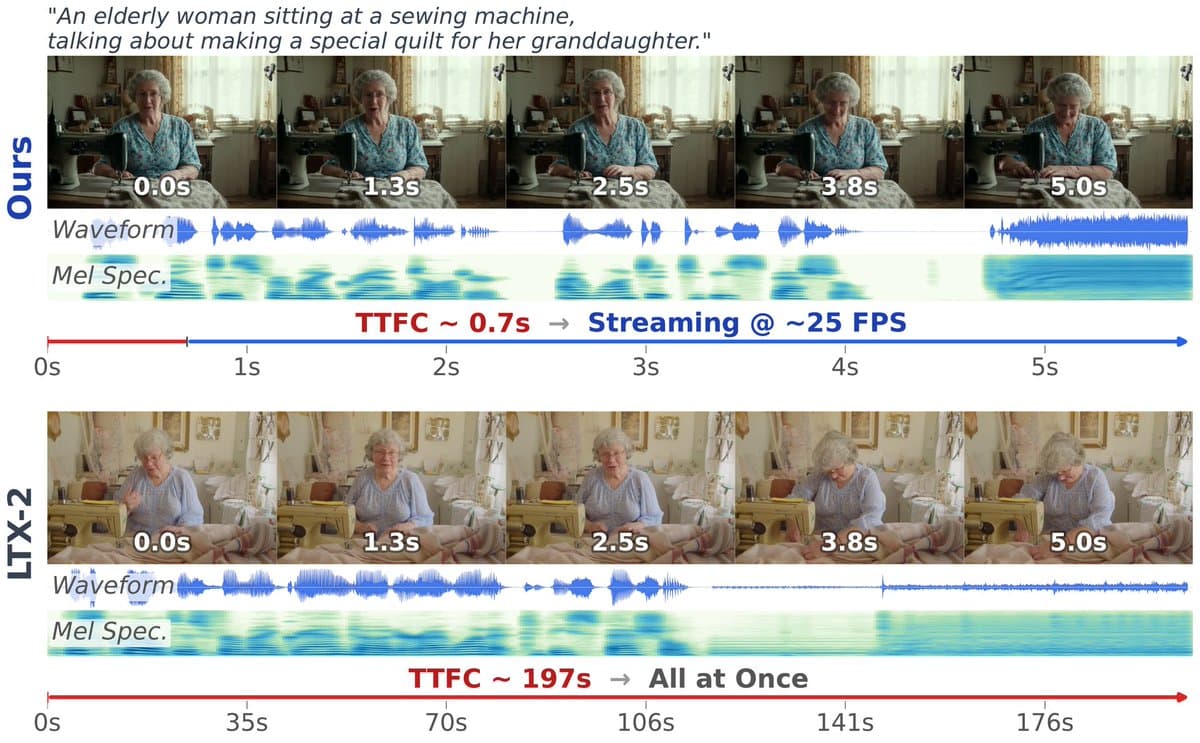
A new method called OmniForcing has been introduced, enabling real-time joint audio-visual generation with performance metrics that significantly outpace previous approaches. According to a summary from HuggingFace Papers, the system achieves approximately 25 frames per second (FPS) with a 0.7-second latency, representing a 35× speedup over offline diffusion models.
The core technical achievement is the distillation of a bidirectional LTX-2 model into a causal streaming generator. This architectural shift is what allows the model to operate in real-time while reportedly maintaining multi-modal fidelity—the quality and coherence of the synchronized audio and visual outputs.
What the Method Achieves
The primary breakthrough is the transition from offline, non-causal generation to online, causal streaming. Traditional diffusion models for audio-visual synthesis are typically bidirectional; they process an entire temporal sequence (e.g., a video clip and its audio track) simultaneously, which is computationally expensive and introduces high latency. This makes them unsuitable for real-time applications like live interactive systems or responsive content creation tools.
OmniForcing addresses this by taking a pre-trained, high-quality bidirectional model (LTX-2) and distilling its knowledge into a causal, autoregressive generator. A causal model generates output sequentially—each new frame or audio sample is produced based only on past and present inputs, not future ones. This is a fundamental requirement for real-time streaming.
The reported metrics are concrete:
- Throughput: ~25 FPS
- Latency: 0.7 seconds
- Speedup: 35x faster than the offline diffusion baseline
How It Works: Distillation for Real-Time Causal Generation
The "OmniForcing" technique appears to be a novel training paradigm for this distillation process. The key challenge is preserving the rich, synchronized multi-modal representations learned by the powerful bidirectional teacher model (LTX-2) within the constraints of a causal student architecture.
Standard knowledge distillation often focuses on matching final outputs. For a complex task like joint audio-visual generation, this likely involves a more sophisticated objective that forces the causal student to internalize the teacher's understanding of temporal dynamics and cross-modal relationships (e.g., how a specific sound correlates with a visual event). The term "OmniForcing" suggests a comprehensive training signal that enforces alignment across multiple dimensions of the data distribution and latent space.
By solving this distillation problem, the researchers created a generator that can produce the next video frame and corresponding audio sample in a streaming fashion, with latency low enough for human perception to consider it instantaneous for many applications.
Why It Matters
Real-time, high-fidelity audio-visual generation has been a significant bottleneck. Prior state-of-the-art models could produce impressive results but required seconds or minutes of processing per second of output. The 35x speedup to 25 FPS and sub-second latency demonstrated by OmniForcing moves this technology from the realm of offline rendering to potential real-time interaction.
Practical implications include:
- Interactive Media and Games: Dynamic generation of character speech with synchronized lip movements and facial expressions.
- Live Communication: Real-time avatars or video conferencing filters with generated, perfectly synced audio.
- Content Creation Tools: Immediate feedback for artists and designers manipulating audio-visual scenes.
The work demonstrates that the performance of large, offline generative models can be effectively transferred to efficient, causal architectures without catastrophic loss in quality—a promising direction for deploying heavy AI models in latency-sensitive environments.