OpenAI Targets First 'AI Intern' by September 2028, Building Toward Autonomous Researchers

OpenAI Targets First 'AI Intern' by September 2028, Building Toward Autonomous Researchers

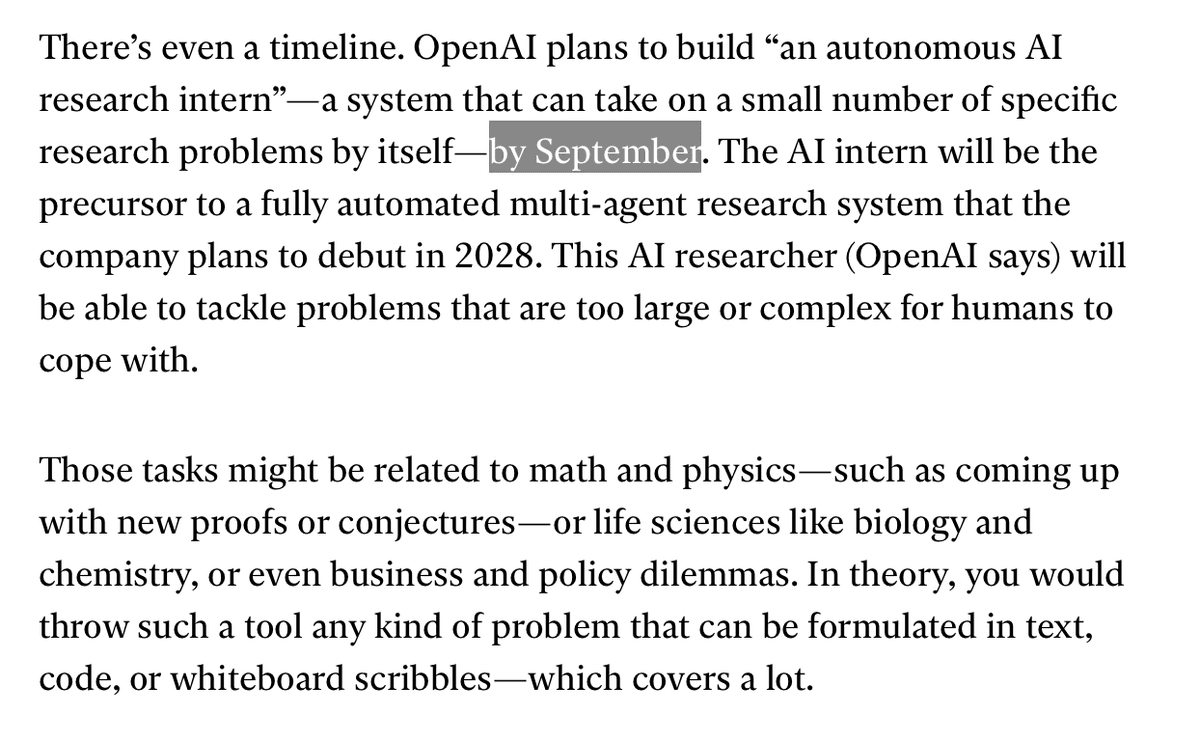
OpenAI plans to deploy its first 'AI intern' by September and aims for a full autonomous research system by 2028. The effort builds on reasoning models and agent systems like Codex, which have shown dramatic productivity gains but still face reliability and safety challenges.

3h ago·2 min read·11 views·via @kimmonismus
Share:

What Happened

According to a post by user @kimmonismus on X, OpenAI is developing an "AI intern" with a target deployment date of September. The company's broader roadmap reportedly aims for a "full system" by 2028. The post states the project is "powered by advances in reasoning models and agent systems like Codex."

The source claims these existing tools "already show dramatic productivity gains, solving problems in days instead of weeks," but acknowledges they "still face reliability and safety challenges." The final line of the post indicates OpenAI is "on this road to autonomous researchers."

Context

The concept of an "AI intern" or research assistant aligns with ongoing industry efforts to automate parts of the software development and research lifecycle. Agent systems, which can break down complex tasks, execute code, and iterate on solutions, have been a focus for OpenAI and others. The mention of Codex—the model family that powers GitHub Copilot—suggests the initiative may build upon code generation and understanding capabilities.

The stated 2028 target for a full system implies a multi-year development timeline, moving from an initial assistive tool (the "intern") toward a more capable, autonomous research agent. The explicit note about reliability and safety challenges reflects known limitations in current AI agent systems, which can produce incorrect outputs or execute unsafe actions without robust oversight.

No official announcement, technical details, benchmarks, or specific model names beyond Codex are provided in the source material.

AI Analysis

This report, while thin on technical specifics, points to a significant and credible direction for OpenAI. The shift from tools like Copilot, which act as a pair programmer, to an 'intern' implies a system capable of taking on defined, sub-project level tasks with less granular human guidance. The key technical hurdle won't be raw code generation—which Codex already handles—but reliable task decomposition, planning, and self-correction over extended horizons, which are active research problems in agent foundations. The 2028 timeline for a 'full system' suggests OpenAI views achieving trustworthy autonomous research as a ~4-year problem. This is ambitious but aligns with the scaling hypothesis and increased investment in reasoning benchmarks. Practitioners should watch for related publications on evaluation frameworks for long-horizon agent tasks and 'process supervision' techniques, as these will be prerequisites for the reliability needed in a research context. The mention of safety challenges is non-trivial; an autonomous system that can write and execute code presents novel containment and alignment risks that go beyond today's chat-based models.
Original sourcex.com

Trending Now

More in Products & Launches

Browse more AI articles