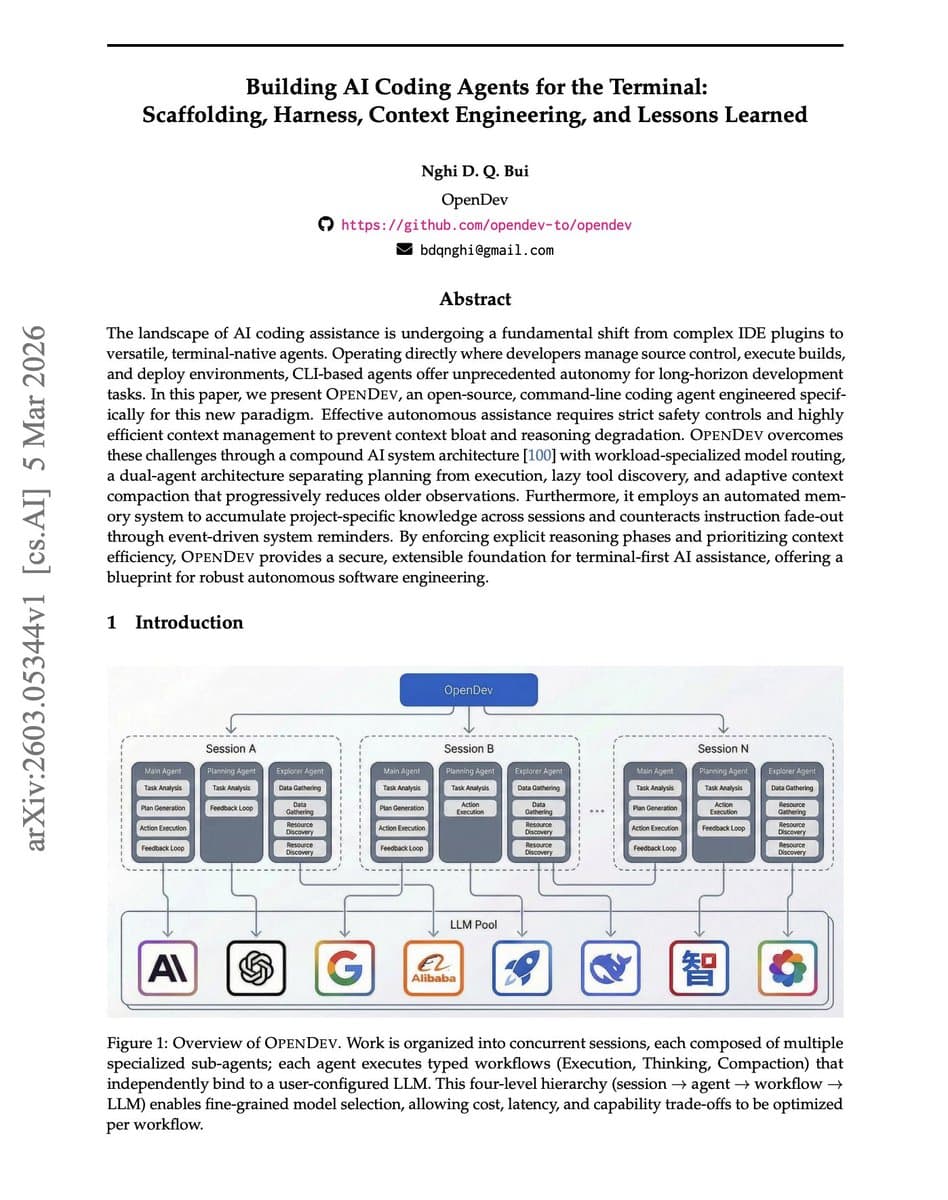
A significant research paper titled OpenDev has emerged as what many are calling the foundational guide for developers building terminal-native AI coding assistants. Spanning 81 pages, the paper systematically addresses the architectural challenges, design patterns, and hard-won lessons from creating command-line interface (CLI) agents that can operate autonomously and reliably.
Shared by AI researcher Omar Sar on X (formerly Twitter), the paper arrives as the industry observes a clear shift from integrated development environment (IDE) plugins toward terminal-native agents. Products like Claude Code and Codex CLI have demonstrated the viability of this approach, but OpenDev provides the formalized engineering principles needed to build such systems at scale.
From IDE Plugins to Terminal-Native Agents
The evolution of AI-assisted coding has largely occurred within IDEs through extensions and plugins. While convenient, these tools often operate within constrained environments and may not fully leverage the power and flexibility of the command line. Terminal-based agents, by contrast, interact directly with the system shell, file system, and development toolchain, enabling more comprehensive automation—from code generation and refactoring to testing, deployment, and system operations.
OpenDev identifies this terminal-native approach as the next frontier for coding agents, arguing that it offers greater autonomy, deeper integration with development workflows, and the ability to handle complex, multi-step tasks that span beyond a single file or editor.
Core Architectural Innovations
The paper introduces several key architectural concepts that address common failure modes in AI agents:
Compound AI System with Workload-Specialized Model Routing
Instead of relying on a single large language model (LLM) for all tasks, OpenDev proposes a system that routes different workloads to specialized models. For example, a model optimized for planning might handle high-level task decomposition, while another fine-tuned for code execution manages shell commands. This improves both performance and cost-efficiency.
Dual-Agent Architecture: Separating Planning from Execution
A central insight of the paper is the separation of planning and execution into distinct agents. The planning agent reasons about the overall goal, breaks it down into steps, and monitors progress, while the execution agent carries out specific commands or code edits. This separation reduces error cascades and makes the system more interpretable and debuggable.
Lazy Tool Discovery and Adaptive Context Compaction
To manage the limited context window of LLMs, OpenDev introduces lazy tool discovery, where the agent dynamically learns about available tools and APIs as needed, rather than loading all possibilities upfront. Adaptive context compaction techniques selectively summarize or remove less relevant information from the agent's memory, preserving critical details while staying within token limits.
Addressing Reliability and Safety
Perhaps the most valuable sections of OpenDev are those derived from practical experience building and deploying such agents. The paper details patterns for:
- Event-driven system reminders to counteract instruction fade-out, where agents forget initial goals or constraints over long interactions.
- Automated memory across sessions, allowing agents to persist knowledge about a project, user preferences, and past failures.
- Strict safety controls for autonomous operation, including permission boundaries, automatic rollback mechanisms, and human-in-the-loop checkpoints for dangerous operations (like file deletion or production deployments).
These features move beyond simple chat-based coding help to create agents that can be trusted with significant autonomy in real development environments.
Implications for Developers and Organizations
For developers building AI coding tools, OpenDev serves as a much-needed handbook. It translates emerging best practices into reusable design patterns, potentially accelerating the development of robust agents. For engineering organizations, the paper signals that terminal-based AI assistance is maturing from experimental prototypes to engineered systems with defined safety and reliability guardrails.
The release also highlights the growing importance of compound AI systems—orchestrations of multiple models, tools, and processes—over single-model approaches. As AI coding tools evolve, their value will increasingly come from thoughtful system design, not just raw model capability.
Looking Ahead
OpenDev arrives at a pivotal moment. As AI continues to reshape software development, there is a clear need for frameworks that ensure these tools are not only powerful but also predictable, safe, and aligned with developer workflows. By formalizing the architecture of terminal-native agents, the paper provides a foundation for the next wave of AI-assisted development tools—ones that work alongside developers as capable, reliable partners in the terminal.
Source: OpenDev Paper via Omar Sar on X (@omarsar0).