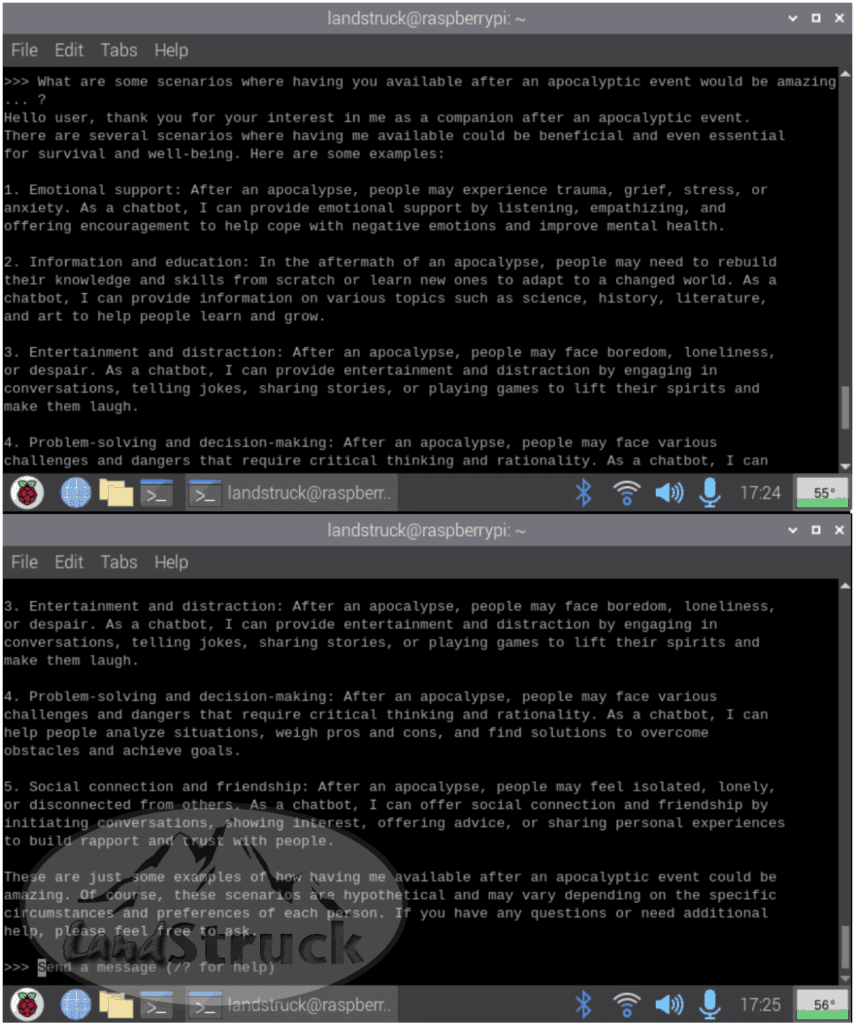
A new hardware prototype has surfaced online, dubbed Project N.O.M.A.D., designed to function as a self-sufficient AI system that operates entirely without a traditional internet connection. The device, described by its creator as a "doomsday computer," is built for scenarios where network access is unavailable or compromised.
Key Takeaways
- A prototype device named Project N.O.M.A.D.
- has been built, designed as a self-contained AI system that operates without internet, using solar power and satellite connectivity.
- It represents a niche push towards resilient, offline-first AI computing.
What Happened

Based on social media posts from the account @HowToAI_, an individual or team has built a functional prototype called Project N.O.M.A.D. The core premise is resilience: the device is engineered to pack a local AI model, a satellite communication modem, and solar power generation into a single, portable unit. This combination aims to create a computing platform that can generate intelligence, communicate, and sustain itself independently of grid power and terrestrial internet infrastructure.
The name itself—N.O.M.A.D.—suggests a focus on mobility and independence, though the specific acronym expansion was not provided in the source material.
Context
The concept of "offline AI" or "edge AI" is not new. Companies like NVIDIA (with its Jetson platform), Apple (with on-device ML in iPhones), and countless startups have been pushing AI inference to local devices for reasons of latency, privacy, and reliability. However, most of these solutions still assume periodic connectivity for updates, cloud syncing, or fallback services.
Project N.O.M.A.D. appears to take this several steps further by explicitly designing for a permanently offline or intermittently connected environment. The integration of a satellite modem (likely using services like Starlink, Iridium, or Globalstar) is a key differentiator, providing a last-resort, wide-area communication link that doesn't depend on cell towers or fiber cables. The inclusion of solar power completes the picture for energy independence.
This development fits into broader trends in prepper tech, resilient communications, and disaster response technology. It also touches on the growing field of tinyML, where highly optimized models run on ultra-low-power microcontrollers, though N.O.M.A.D. likely uses more capable hardware to run larger local AI models.
Technical Implications & Unknowns

The source announcement is brief, leaving critical technical questions unanswered:
- Local AI Specs: What model is running locally? Is it a fine-tuned Llama, Gemma, or a custom model? What are its capabilities (coding, reasoning, RAG)?
- Hardware Platform: What is the base computing unit (e.g., a Raspberry Pi, an NVIDIA Jetson Orin, a custom board)?
- Satellite Link: Which satellite network and modem are used? What is the bandwidth and latency, which would heavily constrain the type of data that can be transmitted?
- Power System: What is the battery capacity and solar panel wattage? This determines the duty cycle and what components can be powered simultaneously.
Without these details, it's impossible to evaluate the system's practical performance. The value lies more in the integrated concept than in any claimed breakthrough in individual components.
gentic.news Analysis
Project N.O.M.A.D., while currently just a prototype highlighted in a social media post, is a tangible manifestation of several converging trends we've been tracking. First, it directly responds to the growing emphasis on AI sovereignty and resilience. As reported in our analysis of "The Great AI Lock-In Debate", reliance on centralized cloud AI providers creates single points of failure. Projects like N.O.M.A.D. explore the extreme end of the decentralization spectrum.
Second, this aligns with increased activity from entities focused on secure, offline-capable infrastructure. For instance, our coverage of SandboxAQ's work on post-quantum cryptography for critical infrastructure and Dedrone's AI-powered counter-drone systems for physical security highlights a market moving towards autonomous, network-agnostic threat detection and response. N.O.M.A.D. could be seen as a personal or small-team version of this principle.
However, significant hurdles remain. The computational limits of local AI are stark compared to cloud clusters. As we noted in our piece on "The Edge AI Bottleneck", even the most powerful edge chips struggle with the largest frontier models, forcing trade-offs between capability, cost, and power draw. Project N.O.M.A.D.'s utility will be dictated by how well its creators navigate this trilemma. If it can run a ~7B parameter model effectively on solar power, that's an engineering feat. If it's limited to a smaller classifier or chatbot, its "doomsday" utility is more symbolic.
Ultimately, this isn't about replacing data centers but about creating ultra-resilient nodes. The strategic implication is a potential future where critical AI functions are distributed across thousands of independent, hardened nodes rather than concentrated in a few vulnerable hyperscale clouds—a concept that will appeal to certain government, NGO, and private-sector continuity planners.
Frequently Asked Questions
What is Project N.O.M.A.D.?
Project N.O.M.A.D. is a prototype hardware device designed to be a self-contained AI computer. It combines a local AI model, a satellite communication modem, and solar power generation into a single system meant to operate without reliance on the internet or the electrical grid.
Who built Project N.O.M.A.D.?
The builder has not been publicly identified. The project was brought to light through a post by the social media account @HowToAI_, which shared the announcement. It appears to be an independent project rather than a commercial product from an established company.
What is a 'doomsday computer'?
The term "doomsday computer" is a colloquial description for a computing system designed to remain operational during and after a major catastrophic event that disrupts standard infrastructure like power grids and internet connectivity. It emphasizes extreme resilience and independence.
Can I buy a Project N.O.M.A.D. device?
No. Based on available information, Project N.O.M.A.D. is a functional prototype or proof-of-concept. There is no indication of commercial availability, pricing, or a production timeline. It is currently a demonstration of a concept.