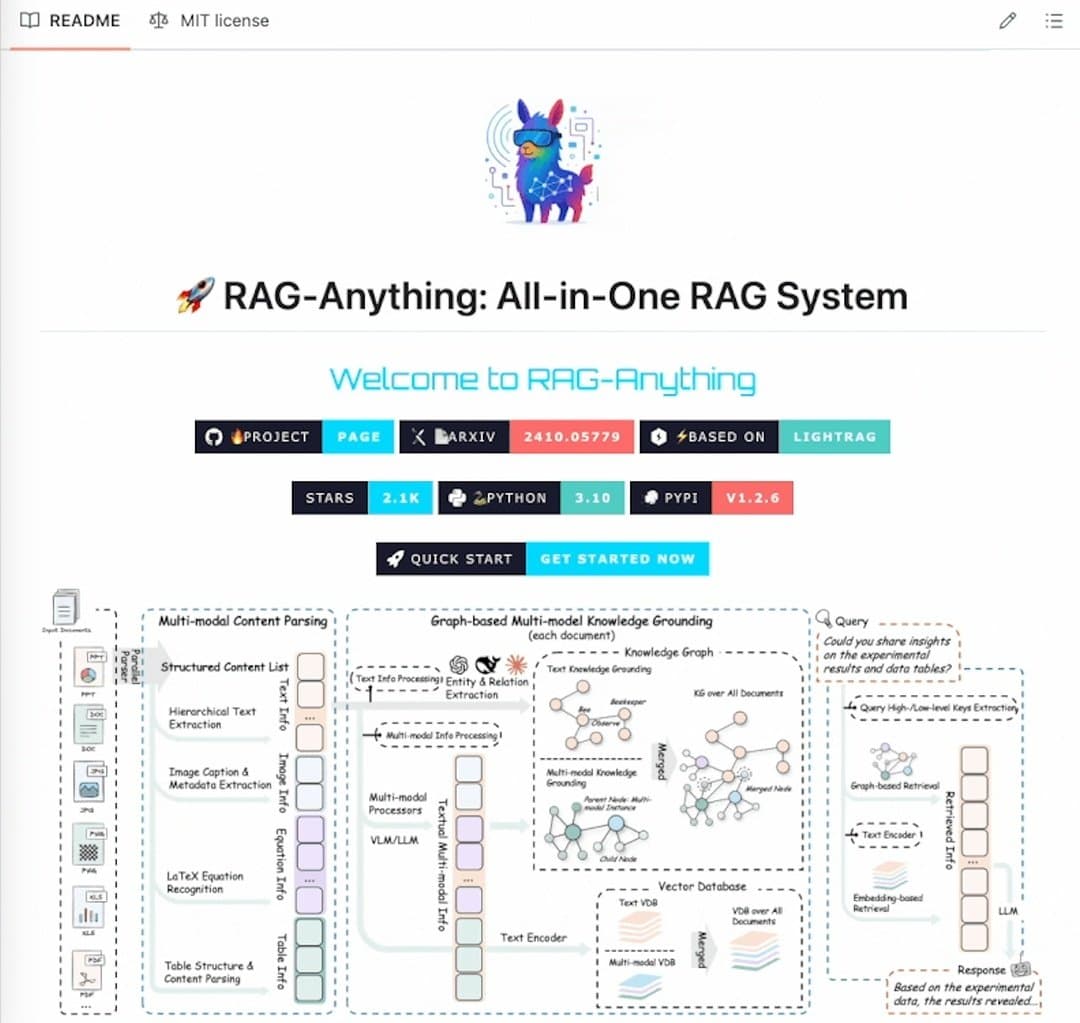
A new open-source project called RAG-Anything directly targets a critical, widespread failure in current Retrieval-Augmented Generation (RAG) systems: their inability to process anything beyond plain text. As highlighted in a viral post by ML engineer @_vmlops, most RAG pipelines "break the moment you throw a real document at them," ignoring tables, charts, images, and equations—effectively losing most of the document's structured information and context.
RAG-Anything proposes a solution by building a multimodal RAG system that can parse, understand, and connect information from all these modalities within a single document, constructing a unified knowledge graph for comprehensive querying.
What Happened
The issue is well-known among practitioners building production RAG systems. Standard text chunking and embedding approaches fail catastrophically when documents contain visual elements or complex layouts. A financial report with key figures in a table, a research paper with central equations, or a business document with illustrative charts becomes unusable—the RAG system only "sees" the surrounding text, rendering answers incomplete or wrong.
RAG-Anything, hosted on GitHub, is presented as a framework to fix this. Its core promise is to move beyond text-only retrieval to a system that:
- Ingests entire documents, preserving all elements.
- Processes text, images, tables, and mathematical formulas.
- Connects the information from these different modalities into a coherent knowledge graph.
- Answers questions by reasoning over this unified graph, not just retrieved text snippets.
How It Works (Based on Project Claims)
While the source is a brief announcement, the project's stated goal reveals a likely technical approach. To achieve multimodal understanding, RAG-Anything would need to integrate several specialized components:
- Multimodal Parsing & Segmentation: Instead of naive text splitting, it would use a document understanding model (like Microsoft's LayoutLM, Google's DocAI, or open-source alternatives) to identify and isolate different semantic regions: paragraphs, tables, figures, and equation blocks.
- Specialized Feature Extraction:
- Text: Standard text embedding models (e.g.,
text-embedding-ada-002,BGE,voyage-2). - Tables: A model to parse table structure and content into a structured format (e.g.,
TAPAS,Table Transformer), then generate a textual description or embedding of its semantic content. - Images/Charts: A vision-language model (VLM) like
GPT-4V,Claude 3,LLaVA, orQwen-VLto generate descriptive captions or embeddings of visual content. - Formulas: A LaTeX parser or math-aware model to convert equations into a searchable, understandable representation.
- Text: Standard text embedding models (e.g.,
- Knowledge Graph Construction: The extracted features and their relationships (e.g., "Figure 1 illustrates the data in Table 2") would be used to build a graph. Nodes represent concepts or data points from any modality, and edges represent their relationships.
- Multimodal Retrieval & Generation: Upon a query, the system would search this unified graph representation. The retrieved context could include text descriptions of images, data from tables, and the meaning of formulas, which is then fed to a large language model (LLM) to generate a complete answer.
Why This Matters

The limitation of text-only RAG is not a minor edge case; it's a fundamental barrier to real-world utility. Most valuable business, academic, and technical documents are multimodal. A RAG system that cannot handle a simple PDF with a table is of limited commercial use. RAG-Anything represents a necessary evolution of the RAG paradigm from text retrieval to document understanding.
Successful implementation would significantly increase the accuracy and reliability of RAG applications in domains like:
- Financial Analysis: Querying earnings reports with embedded charts and tables.
- Scientific Research: Answering questions from academic papers full of equations, figures, and data tables.
- Technical Documentation: Understanding manuals with diagrams, schematics, and specifications.
gentic.news Analysis
This development is a direct response to a glaring, often unspoken gap in the rapid commercialization of RAG. Over the last 18 months, the AI engineering community has heavily focused on optimizing text retrieval—improving embeddings, tuning chunking strategies, and implementing advanced re-ranking. However, as we covered in our analysis of Palo Alto Networks' Cortex XSIAM 2024 launch, enterprise security platforms were already hitting walls with multimodal data ingestion, forcing bespoke, complex pipelines. RAG-Anything attempts to productize a solution to this exact problem.
The trend is clear: after the initial wave of text-based LLM applications, the next competitive frontier is multimodal reasoning. This aligns with the strategic direction of major players like OpenAI (with GPT-4V), Anthropic (Claude 3), and Google (Gemini), all of which have invested heavily in native multimodal foundation models. RAG-Anything sits at the layer above, providing the scaffolding to apply these powerful models to the messy, structured data of real-world documents.
However, the devil is in the implementation details. The major challenges this project must overcome are not conceptual but practical: latency (processing images/VLM calls is slow), cost (VLMs are expensive), and graph complexity (maintaining a coherent, queryable knowledge graph from disparate data types is non-trivial). Its success will depend on the elegance and efficiency of its architecture, which the open-source community will now scrutinize. If it delivers, it could become a foundational component in the next generation of enterprise AI assistants, much like LangChain or LlamaIndex were for the first text-based wave.
Frequently Asked Questions
What is multimodal RAG?
Multimodal RAG (Retrieval-Augmented Generation) extends the standard text-based RAG framework to understand and retrieve information from multiple data types within a document, such as images, tables, charts, and mathematical formulas. Instead of just searching through text, it creates a unified representation of all content to provide comprehensive answers.
Why do most RAG systems fail with tables and charts?
Most RAG systems rely solely on text embedding models. They use simple parsers that extract only the plain text from a document, discarding or ignoring the structural and visual elements. A table's data grid or a chart's axes and bars have no textual representation in these parsers, so the information is completely lost to the retrieval system.
How does RAG-Anything understand images and tables?
While the full implementation details are in the project's code, the standard approach involves using specialized models. A Vision-Language Model (VLM) would analyze an image or chart and generate a descriptive text caption. A table recognition model would parse the table's structure and content into a machine-readable format (like CSV or a semantic description). These textual representations are then embedded and made searchable.
Is RAG-Anything an API or a model I can run myself?
Based on the GitHub repository link, RAG-Anything appears to be an open-source framework or library. This suggests it is a set of tools and code that developers can integrate into their own applications, likely requiring them to bring their own API keys for services like OpenAI's GPT-4V or to run open-source models locally for processing.