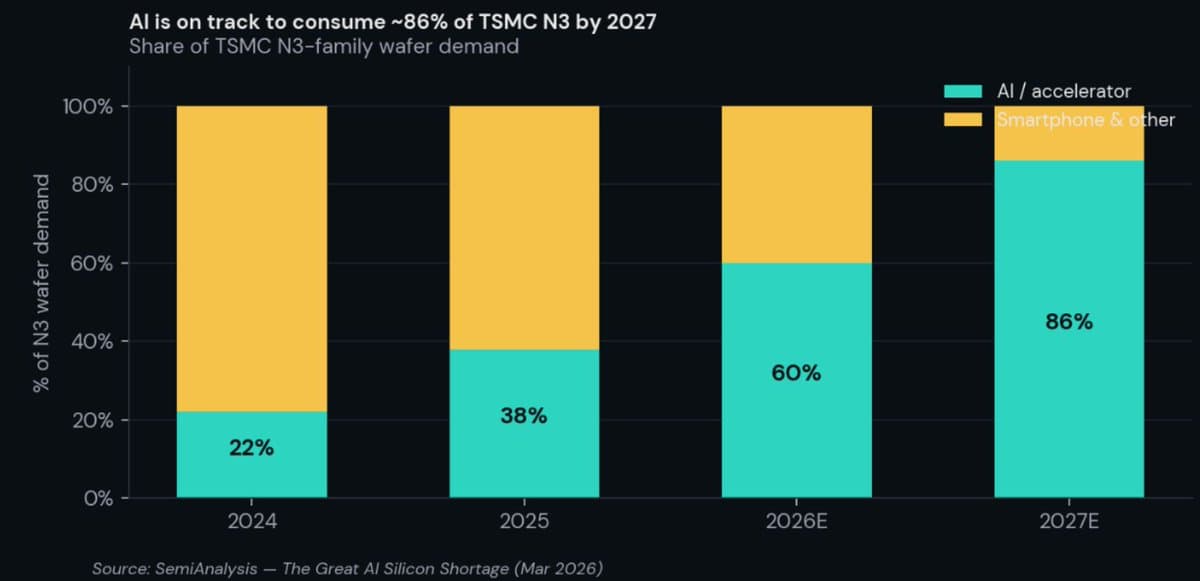
SemiAnalysis published a thread arguing that most consensus accelerator models have not caught up to where N3 demand is actually heading. The analysis implies a structural silicon deficit that current market forecasts have not priced in.
Key facts
- SemiAnalysis: consensus accelerator models underestimate N3 demand.
- The firm's 'Great AI Silicon Shortage' piece is the source.
- N3 is the process node for NVIDIA Blackwell and AMD MI300.
- SemiAnalysis did not disclose specific wafer figures in the thread.
- The claim implies a multi-year capacity mismatch.
SemiAnalysis published a thread on X arguing that the conversation about leading-edge capacity has shifted entirely, and that most consensus accelerator models haven't caught up to where N3 demand is actually heading. The firm's "Great AI Silicon Shortage" piece, linked in the thread, is the source of this claim. [According to @SemiAnalysis_]
What the thread says

The thread's throughline is that demand for N3 (3nm-class) wafers — the process node used by NVIDIA's Blackwell GPUs and AMD's MI300-series — is accelerating faster than public forecasts project. SemiAnalysis does not disclose specific wafer demand figures in this post, but the implication is that accelerator supply constraints will persist longer than widely assumed.
Why this matters more than the press release suggests
The unique take: SemiAnalysis is effectively calling the entire sell-side analyst consensus wrong on silicon supply. If N3 demand is structurally higher than models predict, then NVIDIA's GPU availability, hyperscaler data-center buildouts, and AI training timelines all face a tighter constraint than the market currently prices. This is not a near-term blip — it is a multi-year capacity mismatch that no single fab expansion can fix quickly.
Context from recent reporting
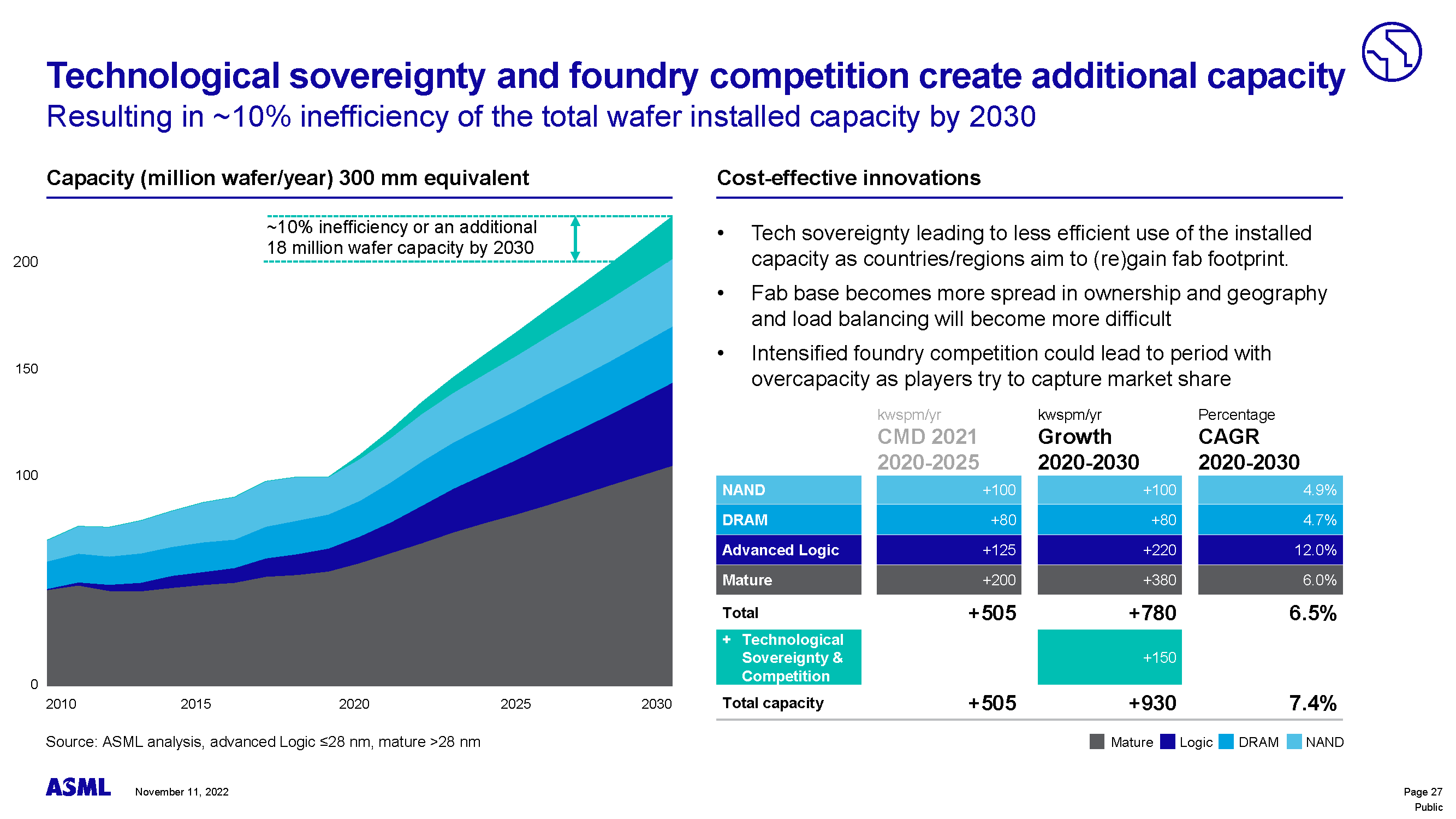
This aligns with SemiAnalysis's broader thesis that AI silicon demand will outpace even the most aggressive foundry buildouts. The firm previously argued that TSMC's N3 capacity additions through 2026 will be fully absorbed by hyperscaler custom chips and NVIDIA's B200/B300 families, leaving little room for second-tier accelerator makers. [Per SemiAnalysis's prior work]
What to watch
Watch for TSMC's Q1 2026 earnings call in April, where capacity utilization rates and forward guidance for N3 will either confirm or contradict SemiAnalysis's thesis. Also monitor NVIDIA's next GPU architecture announcement — if it moves to a more advanced node, the N3 crunch could ease.