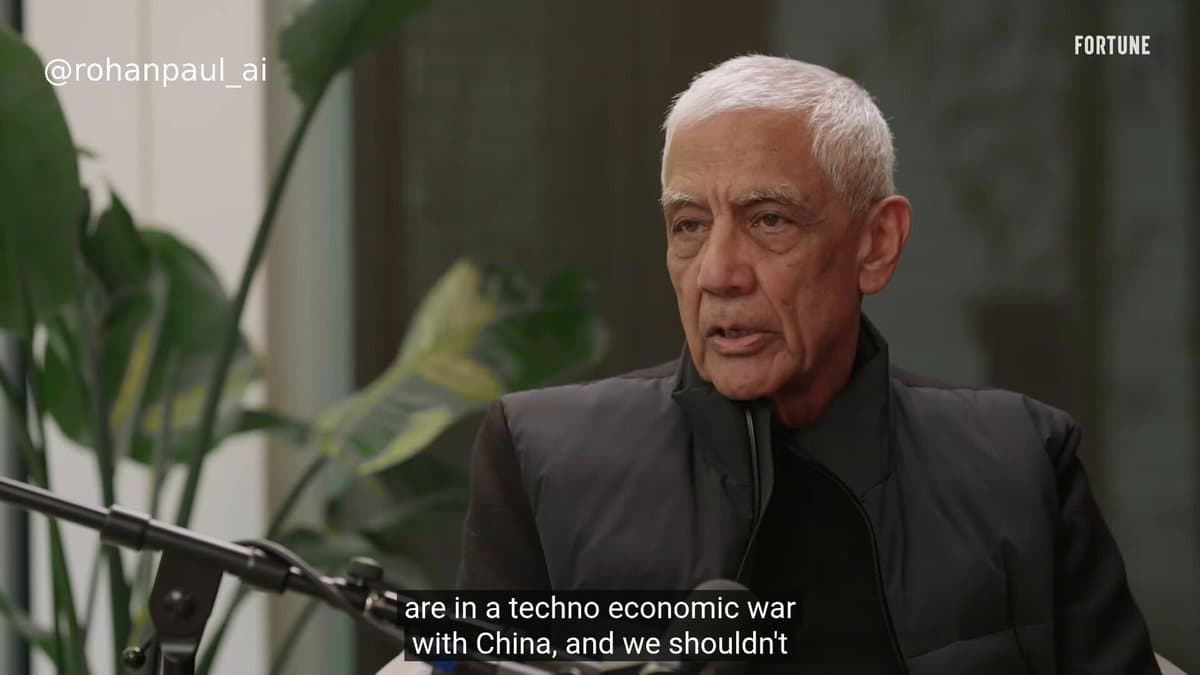
In a stark and unambiguous declaration, legendary Silicon Valley venture capitalist Vinod Khosla has labeled the intensifying competition between the United States and China in artificial intelligence as a "techno-economic war." The co-founder of Sun Microsystems and a pivotal figure in technology investing for decades, Khosla argues that this framing is not hyperbole but a necessary recognition of the stakes. According to his statement, shared via Fortune Magazine, "We are in a techno-economic war with China, and we shouldn't call it anything other than a war. Whoever wins this AI race will win the economic race and will win the race for socio-economic power and influence globally."
The Stakes of the AI Race
Khosla's statement cuts to the core of a debate that has moved from tech conferences to the highest levels of government. His perspective elevates AI from a sector of technological innovation to the central theater of 21st-century geopolitical and economic competition. The prize, as he defines it, is nothing less than global socio-economic power and influence. This view posits that AI is not merely another industrial revolution but a foundational technology that will determine which nation sets the rules, norms, and standards for the future global economy and society.
The "economic race" Khosla references is widely understood by economists and strategists. Leadership in AI is expected to drive massive productivity gains, create entirely new industries, and redefine existing ones—from healthcare and finance to manufacturing and logistics. The nation that leads is projected to capture the lion's share of this multi-trillion-dollar economic value.
From Competition to Conflict: The 'War' Analogy
By insisting on the term "war," Khosla is making a deliberate rhetorical choice. It signifies a shift from peaceful economic competition to a state of conflict where there are clear winners and losers, and where national strategy, investment, and policy must be marshaled with singular focus. This terminology aligns with a growing bipartisan consensus in Washington that views technological supremacy, particularly in semiconductors and AI, as a national security imperative.
The "socio-economic power" component of his warning extends beyond GDP figures. It encompasses which cultural values, governance models, and ethical frameworks are embedded into the global AI infrastructure. A future where Chinese-developed AI systems dominate could see the proliferation of technologies built around different principles of data privacy, surveillance, and social control than those championed in Western democracies.
The Context: A Decade of Strategic Rivalry
Khosla's comments are not made in a vacuum. They reflect over a decade of escalating technological rivalry. China's stated ambition, crystallized in its "Made in China 2025" plan and subsequent AI development goals, has been to achieve global leadership in key technologies. The U.S. response has evolved from concern to action, exemplified by export controls on advanced semiconductors, investment screening mechanisms like the Committee on Foreign Investment in the United States (CFIUS), and major domestic investment bills like the CHIPS and Science Act.
As a venture capitalist whose firm, Khosla Ventures, invests heavily in frontier technology, Khosla operates at the nexus of this conflict. His pronouncement carries the weight of someone who sees the pipeline of innovation, talent, and capital from both sides and is sounding an alarm about the intensity and consequences of the struggle.
Implications for Policy and Innovation
If this is truly a "war," then the implications for national strategy are profound. It suggests that a purely market-driven, laissez-faire approach to AI development may be insufficient. It calls for a coordinated, long-term national strategy involving sustained public investment in basic research, education in STEM fields, immigration policies to attract and retain top global AI talent, and careful alliances with technological partners in allied nations.
However, this framing also presents risks. An overtly adversarial stance could accelerate the decoupling of the U.S. and Chinese tech ecosystems, potentially stifling global scientific collaboration and fracturing the internet. It could also lead to overreach in regulation and surveillance in the name of national security, potentially undermining the open innovation environment that has been Silicon Valley's greatest strength.
The Path Forward
Khosla's declaration is ultimately a call for clarity and resolve. By refusing to soften the language, he aims to shake policymakers, investors, and the public out of any complacency. The message is that the United States must mobilize its resources—its venture capital, its research universities, its innovative corporations—with the same urgency and coordination as it would in a traditional military conflict.
The coming years will test whether this "techno-economic war" narrative drives effective strategy or leads to counterproductive escalation. What is certain is that the race for AI supremacy, as highlighted by one of Silicon Valley's most influential voices, is now recognized as the defining contest for global leadership in the decades to come.
Source: Statement by Vinod Khosla via Fortune Magazine, as shared by @rohanpaul_ai.