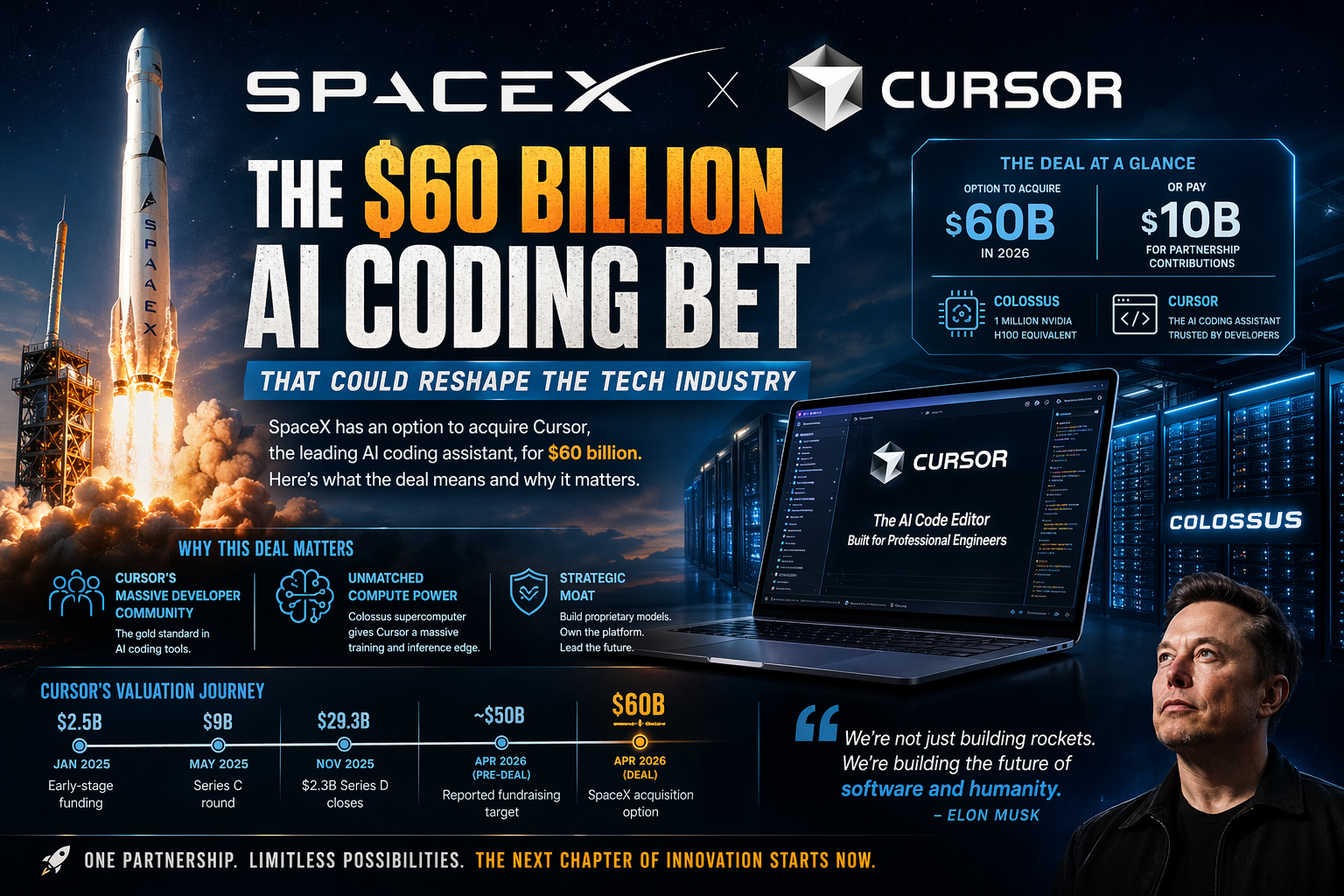
SpaceXAI released Grok 4.5, its fastest coding model, trained on the Colossus supercluster with NVIDIA Blackwell GPUs. The model targets engineering and agentic workflows at lower inference costs than prior versions.
Key facts
- Grok 4.5 trained on Colossus supercluster with NVIDIA Blackwell GPUs.
- Available in Cursor, Grok Build CLI, Vercel, and SpaceXAI API.
- Marketed as SpaceXAI's fastest coding model yet.
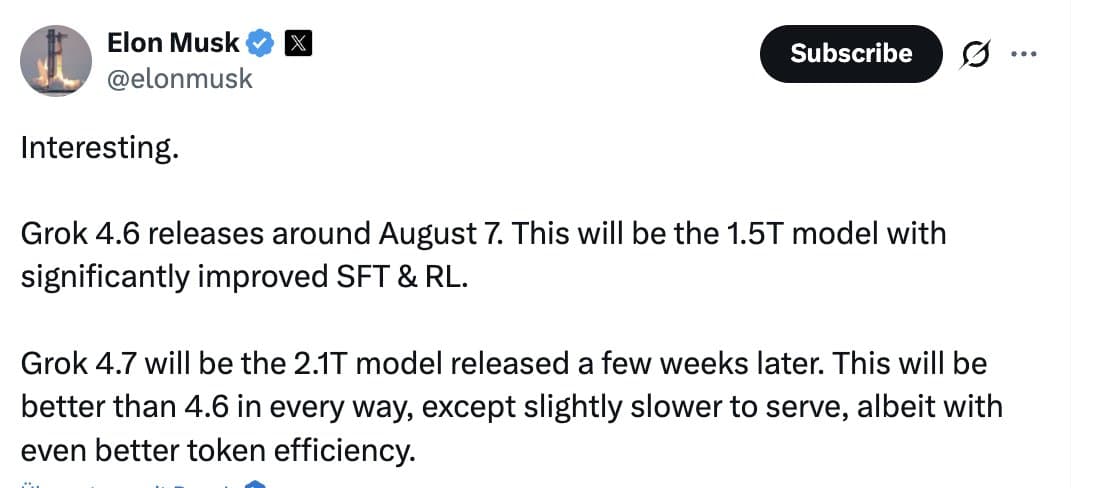
- Elon Musk promises monthly new model releases.
- Benchmark scores and parameter count not disclosed.
SpaceXAI has released Grok 4.5, its latest AI model for coding, engineering, and agentic workflows According to @analyticsindiam. Trained on the Colossus supercluster with NVIDIA Blackwell GPUs, it delivers strong benchmark performance at lower inference costs and is now available in Cursor, Grok Build CLI, Vercel, and the SpaceXAI API. Elon Musk says new models will continue rolling out every month.
The company did not disclose specific benchmark scores, inference cost reductions, or parameter counts. The claim of lower inference costs compared to prior Grok models (Grok 3, released February 2025) is plausible given Blackwell's architectural efficiency improvements — NVIDIA claims up to 4x faster token generation on LLMs with FP4 inference — but SpaceXAI did not provide independent benchmarks to substantiate the claim.
Key Takeaways
- SpaceXAI released Grok 4.5, a coding-focused model trained on Blackwell GPUs, now available in Cursor and Vercel.
- Inference cost claims lack independent benchmarks.
What's New vs. Grok 3

Grok 3, released in February 2025, was a general-purpose model trained on 200K GPUs. Grok 4.5 narrows focus to coding and agentic workflows, a bet that developer tooling adoption drives enterprise revenue faster than broad chat. The integration with Cursor (the AI code editor with an estimated 2M+ monthly active developers) and Vercel (the frontend deployment platform) signals a deliberate go-to-market strategy: meet developers in their existing tools rather than forcing them into a SpaceXAI-specific IDE.
Inference Cost Economics
The lower inference cost claim is the story's most consequential detail, if true. SpaceXAI's API pricing for Grok 3 was $3 per million input tokens and $15 per million output tokens — cheaper than OpenAI's GPT-4o ($5/$15) but pricier than Anthropic's Claude 3.5 Sonnet ($3/$15). A meaningful reduction on output tokens (the dominant cost in code generation) would make Grok 4.5 competitive on price-per-task with open-weight models like DeepSeek-Coder-V2, which costs roughly $0.28 per million output tokens via Together AI.
Availability and Distribution

Grok 4.5 is available immediately in Cursor, Grok Build CLI, Vercel, and the SpaceXAI API. The CLI tool, Grok Build, competes directly with Anthropic's Claude Code CLI and OpenAI's Codex CLI — both released in 2025. SpaceXAI did not disclose whether the model is available in the Grok chatbot on X or whether it supports the full 128K context window that Grok 3 offered.
What to watch
Watch for independent benchmark results on SWE-Bench and HumanEval from the community within two weeks. Also track whether SpaceXAI publishes API pricing for Grok 4.5 — a reduction below $10 per million output tokens would signal aggressive competition with Anthropic and OpenAI on developer pricing.