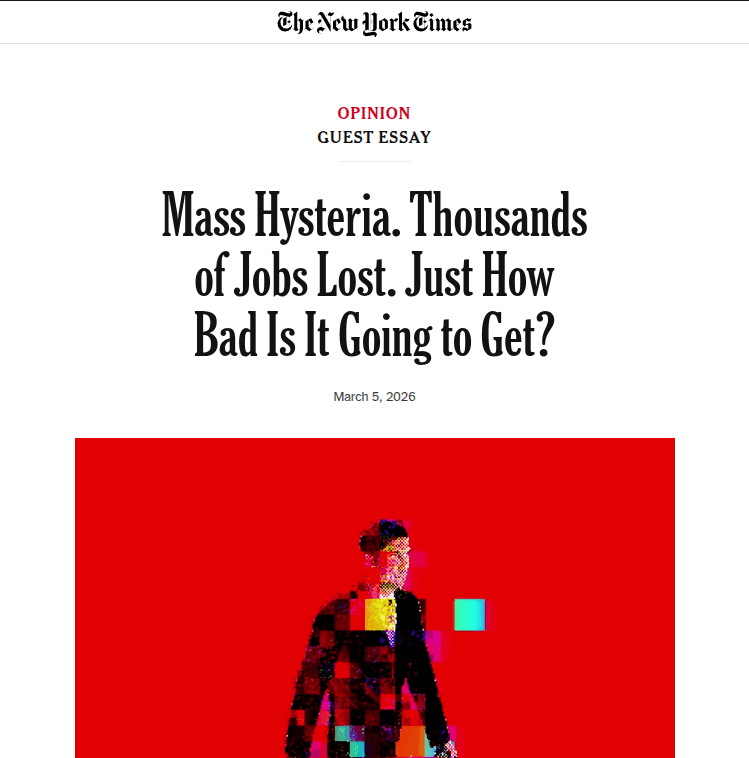
Recent economic data has revealed a troubling new pattern in the American labor market that economists are calling "virtually unprecedented"—a sustained period of slow job growth and gradually rising unemployment occurring without a traditional recession. According to a New York Times analysis highlighted by AI commentator Rohan Paul, the economy added only 181,000 jobs in 2025, a shockingly low figure in a year that saw gross domestic product grow by a modest but respectable 2.2 percent.
The Unprecedented Employment Picture
This disconnect between economic output and job creation represents a significant departure from historical patterns. Typically, economic growth correlates strongly with job creation, but the current situation suggests fundamental structural changes are underway. Lawrence Katz, a professor of economics at Harvard University, notes that what we are experiencing now—a sustained period of "slow job growth and gradually rising unemployment without a real recession"—has few historical parallels.
The 181,000 jobs added in 2025 represent a dramatic slowdown from previous recovery periods. For context, during the recovery from the 2008 financial crisis, job growth regularly exceeded 200,000 per month, not per year. This stark contrast highlights how different the current economic environment has become.
The AI Factor in Labor Market Transformation
While the source material doesn't claim definitive causation, it raises the crucial question: "So are those cracks the first signs of an A.I. jobs apocalypse?" The timing of this employment slowdown coincides with the rapid adoption of artificial intelligence across multiple sectors, suggesting AI may be playing a significant role in reshaping labor demand.
Unlike previous technological revolutions that destroyed some jobs while creating new categories of employment, early evidence suggests AI might be having a more complex impact. The technology appears to be enhancing productivity (contributing to GDP growth) while simultaneously reducing the labor intensity of that production. This creates the paradoxical situation where the economy grows but requires fewer human workers to achieve that growth.
Public Sentiment and Social Implications
The employment data comes against a backdrop of growing public anxiety about artificial intelligence. According to the analysis, "Many Americans already take a dim view of A.I. and feel as if they are being frog-marched to a future that they neither asked for nor wanted." This sentiment reflects a broader cultural tension between technological advancement and human welfare.
The source material warns of potentially severe social consequences: "If A.I. robs some of them of their livelihoods, knocks them out of the middle class and thwarts the aspirations of their kids, wariness will quickly give way to rage." This observation points to the high stakes involved in managing the transition to an AI-augmented economy. The concern isn't merely about unemployment statistics but about the preservation of the middle class and intergenerational mobility.
Historical Context and What Makes This Different
Previous technological disruptions, from the Industrial Revolution to computerization, eventually led to net job creation as new industries emerged. What makes the current situation potentially different is the breadth of AI's capabilities. Unlike specialized automation technologies of the past, AI systems demonstrate general-purpose problem-solving abilities that could affect a much wider range of occupations simultaneously.
The fact that this job slowdown is occurring without a traditional recession is particularly significant. In past economic cycles, weak job growth typically signaled broader economic contraction. The current scenario suggests something more structural—a fundamental change in the relationship between economic output and employment.
Policy Implications and Future Trajectories
This new economic reality presents unprecedented challenges for policymakers. Traditional tools for stimulating employment may prove less effective if the issue isn't cyclical but structural. The situation calls for rethinking everything from education and retraining programs to social safety nets and potentially even reimagining the relationship between work and income.
The source material wisely notes that "It's too soon to say" whether this represents the beginning of an "AI jobs apocalypse," but the warning signs are clear enough to warrant serious attention. The coming years will be crucial in determining whether this represents a temporary adjustment period or a permanent shift in the nature of work.
Looking Ahead: Adaptation and Mitigation
As AI continues to advance, the key question becomes how societies can harness its productivity benefits while mitigating its disruptive effects on employment. This will likely require coordinated efforts across multiple domains: educational systems that emphasize uniquely human skills, labor policies that support transition periods, and perhaps most importantly, social consensus about how to distribute the gains from AI-enhanced productivity.
The current employment data serves as an early indicator that the AI revolution may unfold differently than previous technological transformations. While it's premature to draw definitive conclusions, the unprecedented nature of "slow job growth and gradually rising unemployment without a real recession" suggests we may be entering uncharted economic territory that will require new thinking and innovative solutions.
Source: Analysis based on New York Times reporting highlighted by @rohanpaul_ai on X/Twitter