What the Source Actually Reports
The Medium article "When Algorithms Don't Know You Yet" uses a simple but effective analogy to explain one of the most persistent challenges in recommendation systems: the cold start problem. The author compares a familiar Subway sandwich shop worker named Sam—who knows your "usual" order perfectly—to a new employee who has no idea what you typically order.
This analogy perfectly captures the dilemma facing recommendation algorithms when they encounter new users with no historical data. Just as the new Subway worker might suggest random or generic sandwich combinations, recommendation systems struggle to provide personalized suggestions for users they "don't know yet."
The Technical Challenge Explained
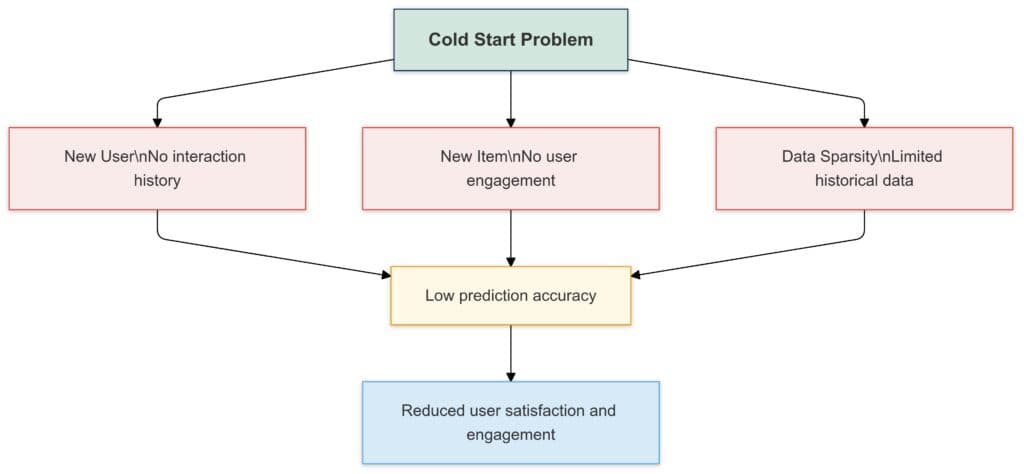
The cold start problem occurs in three main scenarios:
- New User Cold Start: When a user signs up for a service but hasn't interacted enough to generate meaningful preference data
- New Item Cold Start: When new products are added to a catalog but haven't been rated or purchased yet
- New System Cold Start: When launching a recommendation system from scratch with minimal historical data
Traditional collaborative filtering approaches—which recommend items based on what similar users liked—fail completely in these scenarios because there's insufficient data to establish user similarities or item relationships.
Common Solutions and Their Limitations
The article likely discusses (based on the analogy and typical coverage of this topic) several approaches to mitigating the cold start problem:
Content-Based Filtering: Instead of relying on user behavior patterns, this approach analyzes item attributes. For a sandwich shop, this might mean suggesting turkey sandwiches to someone who ordered chicken, or whole wheat bread to someone who ordered multigrain.
Hybrid Approaches: Combining collaborative filtering with content-based methods or other signals to provide better initial recommendations.
Explicit Data Collection: Asking users directly about their preferences through onboarding surveys, preference selectors, or initial ratings.
Contextual Signals: Using available metadata like location, device type, signup source, or time of day to make educated guesses about user preferences.
Popularity-Based Fallbacks: Showing trending or generally popular items when personalized recommendations aren't possible.
Each solution has trade-offs. Content-based filtering requires rich item metadata that may not exist. Explicit data collection creates friction during onboarding. Popularity-based recommendations can create feedback loops where popular items become even more popular.
The Human Element in the Analogy
The Subway worker analogy highlights what's still missing from even the most sophisticated recommendation systems: true understanding. Sam doesn't just know your usual order—he might remember that you were experimenting with different sauces last month, that you seemed to enjoy the new seasonal vegetable, or that you always ask for extra pickles on Fridays.
This level of contextual, temporal, and nuanced understanding remains challenging for algorithms, especially with limited data. The human worker can also ask clarifying questions ("Still avoiding onions?") or make observational inferences ("You look like you're in a hurry today—want your usual but toasted faster?") that algorithms cannot easily replicate.
Why This Problem Persists
Despite decades of research and implementation, the cold start problem remains relevant because:
- User expectations have risen: Consumers now expect Netflix-level personalization from every service
- Competition is fierce: A poor initial experience often means users abandon the platform entirely
- Privacy concerns limit data collection: Regulations like GDPR make aggressive data collection riskier
- The problem scales: Every successful platform constantly acquires new users and adds new items
Recent Advances and Future Directions
While not explicitly covered in the source article, recent approaches to the cold start problem include:
- Meta-learning: Training models to quickly adapt to new users with minimal data
- Cross-domain recommendations: Leveraging data from related domains or platforms (with proper consent)
- Zero-shot learning: Using pre-trained models that can make reasonable inferences without specific training data
- Federated learning: Building models that learn from user behavior without centralizing personal data
These approaches show promise but introduce new complexities around implementation, privacy, and computational requirements.
The Fundamental Trade-Off
The article's sandwich shop analogy ultimately points to a fundamental trade-off in recommendation systems: immediate relevance versus long-term learning.
Aggressive data collection and inference might provide better initial recommendations but could creep users out. Conservative approaches respect privacy but deliver poor initial experiences. The optimal balance depends on the specific context, user expectations, and regulatory environment.
What makes the cold start problem particularly challenging is that first impressions matter tremendously in digital experiences, yet those first impressions occur when the system knows the least about the user.