We are witnessing a fundamental transformation in how software is created and who gets to create it. For decades, software development has been gated behind esoteric programming languages, complex syntax, and specialized training that created artificial scarcity in a digital world. According to AI observer Rohan Paul, we're now moving "from a world of software scarcity to software abundance" where "natural language is the ultimate compiler."
The Historical Gatekeeping of Software
For over half a century, software development has been controlled by those who could master specialized languages and tools. This created a priesthood of developers who held the keys to digital creation. The barrier wasn't just technical knowledge—it was the entire mindset and vocabulary required to translate human intent into machine instructions. This gatekeeping served to limit who could participate in building the digital world, creating artificial scarcity in an otherwise infinitely replicable medium.
Paul notes that "we spent decades gatekeeping logic behind esoteric programming languages," creating an industry where institutional software development became the primary pathway to creating digital tools and experiences. This centralized control mirrored other industries before their democratization, from broadcasting to publishing to manufacturing.
Natural Language as the Ultimate Compiler
The breakthrough comes from AI systems that can understand and execute instructions given in natural human language. When you can simply describe what you want a program to do—in English, Spanish, Mandarin, or any other human language—and have an AI system translate that into functional code, the entire paradigm shifts. The "compiler" is no longer a technical tool that requires specialized knowledge; it's the natural language interface itself.
This represents a fundamental change in bottlenecks. As Paul observes, "the bottleneck is no longer execution capability. The only remaining bottleneck is having a useful idea." When the technical execution barrier falls, what matters shifts from technical proficiency to creativity, problem identification, and domain expertise.
Historical Parallels: From Broadcasting to Content Creation
This transformation follows a pattern we've seen repeatedly throughout technological history. Paul draws a direct parallel to broadcasting: "The barrier to broadcast globally in 1990 was a television network and satellite uplinks. The barrier to broadcast globally in 2020 is a smartphone and a wifi connection."
Similarly, publishing once required printing presses, distribution networks, and gatekeepers at every stage. Today, anyone can publish globally with a blog or social media account. The result in broadcasting and publishing has been "the death of the monoculture and an infinite supply of hyper specific content."
Implications for Software Development
The implications of this shift are profound. "Institutional software development will be dead soon," Paul predicts, not because organizations won't need software, but because the creation process will be fundamentally democratized. We're moving toward a world where:
- Domain experts can build their own tools without learning to code
- Small businesses can create custom software solutions without hiring developers
- Individuals can prototype ideas in hours rather than months
- Innovation accelerates as the friction of implementation decreases
This represents what Paul calls "algorithmic decentralization"—the permanent destruction of legacy gatekeepers who controlled access to software creation. Just as desktop publishing democratized design and social media democratized broadcasting, natural language programming will democratize software development.
The New Landscape of Software Abundance
In a world of software abundance, we can expect several key developments:
- Hyper-specific solutions: Instead of one-size-fits-all software, we'll see tools tailored to incredibly specific needs and niches
- Rapid iteration: The feedback loop between idea and implementation will shrink dramatically
- Democratized innovation: People closest to problems will be able to build solutions without technical intermediaries
- New forms of literacy: Just as social media created new forms of communication literacy, natural language programming will create new forms of creation literacy
This doesn't mean traditional programming disappears—just as professional photographers still exist in the age of smartphone cameras—but it does mean the center of gravity shifts. The value moves from technical implementation to problem identification, user experience design, and creative vision.
Challenges and Considerations
While this democratization brings tremendous opportunity, it also presents challenges. Quality control, security, and maintenance become more complex when anyone can create software. We'll need new systems for verification, validation, and collaboration in this more distributed creation environment.
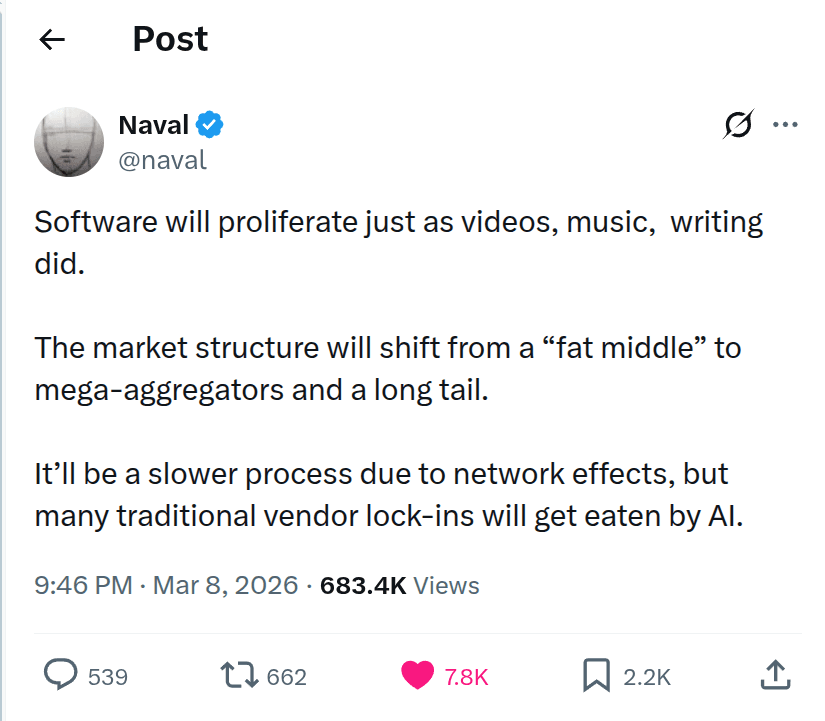
Additionally, as with previous democratizations, we may see information overload and discoverability challenges. When everyone can create software, how do users find the tools that actually solve their problems effectively?
The Future of Creation
We stand at the threshold of one of the most significant democratizations in human history. For the first time, the ability to create functional digital tools and experiences is becoming accessible to anyone with a useful idea and the ability to describe it clearly. This represents not just a technological shift but a cultural and economic one—a rebalancing of who gets to participate in building our digital future.
As Paul concludes, "The gatekeepers must fall." And in their place, we're building a world where creativity and problem-solving matter more than technical pedigree, where useful ideas find expression without artificial barriers, and where software truly becomes abundant rather than scarce.
Source: Rohan Paul (@rohanpaul_ai) on X/Twitter