Key Takeaways
- Towards AI's piece argues metrics that seem to improve can degrade production quality.
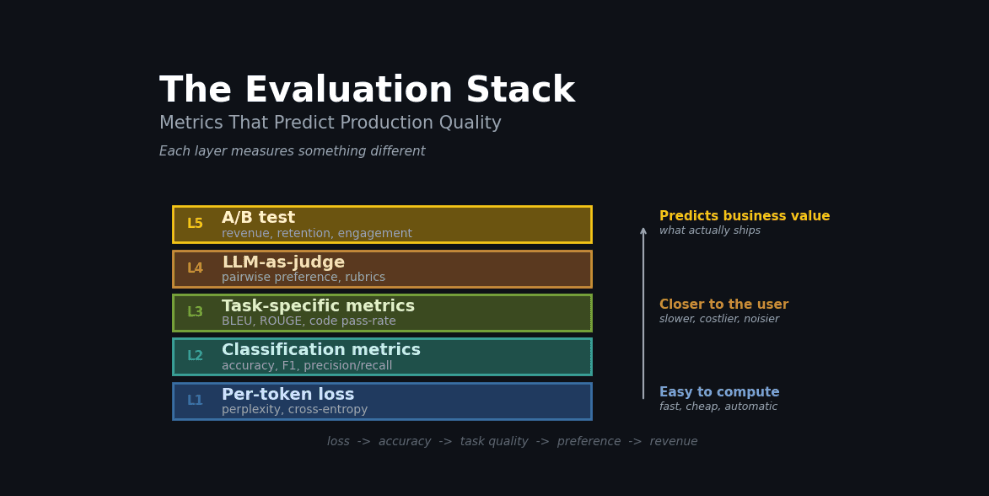
- It introduces the evaluation stack, a framework for metrics that predict real-world LLM performance, crucial for AI teams.
What Happened

Towards AI published an analysis arguing that the hardest engineering problem in LLM deployment is not latency or cost — it is knowing whether your model got better. The piece, titled "The Evaluation Stack: Metrics That Predict Production Quality," challenges the assumption that standard benchmark improvements translate to better production outcomes. It warns that "metrics that seem to improve can actually degrade production quality," an uncomfortable truth for teams shipping LLM features.
Technical Details
The article introduces the concept of an "evaluation stack" — a layered framework for assessing LLM quality beyond single-number benchmarks. The core argument: traditional metrics (e.g., accuracy on static test sets) fail to capture how models behave in dynamic, real-world contexts. The evaluation stack instead emphasizes:
- Task-specific metrics: Measures tied to the actual business function (e.g., retrieval accuracy for RAG pipelines, tool-call correctness for agents).
- Adversarial testing: Probing models with edge cases that production traffic will likely include, not just curated test sets.
- Human-in-the-loop evaluation: Using human raters for subjective qualities like tone, safety, and brand voice — areas where automated metrics are weak.
- Online evaluation: A/B testing and canary releases to measure live performance against the previous model version.
The piece argues that these layers, combined, predict production quality better than any single offline benchmark. It positions evaluation as a continuous engineering discipline, not a one-time pre-launch checklist.
Retail & Luxury Implications
For AI teams at luxury and retail companies, this framework is directly actionable. Consider the gap between a model scoring 95% on an offline Q&A benchmark and the same model failing to understand a customer's nuanced query about product authenticity or sizing. The evaluation stack addresses this gap.
Concrete scenarios:
- Customer service chatbots: A model may ace generic intent classification but fail on brand-specific vocabulary (e.g., "prêt-à-porter," "capsule collection"). The evaluation stack would include adversarial tests with luxury-specific slang and product names.
- Product search and recommendation: Offline ranking metrics (NDCG, recall@k) can improve while live conversion drops. Online evaluation via A/B testing would catch this discrepancy before full rollout.
- Content generation for marketing: An LLM might produce grammatically perfect copy that violates brand voice guidelines. Human-in-the-loop evaluation is essential here.
Business Impact
The business impact is significant. A model that "got better" on paper but degrades in production can lead to:
- Increased customer service escalation rates (costly for luxury brands where service is a differentiator).
- Reduced conversion from search and recommendation if rankings are subtly worse.
- Brand reputation damage from off-tone AI-generated content.
Conversely, a robust evaluation stack reduces the risk of regressions, enabling faster iteration. Teams can ship model updates with confidence, knowing that the evaluation stack will catch issues before customers do.
Implementation Approach
Implementing the evaluation stack is not a single tool purchase but a process change. Practical steps:
- Define production KPIs: What does "good" look like for your use case? (e.g., containment rate for chatbots, add-to-cart rate for recommendations).
- Build adversarial test sets: Curate edge cases from real customer interactions and failure logs.
- Integrate human raters: Use internal teams or crowdsourcing for subjective quality checks.
- Set up online evaluation: Implement A/B testing frameworks for model updates, with guardrails to auto-rollback on metric decline.
The complexity is moderate; the main cost is engineering time to build the evaluation pipeline. Tools like LangSmith, Weights & Biases, and open-source frameworks (e.g., DeepEval) can accelerate this.
Governance & Risk Assessment
- Maturity: The evaluation stack is a maturing practice. Most organizations still rely on offline benchmarks, but the industry is shifting toward more holistic evaluation.
- Privacy: Online evaluation requires careful handling of customer data. Ensure A/B tests comply with data protection regulations (GDPR, CCPA).
- Bias: Human raters can introduce bias. Use diverse rater pools and clear rubrics.
- Risk: Over-reliance on offline metrics remains the biggest risk. The evaluation stack mitigates this but requires sustained investment.
gentic.news Analysis
The evaluation stack resonates with broader industry trends. As noted in our prior coverage of METR (Model Evaluation and Threat Research), evaluation is becoming a discipline in its own right — METR focuses on evaluating frontier models for long-horizon agentic tasks, a specific form of the evaluation challenge. The Towards AI piece generalizes this to production LLM deployment, making it relevant for every team shipping AI features.
The key insight is that evaluation is not a gate but a continuous process. For retail and luxury, where brand voice and customer experience are paramount, the evaluation stack's emphasis on human-in-the-loop and online evaluation is particularly apt. A luxury brand cannot afford a chatbot that sounds generic or a recommendation engine that feels off-brand. The evaluation stack provides a framework to prevent that.
However, the article is conceptual, not prescriptive. It does not provide specific benchmark scores or case studies. Teams should treat it as a strategic framework and build their own empirical evidence. The honest assessment: the evaluation stack is the right direction, but its implementation is still an art requiring domain expertise.
Source: pub.towardsai.net