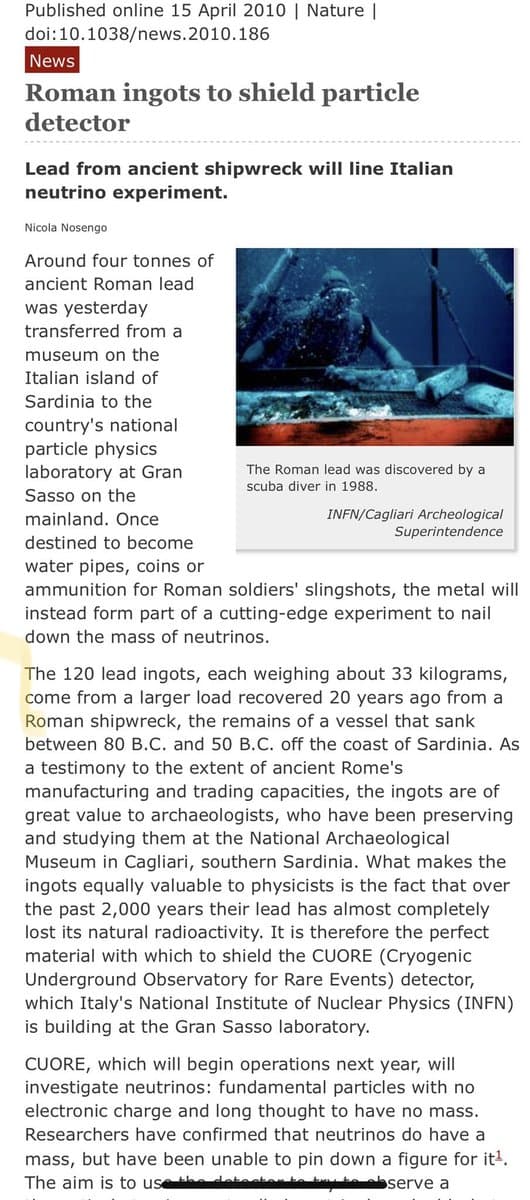
In a provocative social media post that has sparked widespread discussion among AI researchers and information scientists, Wharton professor Ethan Mollick has declared 2022 as the watershed moment in human information history. Drawing a striking historical parallel, Mollick suggests that "content before 2022 is the Roman lead or the Scapa Flow steel of human information," while everything created afterward exists in a fundamentally different state—potentially influenced by artificial intelligence in ways we're only beginning to understand.
The Historical Analogy: Understanding the Divide
Mollick's comparison to Roman lead and Scapa Flow steel isn't merely poetic—it's scientifically significant. Roman lead, mined two millennia ago, contains isotopic signatures that allow archaeologists to date artifacts with remarkable precision. Similarly, steel produced before nuclear testing began carries a different radioactive signature than post-1945 steel, making pre-atomic era steel valuable for sensitive scientific instruments.
In this context, Mollick suggests that pre-2022 digital content represents a "pure" baseline of human-generated information, while post-2022 content exists in what he calls a state of "ambient contamination"—where AI influence permeates our digital ecosystem through three primary channels:
- Direct AI authorship: Content explicitly created by AI systems
- Human-AI collaboration: Content produced through co-working with AI assistants
- Unconscious influence: Content where AI stylistic patterns have subtly influenced human creators
The 2022 Turning Point: Why This Specific Year?
2022 marked several critical developments in AI accessibility and capability. The public release of ChatGPT in November 2022 represented the most visible milestone, but the groundwork had been laid throughout the year with increasingly sophisticated language models becoming available through various platforms. This period saw:
- The transition from AI as a specialized tool to a ubiquitous writing assistant
- The normalization of AI-generated content across industries
- The emergence of AI writing styles that began influencing human expression
The Three Channels of Contamination
Direct AI Authorship
The most obvious form of contamination comes from content explicitly generated by AI systems. From marketing copy to academic papers, AI-generated text now comprises a significant portion of digital content. The challenge lies not just in the volume but in the difficulty of detection—as AI systems improve, distinguishing their output from human writing becomes increasingly challenging.
Human-AI Collaboration
Perhaps more significant is the collaborative space where humans and AI systems co-create content. This represents a fundamental shift in creative and intellectual processes, where the boundary between human and machine contribution becomes blurred. Writers, researchers, and creators across disciplines now routinely use AI as a thinking partner, editor, or idea generator, creating hybrid content that defies traditional categorization.
Ambient Stylistic Influence
The most subtle yet pervasive form of contamination comes from what Mollick calls "AI style slipping unconsciously into our work." As humans consume AI-generated content and interact with AI systems, we unconsciously absorb stylistic patterns, syntactic structures, and even conceptual frameworks that then influence our own writing and thinking. This creates a feedback loop where AI-influenced human content further trains AI systems, potentially leading to a homogenization of digital expression.
Implications for Research and Information Integrity
This contamination hypothesis raises profound questions for multiple fields:
For historians and archivists: How will future researchers distinguish between "pure" human expression and AI-influenced content? Will we need new methodologies for analyzing 21st-century digital artifacts?
For legal and regulatory frameworks: How do we establish provenance and authorship in an age of AI contamination? What constitutes original work when AI influence is ubiquitous?
For education: How do we teach critical thinking and writing skills when students are constantly exposed to and potentially influenced by AI-generated patterns?
For AI development itself: If AI systems are increasingly trained on AI-contaminated data, does this risk creating degenerative feedback loops that amplify certain stylistic or conceptual patterns?
The Archaeological Perspective on Digital Artifacts
Just as archaeologists use isotopic analysis to date ancient materials, future information scientists may need to develop similar techniques for digital content. Potential approaches could include:
- Stylometric analysis to detect AI-influenced patterns
- Metadata examination for signs of AI tool usage
- Comparative analysis against verified pre-2022 baselines
- Network analysis to trace information flows and contamination pathways
Moving Forward: Living with Contamination
Rather than viewing AI contamination as purely negative, some researchers suggest we're witnessing the emergence of a new form of human-machine symbiosis. The challenge becomes not eliminating AI influence (which may be impossible) but:
- Developing transparency standards for AI involvement in content creation
- Creating educational frameworks that help people understand and navigate this new landscape
- Establishing ethical guidelines for AI-human collaboration
- Preserving "uncontaminated" datasets for research and comparison
The Broader Philosophical Question
Mollick's observation touches on deeper questions about human creativity and expression in the AI age. If our thoughts and expressions are increasingly shaped by—or created alongside—artificial intelligence, what does this mean for concepts like originality, authenticity, and human uniqueness? Are we witnessing the gradual emergence of a new hybrid intelligence, or simply the latest tool in humanity's long history of technological augmentation?
As we move further from the 2022 divide, the contours of this new landscape will become clearer. What's certain is that we've crossed a threshold where pure human-generated digital content may become increasingly rare—and where understanding the nature and extent of AI contamination will be essential for making sense of our information ecosystem.