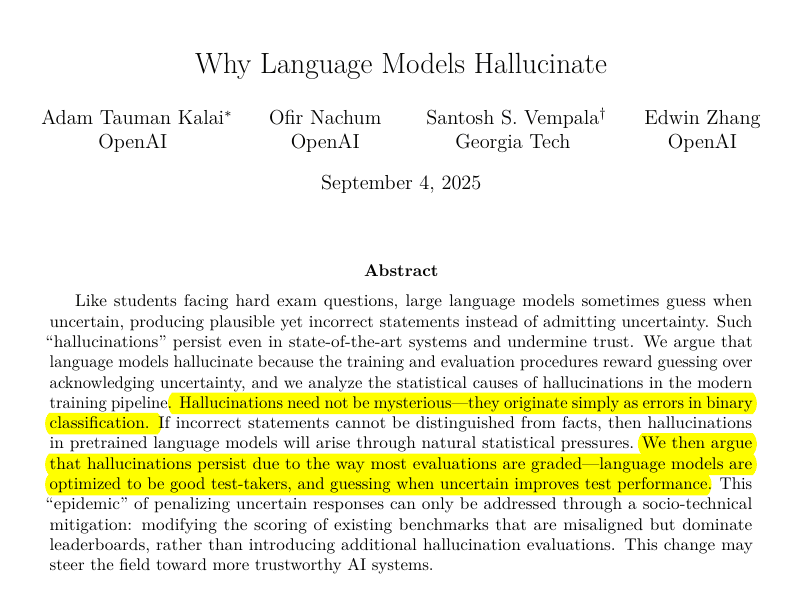
A foundational OpenAI paper, recently highlighted by AI researcher Rohan Paul, provides a clear statistical explanation for why large language models (LLMs) hallucinate—and why they likely always will under current training paradigms. The core insight is simple yet profound: LLMs are optimized to guess, not to know when they don't know.
The Problem: Training Rewards Confidence, Not Truth
The paper establishes that during standard training and evaluation, models are incentivized to produce confident-sounding answers—even if those answers are wrong—rather than admit uncertainty. This creates a perverse statistical reward system where a model is better off making a plausible guess than saying "I don't know." As the source notes, the training process effectively puts "simple, test-like incentives that reward confident wrong answers over honest 'I don't know' responses."
This isn't a bug in model design but a fundamental flaw in how we measure success. When accuracy metrics prioritize any answer over no answer, models learn that guessing is the optimal strategy, even when their internal confidence is low.
The Solution: Reward Abstention, Not Just Accuracy
The paper proposes a paradigm shift: instead of grading models solely on right vs. wrong answers, we should reward appropriate uncertainty. This means giving credit when a model correctly abstains from answering a question it's unsure about, while penalizing confident errors more heavily than simple abstentions.
OpenAI's research demonstrates this works in practice. According to the findings, increasing model abstention from 1% to 52% leads to substantially fewer wrong answers. While this might appear to lower overall accuracy (since the model answers fewer questions), it dramatically reduces hallucinations because most false information comes from incorrect guesses.
Why This Matters for AI Safety and Reliability
This research has significant implications for how we deploy language models in real-world applications:
1. Trustworthy AI Systems: In fields like healthcare, law, and finance, a wrong answer can be far more dangerous than no answer. Training models to recognize their limitations could prevent harmful misinformation.
2. Evaluation Metrics Need Rethinking: Current benchmarks that prioritize answer quantity over quality may be steering AI development in the wrong direction. New evaluation frameworks that reward calibrated uncertainty are needed.
3. Transparency in AI Responses: When models can honestly communicate their uncertainty, users can make better-informed decisions about whether to trust the information provided.
The Challenge of Implementation
While the statistical solution is clear, implementing it presents practical challenges. Determining the optimal threshold for abstention requires balancing usefulness against reliability. A model that abstains too frequently becomes unhelpful, while one that abstains too rarely continues to hallucinate.
Furthermore, this approach requires retraining or fine-tuning models with different reward structures—a non-trivial undertaking given the massive computational resources required for modern LLMs.
Looking Forward: Honest AI as a Design Goal
The OpenAI paper suggests that hallucination isn't an inevitable byproduct of language model architecture but rather a consequence of how we train and evaluate these systems. By redesigning our incentives, we can create AI that's more honest about its limitations.
This research points toward a future where AI systems might include built-in confidence indicators or uncertainty scores, allowing users to gauge the reliability of each response. Such transparency could transform how humans interact with and trust artificial intelligence.
Source: Analysis of OpenAI research as highlighted by Rohan Paul (@rohanpaul_ai) on X/Twitter.
Key Takeaway: Language models hallucinate because we've trained them to prioritize confidence over truth. The fix requires fundamentally changing how we reward AI behavior—valuing honest uncertainty as much as correct answers.