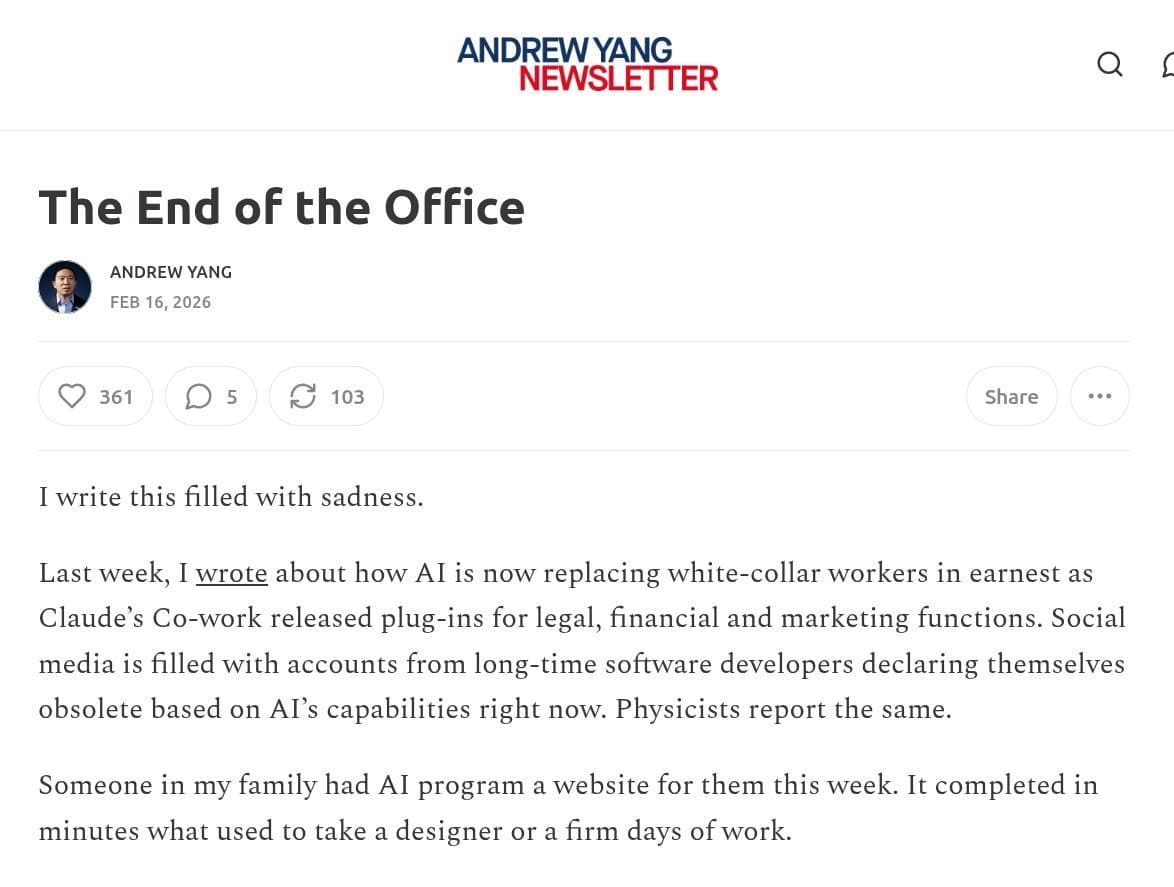
In a sobering analysis shared by AI commentator Rohan Paul, former presidential candidate Andrew Yang paints a stark picture of what he calls "the great disemboweling of white-collar jobs." This isn't about factory robots replacing blue-collar workers—this is about artificial intelligence systematically dismantling the professional class that has defined post-industrial economies for decades.
The Coming Automation Wave
Yang's central thesis is straightforward: AI will automate massive amounts of white-collar work, replacing millions of roles in legal, finance, marketing, coding, and other desk-based professions. Unlike previous technological shifts that primarily affected manufacturing, this transformation targets the educated workforce that assumed their advanced degrees and specialized knowledge would provide lifelong career security.
What makes this wave particularly disruptive is the speed at which companies will adopt these technologies. As Yang notes, "Companies will cut headcount fast because competitors will copy the AI-driven savings and markets will reward leaner teams." This creates a competitive domino effect where once one major player in an industry demonstrates significant cost savings through AI automation, others must follow or risk becoming uncompetitive.
The Human Toll: From Mid-Career Crisis to Graduate Struggles
The most immediate impact will fall on mid-career workers and middle managers who suddenly find their decades of experience devalued overnight. Yang predicts many will face major layoffs and, after prolonged job searches, be forced into lower-paying positions—a devastating financial and psychological blow for professionals accustomed to certain income levels and career trajectories.
Equally concerning is the impact on new graduates. "New grads will struggle to get career-starting jobs," Yang warns, leading more young people to move back home or pursue additional schooling as they wait out the economic storm. This creates a generational bottleneck where experienced workers can't find appropriate positions while entry-level opportunities evaporate.
The Educational Implosion
Perhaps the most profound long-term consequence involves higher education itself. "Degrees will lose value, weaker colleges will close, and expensive programs without clear payback will look worse," Yang predicts. For generations, the formula has been simple: invest in education, secure professional employment, reap lifetime earnings benefits. That entire social contract now faces unprecedented pressure.
As AI systems demonstrate they can perform tasks previously requiring years of specialized training, the return on investment for expensive degrees—particularly in fields most vulnerable to automation—will come under intense scrutiny. This could accelerate the trend toward alternative credentialing and skills-based hiring while potentially leaving millions with educational debt for qualifications of diminishing economic value.
The Urban Domino Effect
The ripple effects extend far beyond individual careers. With fewer professionals commuting to centralized offices, downtown economies face what Yang describes as a hollowing-out process. Local service businesses—from coffee shops to dry cleaners to lunch restaurants—that depend on office worker traffic will struggle. City finances, heavily reliant on commercial real estate taxes and downtown economic activity, will weaken significantly.
This urban transformation creates a vicious cycle: as downtowns decline, municipal services suffer, making cities less attractive places to live and work, which further accelerates the exodus. The pandemic provided a preview of this dynamic, but AI-driven job displacement could make remote work permanent for millions who previously had no choice but to commute.
Economic and Social Spillover Effects
Yang doesn't shy away from the darker consequences. "Bankruptcies will rise as households with mortgages and fixed bills will lose income, and stress will spill into family and mental health problems," he writes. The psychological impact of professional displacement—particularly for those who derive identity and status from their careers—could create a public health crisis alongside the economic one.
The political implications are equally significant. "Anger will rise," Yang notes succinctly, pointing to potential social unrest as educated, previously secure professionals join the ranks of the economically displaced. This isn't traditional class conflict between labor and capital, but rather a crisis within the professional class itself.
Navigating the Transition
While Yang's analysis is deliberately provocative, it raises crucial questions about how society should prepare for this transition. Traditional retraining programs designed for manufacturing workers may prove inadequate for professionals whose entire career identities are being disrupted. The social safety net in most developed countries assumes temporary unemployment, not permanent professional obsolescence.
The most immediate need may be for massive investment in AI-complementary skills—those that enhance rather than compete with artificial intelligence. Creativity, complex problem-solving, emotional intelligence, and interdisciplinary thinking may become more valuable even as technical specialization becomes more automated.
A Historical Perspective
It's worth remembering that previous technological revolutions, while disruptive, ultimately created new forms of work that were difficult to imagine during the transition. The automation of agriculture didn't lead to permanent mass unemployment but rather enabled the industrial revolution. The question is whether AI represents a similar transition or something fundamentally different in its capacity to replace human cognition rather than just human labor.
What makes this moment unique is that we're potentially automating the very functions—analysis, pattern recognition, even creativity—that previously seemed uniquely human and therefore safe from technological displacement.
Source: Analysis based on Andrew Yang's "The End of the Office" as shared by @rohanpaul_ai on X/Twitter.