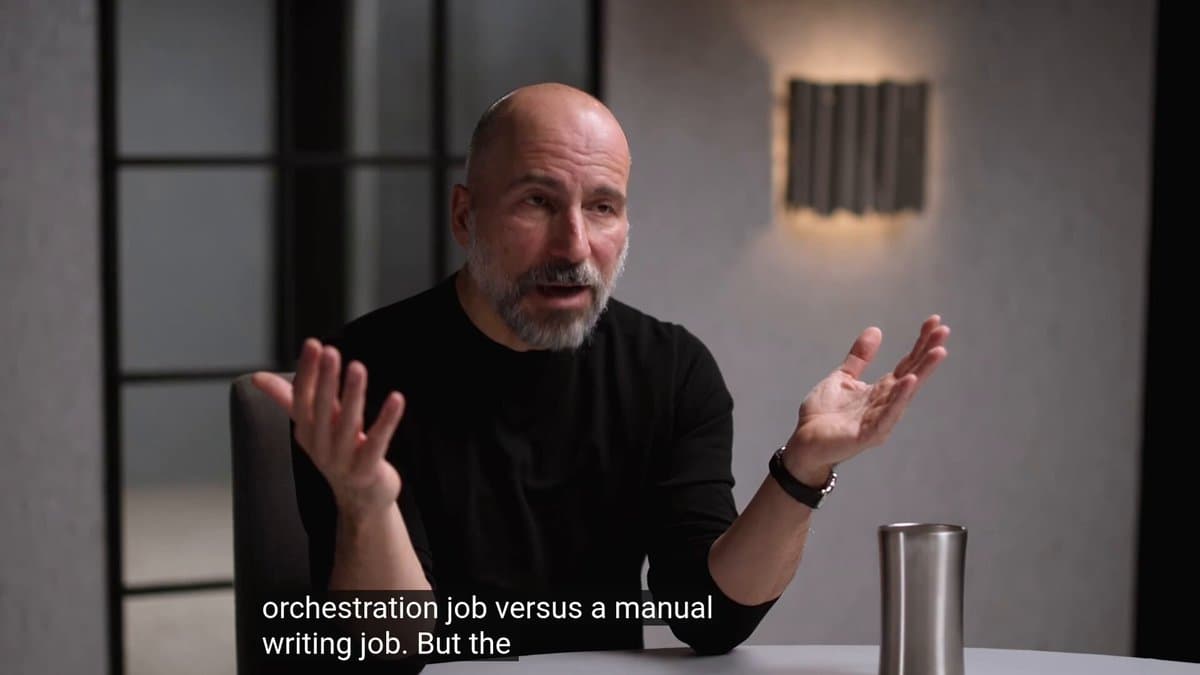
In a revealing interview on 'The Diary Of A CEO' YouTube channel, Uber CEO Dara Khosrowshahi outlined a strategic vision that could reshape the future of tech employment and artificial intelligence investment. His comments provide a rare glimpse into how major technology companies are calculating the economic trade-offs between human talent and AI systems.
The Efficiency Paradox: More Productive Engineers, More Hiring
Khosrowshahi presented what he called an "efficiency paradox" that challenges conventional wisdom about automation and employment. "My attitude is, if my average engineer became 25% more efficient, which we haven't gotten there yet, but we will get there, I'm going to hire more engineers because I want to go faster," he explained. "There's still lots of unsolved problems that we haven't solved."
This perspective aligns with recent data from Citadel Securities showing a spike in software engineering job postings despite widespread AI adoption. Rather than viewing AI as a replacement for human engineers, Khosrowshahi sees it initially as a force multiplier that enables companies to tackle more ambitious projects with their existing workforce.
The Five-Year Tipping Point
The most striking aspect of Khosrowshahi's prediction is his timeline. "However, he predicts in 5 Years the ROI of a human engineer is surpassed by the ROI of adding more AI agents and GPU power," according to the interview summary. "So at that time he will just hire more AI agents and pay for NVIDIA GPUs instead of human software engineers."
This five-year horizon represents one of the most specific and consequential predictions from a major tech CEO about AI's impact on high-skilled employment. It suggests that by 2029, the economic calculus for technology companies will fundamentally shift from investing in human capital to investing in computational resources.
The Economic Calculus: ROI as the Deciding Factor
Khosrowshahi's framework centers entirely on return on investment (ROI) calculations. This represents a significant departure from previous technological shifts, where human judgment, creativity, and domain expertise often maintained value even as automation advanced. His prediction suggests that AI systems will reach a point where they not only match but exceed human capabilities across enough dimensions to make them the superior economic choice.
This ROI-focused approach reflects how large-scale technology companies evaluate all investments, including human resources. As AI systems become more capable and their costs continue to decline relative to human compensation packages, the economic advantage could shift decisively toward artificial systems.
Implications for the Tech Industry
Khosrowshahi's comments have several important implications for the technology sector:
Short-term hiring surge: Companies may actually increase engineering hiring as AI tools boost productivity, creating a temporary boom in software engineering employment.
Long-term structural shift: The fundamental relationship between tech companies and engineering talent could change, with fewer permanent positions and more investment in AI infrastructure.
GPU and AI infrastructure demand: Companies like NVIDIA could see sustained demand growth as enterprises shift spending from human capital to computational resources.
Skill evolution: The definition of "software engineering" will likely evolve dramatically, with engineers focusing more on AI system design, training, and oversight rather than traditional coding.
The Broader Economic Context
Khosrowshahi's prediction comes amid growing debate about AI's impact on knowledge work. While previous automation waves primarily affected manufacturing and routine cognitive tasks, AI systems are now demonstrating capabilities in creative and analytical domains once considered exclusively human.
Uber's position as both a technology company and a platform connecting millions of workers gives Khosrowshahi a unique perspective on labor markets. His prediction suggests that even the most skilled technical professions are not immune to the economic pressures of automation.
Strategic Considerations for Companies
For technology leaders, Khosrowshahi's timeline creates several strategic imperatives:
Investment in AI infrastructure: Companies need to develop their AI capabilities now to remain competitive in a future where computational resources may replace human talent as the primary constraint on innovation.
Workforce planning: Organizations must balance short-term hiring needs with long-term strategic shifts, potentially investing in reskilling programs to prepare existing employees for new roles in an AI-driven environment.
Ethical considerations: The transition from human to AI systems raises important questions about corporate responsibility, particularly for companies like Uber that have faced criticism about their treatment of workers in the past.
The Human Element in an AI-First Future
Despite his stark economic prediction, Khosrowshahi acknowledged that "there's still lots of unsolved problems" that require human ingenuity. This suggests that even in an AI-dominated future, human oversight, strategic direction, and creative problem-solving will remain valuable, though potentially concentrated in fewer roles.
The transition he describes may not eliminate software engineering as a profession but could dramatically reshape it, with engineers focusing less on writing code and more on designing, training, and managing AI systems.
Conclusion: A Watershed Moment for Tech Employment
Dara Khosrowshahi's prediction represents a watershed moment in how technology leaders view the relationship between human talent and artificial intelligence. His five-year timeline for AI surpassing human engineers in ROI provides a concrete framework for companies to plan their investments in both people and technology.
As AI capabilities continue to advance at an accelerating pace, the economic calculus that has favored human intelligence for centuries may be approaching a fundamental inflection point. How companies, workers, and policymakers navigate this transition will shape the future of work, innovation, and economic growth for decades to come.
Source: Interview on 'The Diary Of A CEO' YouTube channel, as summarized by @rohanpaul_ai on X.