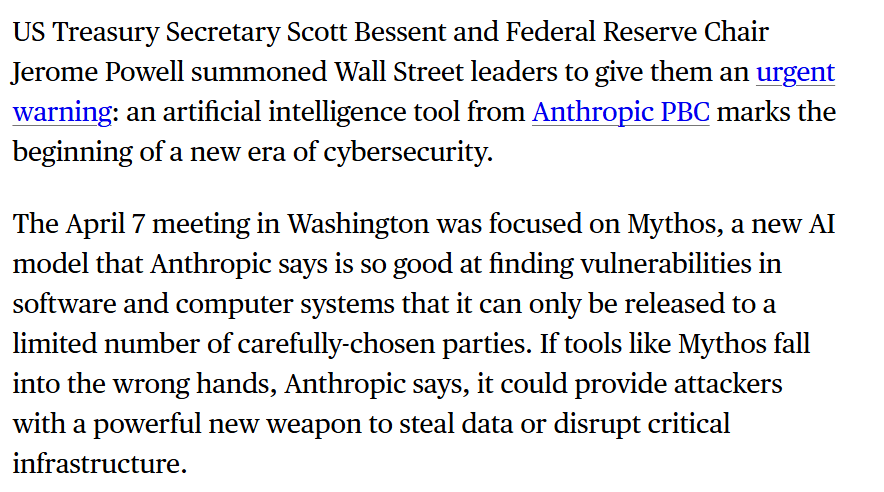
Senior U.S. officials, including Federal Reserve Chair Jerome Powell and hedge fund manager Scott Bessent, have issued warnings about Anthropic's highly advanced AI model, internally codenamed "Mythos." According to a Bloomberg report, these officials believe the model's unprecedented ability to find and exploit system vulnerabilities could usher in a new era of cybersecurity threats, necessitating tight restrictions to prevent malicious use.
Key Takeaways
- Senior US officials, including Jerome Powell, warn that Anthropic's highly advanced 'Mythos' AI model presents significant cybersecurity risks.
- Its powerful ability to find system vulnerabilities requires tight restrictions to prevent misuse.
What Happened

The warnings center on the specific capabilities of Anthropic's "Mythos" model. While details of the model's architecture and training are not public, officials are concerned about its proficiency in automated vulnerability discovery—a capability that, if unrestricted, could be weaponized to attack critical infrastructure, financial systems, and government networks. The call for tight controls suggests the model's capabilities in this domain are significantly more advanced than current publicly available AI systems.
Context of AI Security Concerns
This is not the first time advanced AI capabilities have raised red flags in Washington. The concern over AI-powered cybersecurity tools exists in a tense balance: the same models that can proactively defend networks by finding flaws can also be used offensively. The U.S. government has previously established guidelines and executive orders aimed at managing the risks of frontier AI models, particularly those with dual-use potential. The specific naming of "Mythos" and the high-level officials involved indicate this model represents a tangible step-change in capability that has triggered a direct response from policymakers and financial regulators.
The Immediate Implications

The primary implication is increased scrutiny and likely regulatory action targeting the development and deployment of frontier AI models with advanced cybersecurity capabilities. For Anthropic, this means operating under a brighter spotlight and potentially facing mandated safeguards, controlled access, or export restrictions on "Mythos." For the broader AI industry, it signals that government oversight is focusing on specific, tangible capabilities rather than abstract existential risk, with vulnerability discovery being a key trigger.
gentic.news Analysis
This warning aligns with a growing trend of concrete, capability-specific regulatory concern, moving beyond theoretical discussions of AI safety. Jerome Powell's involvement is particularly notable, connecting AI capability directly to financial system stability—a core mandate of the Federal Reserve. It suggests regulators are modeling scenarios where AI tools could automate attacks on market infrastructure or banking networks.
This development follows Anthropic's established pattern of engaging with policymakers on safety, but now concerning a specific, powerful model. The company, co-founded by former OpenAI safety researchers, has positioned itself as a leader in AI safety research. However, the "Mythos" warnings indicate that even with a safety-focused ethos, the raw capabilities of a sufficiently advanced model can alarm officials based on its potential misuse alone. This creates a challenging precedent: how does a company responsibly develop cutting-edge AI for defensive purposes when the capability itself is deemed a threat?
The focus on cybersecurity vulnerability discovery also intersects with ongoing DARPA and NSA research into AI for cyber defense. The U.S. government is actively investing in similar capabilities for national security. The official concern over "Mythos" may reflect anxiety about this powerful tool existing outside direct government control, potentially leveling the cyber playing field in ways that complicate national security strategy.
Frequently Asked Questions
What is the Anthropic "Mythos" AI model?
"Mythos" is the reported internal codename for a highly advanced AI model under development by Anthropic. While not officially detailed, U.S. officials warn its specific capability to find and exploit software vulnerabilities is powerful enough to pose a significant cybersecurity threat if misused.
Why are US officials like Jerome Powell warning about it?
Jerome Powell, as Chair of the Federal Reserve, is responsible for the stability of the U.S. financial system. His warning suggests that the "Mythos" model's capabilities are seen as a potential tool to attack financial market infrastructure, banking networks, or payment systems, representing a direct risk to economic stability.
What kind of restrictions might be placed on "Mythos"?
While specific measures aren't outlined, restrictions could include controlled access via a secure API (similar to some biosecurity protocols), mandatory auditing and logging of all usage, limits on who can access the model, export controls, or even requirements for the model to be used only within certain secure, government-vetted environments.
How does this compare to other AI security warnings?
This warning is more targeted than general warnings about AI misalignment or existential risk. It focuses on a specific, near-term, and tangible capability—automated vulnerability discovery—that has immediate dual-use potential. It involves current financial and policy figures rather than primarily AI researchers, indicating the concern has reached the highest levels of operational governance.