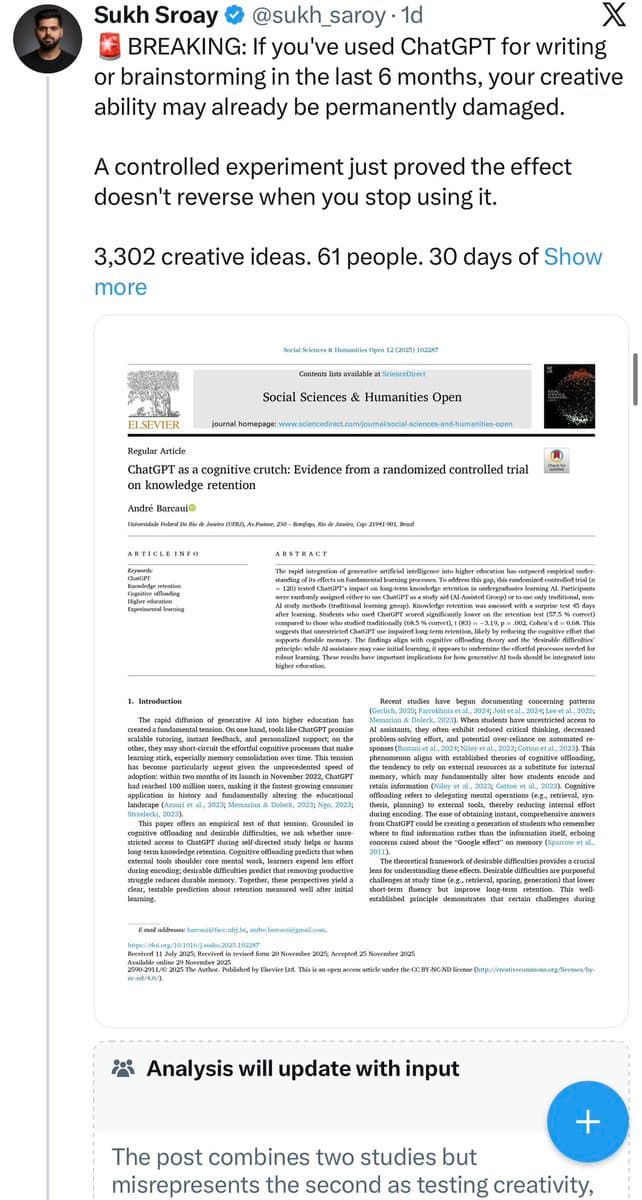
A recent social media post claiming that using ChatGPT "makes you less creative over time" has gained significant traction, accumulating over 15,000 likes despite fundamentally misrepresenting the findings of the actual academic research it references. The post, which circulated widely on platform X (formerly Twitter), represents a growing pattern where complex scientific studies about artificial intelligence are reduced to misleading soundbites that spread faster than factual corrections.
What the Research Actually Found
The study in question, conducted by researchers from prominent institutions, examined how using AI tools like ChatGPT affects human creativity over time. Contrary to the viral claim, the paper's findings were far more nuanced and ultimately more positive about AI's creative potential.
Key findings from the actual research:
- The study involved 61 participants (acknowledged by researchers as a relatively small sample)
- Participants who used ChatGPT showed significantly higher creativity scores initially
- After 30 days, there was no statistically significant drop in creativity scores for the ChatGPT group
- The ChatGPT group maintained significantly higher creativity scores than the control group at the end of the study period
The Misinformation Problem in AI Discourse
This incident highlights a critical challenge in public understanding of AI research. The original social media post presented a simplified, negative narrative about AI's impact on human creativity that directly contradicted the study's actual conclusions. Even the community note added to the post—a platform feature designed to provide factual corrections—reportedly "undersells how wrong" the original claim was, according to AI researcher and professor Ethan Mollick, who called attention to the misinterpretation.
"The creativity paper measured 61 people (underpowered) and found NO drop in creativity at 30 days," Mollick noted in his correction. "The ChatGPT group was actually still (significantly!) higher at the end."
The study's methodology involved measuring creativity through standardized assessments before and after participants engaged with ChatGPT over a month-long period. Researchers were specifically investigating whether reliance on AI tools might diminish human creative capacity—a concern frequently raised by AI skeptics. Their findings suggested the opposite: AI assistance appeared to enhance creative output without the negative long-term effects some had predicted.
Why Accurate Research Communication Matters
Misinterpretations of AI research have real-world consequences. When studies are misrepresented:
1. Public Policy Implications: Policymakers may base decisions on incorrect assumptions about AI's effects
2. Educational Applications: Schools and universities might avoid beneficial AI tools based on unfounded fears
3. Workplace Integration: Businesses could hesitate to implement AI-assisted creative processes
4. Research Funding: Misunderstood findings might skew funding priorities away from promising areas of study
The small sample size (61 participants) mentioned by Mollick represents another important aspect of research interpretation. While the study provides valuable preliminary evidence, larger-scale replication would strengthen confidence in the findings. This nuance—understanding the difference between preliminary findings and conclusive evidence—often gets lost in social media discussions.
The Broader Context of AI and Creativity Research
This incident occurs amid growing academic interest in how AI tools affect human cognitive processes. Previous research has shown mixed results, with some studies suggesting AI can enhance certain types of creative thinking while potentially affecting others. The current study adds to this literature by specifically examining longitudinal effects—how AI use impacts creativity over time rather than just in immediate sessions.
The maintenance of higher creativity scores after 30 days suggests that AI tools might help users develop sustainable creative habits or thinking patterns rather than creating temporary boosts followed by declines. This has important implications for how we think about integrating AI into creative workflows and education.
Moving Forward: Better Science Communication
This case illustrates the need for:
- More accessible research summaries from academic institutions
- Better media literacy around scientific findings
- Responsible sharing of research by influencers and thought leaders
- Clear communication of study limitations alongside findings
Researchers themselves might consider developing more robust public communication strategies, including plain-language summaries, infographics explaining key findings, and engagement with science communicators who can accurately translate complex results for general audiences.
As AI continues to advance and integrate into more aspects of daily life, the accuracy of public understanding about its effects becomes increasingly important. This incident serves as both a cautionary tale about the spread of misinformation and an encouraging sign that factual corrections can gain traction—even if they sometimes arrive after false claims have already spread widely.
Source: Ethan Mollick's analysis of the misinterpreted AI creativity study on X/Twitter, referencing original research examining ChatGPT's effects on human creativity over time.