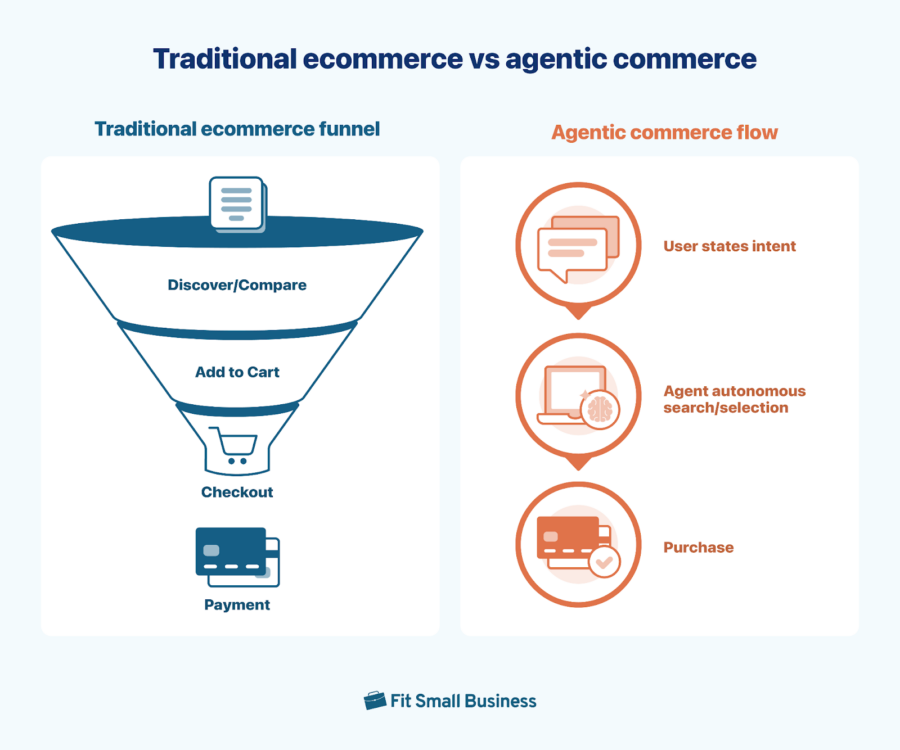
Recent coverage from Retail TouchPoints and Digital Commerce 360 spotlights a significant trend: the rapid emergence of Agentic AI as a transformative force in digital commerce. This isn't about simple chatbots; it's about autonomous systems capable of orchestrating entire customer journeys, from discovery to post-purchase support. The narrative is supported by industry projections, including a bold prediction that autonomous AI agents could facilitate 50% of all online transactions by 2027.
The Innovation — What the Source Reports
The core concept is "agentic commerce." Unlike traditional, single-task automation, agentic AI involves systems that can plan, execute, and adapt a sequence of actions to achieve a complex goal without constant human intervention. For ecommerce, this means an AI that doesn't just answer a FAQ but can autonomously:
- Research products across a catalog based on nuanced, multi-faceted customer requests.
- Handle intricate customer service issues that require accessing multiple backend systems (CRM, OMS, inventory).
- Proactively manage post-purchase experiences, like arranging returns, rescheduling deliveries, or suggesting complementary items for a future purchase.
The coverage notes that both B2B and B2C companies are increasing their AI investments specifically to gain traction in this new paradigm. This aligns with a broader Gartner projection that 40% of enterprise applications will feature task-specific AI agents by 2026. The underlying driver is the maturation of large language models (LLMs) and reasoning frameworks that allow these agents to understand context, make decisions, and use tools (APIs, databases) effectively.
Why This Matters for Retail & Luxury
For luxury and high-touch retail, the implications are profound. The sector has historically balanced scale with personalized, concierge-level service. Agentic AI offers a path to scale the latter.
The Hyper-Personalized Concierge: Imagine a customer messaging, "I need an outfit for a gala in Monaco next month. I prefer Italian tailoring, my last purchase was a navy Zegna suit, and I need it to coordinate with my partner's emerald-green dress." An agentic system could parse this, access purchase history, browse the current collection, check inventory and production timelines for made-to-measure, suggest complete looks (suit, shirt, shoes, accessories), and initiate a personalized video consultation with a stylist—all in one autonomous workflow.
Complex Clienteling at Scale: For sales associates and client advisors, an AI agent can act as a powerful co-pilot. It could autonomously prepare for a client meeting by synthesizing the client's entire history, recent online browsing behavior, and product availability into a concise brief, suggesting talking points and potential upsell opportunities aligned with the client's taste.
After-Sales and Loyalty Automation: Handling a return for a defective item, arranging a home pickup for alterations, or managing a multi-year warranty claim are complex, process-heavy tasks. An AI agent can navigate these workflows, interfacing with logistics partners, CRM, and payment systems to resolve the issue seamlessly, preserving the luxury service experience without manual back-office burden.
Business Impact
The projected impact is quantitative and transformative. The prediction that agents could facilitate 50% of online transactions by 2027 suggests a fundamental shift in the customer interface. The business impact extends beyond sales conversion:
- Operational Efficiency: Significant reduction in handle time for complex customer service inquiries.
- Average Order Value (AOV): Agents capable of holistic outfit building and cross-selling based on deep context can increase AOV.
- Client Retention: Proactive, personalized service powered by agents can dramatically enhance loyalty and lifetime value.
- Labor Allocation: Frees highly skilled human staff (stylists, client advisors) from administrative tasks to focus on the deepest relationship-building and creative aspects of sales.
Implementation Approach
Building a production-ready agentic system is not a plug-and-play endeavor. It requires a strategic technical foundation:
- Robust Tooling: The agent must have secure, reliable access to a suite of tools and APIs—your PIM (Product Information Management), CRM, OMS (Order Management System), inventory database, and communications platforms.
- Orchestration Framework: This is the "brain" that sequences tasks, handles errors, and maintains context. Platforms like Google's Vertex AI or open-source frameworks (LangChain, LlamaIndex) provide the scaffolding for building these orchestration layers.
- Core Reasoning Model: The LLM that powers the agent's planning and decision-making. It must be capable of complex reasoning, reliability, and brand-aligned communication. Models like Google's Gemini 1.5 Pro or Anthropic's Claude 3, which excel at long-context reasoning, are strong candidates.
- Guardrails and Evaluation: Implementing strict controls is non-negotiable. This includes hallucination detection, brand tone enforcement, fallback procedures to human agents, and continuous evaluation against key performance indicators (KPIs) for accuracy and customer satisfaction.
Governance & Risk Assessment
The power of autonomy comes with significant risk, especially for brands where reputation is everything.
- Brand Safety & Tone: An autonomous agent must communicate with the nuance, discretion, and elegance expected of a luxury brand. Prompt engineering and fine-tuning are critical to avoid generic or off-brand interactions.
- Data Privacy & Security: These agents will have access to the crown jewels of customer data. Implementation must adhere to the highest standards of data governance (e.g., GDPR, CCPA), with clear audit trails for all agent actions.
- Bias and Fairness: The agent's recommendations must be scrutinized for potential bias, ensuring it does not unfairly favor certain products or customer segments based on flawed training data.
- Maturity Level: While the technology is advancing rapidly, fully autonomous agents for critical customer journeys are at an early-adopter stage. A prudent approach is to start with supervised or "human-in-the-loop" agents for high-stakes interactions, gradually increasing autonomy as the system proves its reliability.
The move towards agentic commerce is not a speculative future; it is an active investment frontier. For luxury retail leaders, the imperative is to begin architecting their systems now—not to replace human touch, but to empower it at a scale previously unimaginable.