What Happened
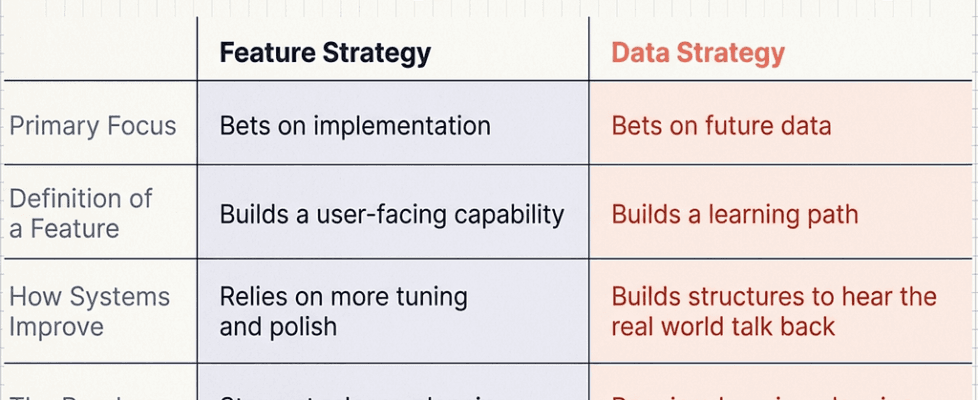
The central thesis, articulated in a piece from Towards AI, is a critical correction to how many companies approach AI product development. It argues that treating AI features like traditional software features—defined, built, launched, and improved through logic and implementation—is fundamentally misleading and limits potential.
In conventional software, a feature's success is largely determined by its design and code. In AI, a feature's success is equally dependent on a less visible but crucial component: its ability to generate and utilize data for continuous learning. Specifically, an AI product must be designed to discover what it does not know. It needs mechanisms to collect new examples, user corrections, and evidence of its own failures, then transform that data into improvements.
The article highlights a common failure mode: teams focus intensely on architecture, model selection, latency, cost, and UI, while neglecting to design the product to "expose its own weaknesses in a form that the company can learn from." This leads to a cycle of superficial fixes—prompt tuning, workflow changes, model swaps—that only buy time. The core ceiling remains because the system lacks the built-in capacity to learn in directions it wasn't designed to observe.
This is framed as the difference between a Feature Strategy and a Data Strategy. Every AI feature has a hidden half: the product's inherent ability to gather the data that will make that feature reliable in the real world.
Technical Details
The concept is less about a specific algorithm and more about a foundational product philosophy and system design pattern. It involves architecting for:
- Observability & Instrumentation: Building comprehensive logging to capture not just user inputs and model outputs, but also user corrections, implicit rejections (e.g., rephrasing a query), and edge-case interactions.
- Feedback Loops: Creating seamless, often passive, ways for users to provide corrective signals (e.g., "thumbs down," editing an AI-generated response) and ensuring those signals are cleanly routed to retraining or fine-tuning pipelines.
- Failure Discovery: Proactively designing interactions that reveal model uncertainty or ignorance, rather than allowing the system to confidently output incorrect information.
- Data Pipeline Integration: Treating the production application as the primary source of high-quality training data, necessitating robust data versioning, labeling, and curation workflows that are as integral as the application backend.
This approach shifts the product roadmap. Roadmap items become questions like: "How will this feature teach us?" and "What data do we need to capture to make this 20% better in six months?" rather than just "What will this feature do?"
Retail & Luxury Implications
For retail and luxury AI practitioners, this framework is acutely relevant. Many initiatives—personalized styling assistants, visual search for products, dynamic pricing engines, automated customer service, or sustainability impact trackers—are fundamentally AI products, not software features.
Concrete Scenarios:
- A Conversational Styling Agent: A feature strategy asks, "Can it recommend outfits based on a user's wardrobe?" A data strategy asks, "How will it learn when a recommendation is ignored or saved? How will it capture subtle feedback on style alignment (too bold, too safe)? How will it discover new, emerging micro-trends it doesn't yet recognize?" The product must be designed to gather this implicit and explicit feedback.
- Visual Search for Luxury Items: A feature strategy focuses on accuracy metrics on a test set. A data strategy focuses on building a system that logs all failed searches ("no results found" or user abandonment), analyzes the attributes of the query image (material, craftsmanship detail, logo placement) that confused the model, and uses that to prioritize new data collection for fine-tuning.
- AI-Generated Product Descriptions: The feature is the generation. The data strategy is the system that allows merchandisers to efficiently edit and approve descriptions, where every edit becomes a high-quality training example to improve tone, brand voice, and attribute highlighting for the next iteration.
The Gartner context reinforces this shift, predicting AI as a "collaborative partner." A true partner learns and adapts. For a luxury brand, an AI that collaborates with a personal shopper must learn from that shopper's overrides and refinements, building a shared, evolving understanding of client taste. This cannot be a static feature; it requires a data strategy embedded in the daily workflow.
The risk of ignoring this is building impressive but brittle AI capabilities that plateau quickly and cannot adapt to the nuanced, fast-evolving world of fashion and luxury consumer behavior. The opportunity is to build AI systems that grow more valuable and intimately aligned with the brand and its clients over time, turning every customer interaction into a learning opportunity.