Key Takeaways
- Orhan's Medium article recounts building user- and item-based collaborative filtering for movies, uncovering a subtle statistical bias in evaluation, and correcting it.
- Netflix's use of collaborative filtering underscores the technique's industry relevance.
What Happened
A. Orhan, writing on Medium, documents the process of building a user-based and item-based collaborative filtering recommender system for movies from scratch. The article's core value isn't the implementation itself — it's the discovery of a "subtle bias hiding in my results" and the subsequent fix.
The author describes the journey of implementing both collaborative filtering approaches, then encountering an evaluation result that looked too good to be true. The "statistical trap" refers to a flaw in how the recommendation quality was being measured, leading to inflated performance metrics that didn't reflect real-world usefulness.
While the article doesn't specify the exact nature of the bias in the summary (the full text is behind Medium's paywall), the framing — "almost fooled me" — is a familiar scenario for anyone who has evaluated recommender systems. Common traps include:
- Data leakage: Using test data during training or validation, accidentally including the target item in the candidate set.
- Popularity bias: Not accounting for the fact that recommending popular items trivially scores well on accuracy metrics but provides little personalization value.
- Temporal leakage: Using future data to predict past interactions, which inflates offline metrics but fails in production.
Technical Details
The article covers two core collaborative filtering techniques:
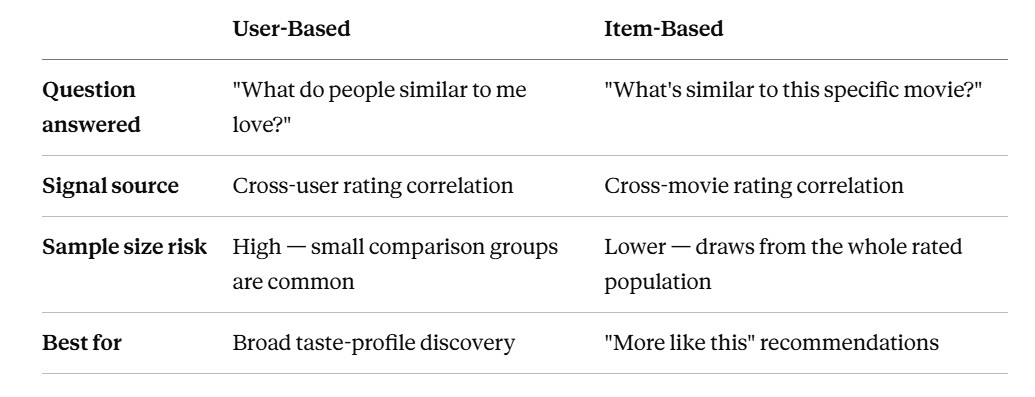
User-Based Collaborative Filtering: Finding users similar to the target user based on their rating history, then recommending items those similar users liked.
Item-Based Collaborative Filtering: Finding items similar to those the user has already rated or interacted with, then recommending those similar items. This approach is often more stable and computationally efficient than user-based methods, which is why Amazon and Netflix have favored it historically.
The "statistical trap" likely relates to how similarity scores or evaluation metrics were computed — for instance, using Pearson correlation on sparse rating matrices can produce misleadingly high similarity scores for users with very few overlapping ratings.
Retail & Luxury Implications
Collaborative filtering remains a foundational technique for retail recommendation engines. For luxury and fashion e-commerce, the stakes are higher than for movies: a poor recommendation not only loses a sale but can damage brand perception.
The statistical trap described in this article is directly transferable to retail scenarios:
- Basket-level recommendations: If your evaluation doesn't account for the fact that most customers buy from a narrow set of best-selling items, your offline metrics will look great while online conversion stays flat.
- New customer cold start: User-based CF fails for new customers with no purchase history. Item-based CF is generally more robust here, which is why it's the workhorse for most e-commerce platforms.
- Seasonal and trend effects: Luxury retail has strong seasonal patterns. If your validation split doesn't respect temporal boundaries, you'll leak "future" trend information into your training set and overestimate performance.
Business Impact
While the article provides no quantified business metrics, the lesson has clear cost implications. A recommender system that appears to perform well in offline evaluation but fails in production leads to:
- Wasted engineering time debugging live systems
- Lost revenue from poor recommendations
- Erosion of trust in the data science team's evaluation methodology
For retail teams, the takeaway is to invest in rigorous offline evaluation before deploying any recommender system. This includes:
- Using proper train/test splits that respect time
- Reporting multiple metrics (precision, recall, NDCG, coverage) rather than a single accuracy number
- Running A/B tests to validate offline findings
Implementation Approach
For a retail team building or evaluating collaborative filtering:
Choose the right algorithm: Start with item-based CF for its stability and interpretability. Matrix factorization (SVD, ALS) can improve accuracy but adds complexity.
Validate rigorously: Use time-based splits, not random splits. Include a holdout of recent interactions only.
Watch for the traps: Check for popularity bias (does your model just recommend bestsellers?), data leakage, and cold-start failures.
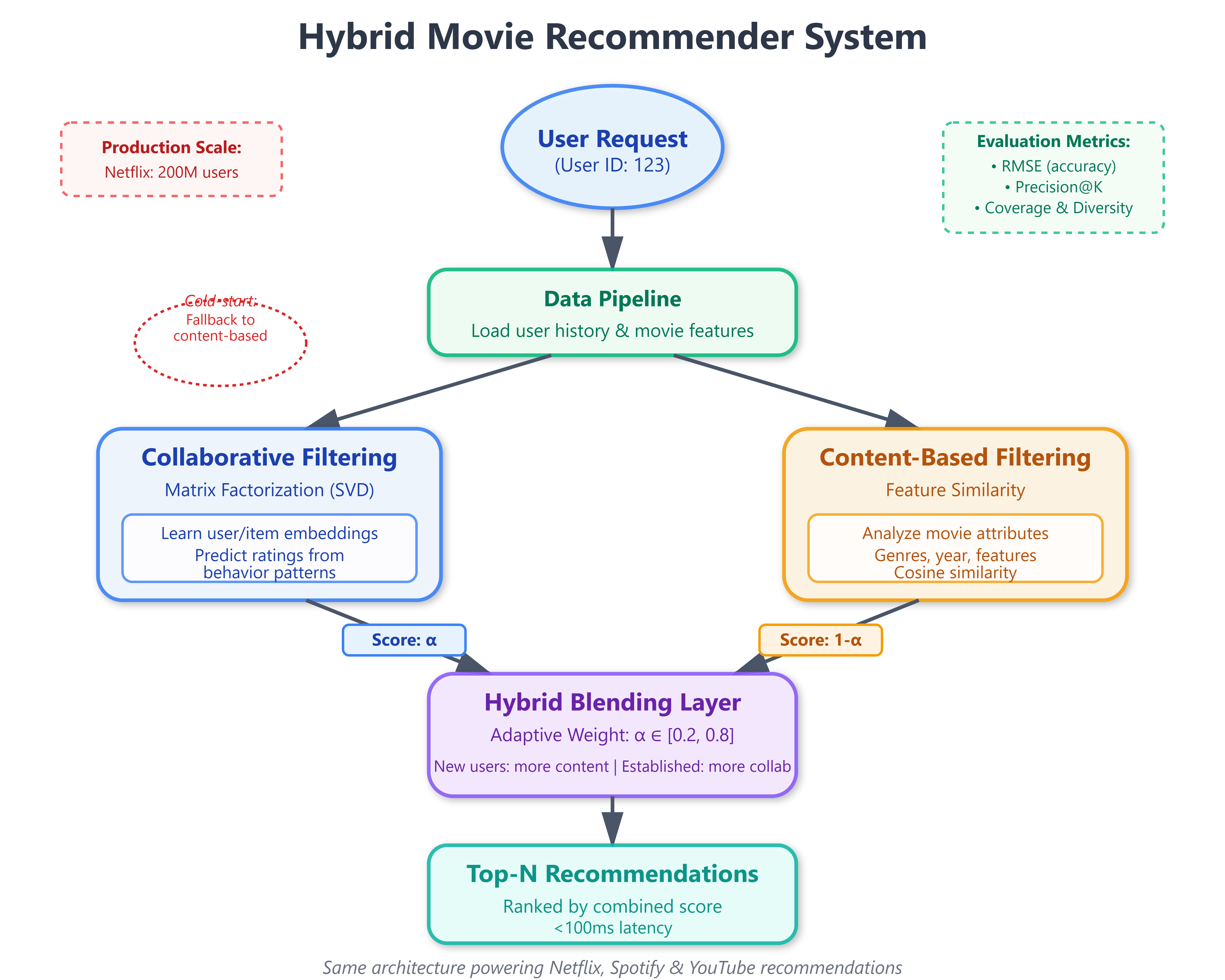
Consider hybrid approaches: Combine CF with content-based features (product attributes, brand, price point) for better coverage and personalization.
Governance & Risk Assessment
Recommender systems carry governance risks beyond statistical accuracy:
- Bias amplification: If your training data reflects historical biases (e.g., recommending only mainstream luxury items to certain demographics), CF will amplify them.
- Filter bubbles: Over-personalization can narrow customer discovery, which is particularly problematic for luxury brands that want to introduce customers to new collections.
- Transparency: Customers and regulators increasingly expect explainability. Item-based CF is more explainable ("because you bought X, we recommend Y") than deep learning approaches.
gentic.news Analysis
The Medium article is a useful, if modest, contribution to the recommender systems literature. Its value lies not in novelty but in the honest documentation of a common evaluation pitfall. For retail AI teams, it reinforces a critical operational lesson: offline metrics are necessary but not sufficient for deploying recommendation systems.
The broader context matters too. Netflix's long-standing use of collaborative filtering — as captured in our knowledge graph — demonstrates that even the most sophisticated companies rely on these foundational techniques. The difference between success and failure often comes down to evaluation rigor, not algorithmic sophistication.
For luxury retail specifically, the implications are amplified. The margin for error is smaller, the cost of a poor recommendation is higher (brand dilution), and the data is sparser (fewer transactions per customer). Teams should treat the statistical trap described here as one of many potential failure modes, and invest accordingly in robust evaluation infrastructure.
The article also serves as a reminder that recommender systems are not a solved problem. Even "simple" collaborative filtering can hide subtle biases that undermine performance. As retail AI teams scale their personalization efforts, maintaining evaluation discipline will be a competitive differentiator.
Source: medium.com