What Happened
A clear technical framework has emerged for designing multi-agent systems using Anthropic's Claude, distinguishing between two distinct architectural patterns: sub-agents and agent teams. The core argument is that developers should default to a single-agent architecture and only introduce multi-agent complexity when specific, measurable needs arise.
The Two Claude Multi-Agent Models
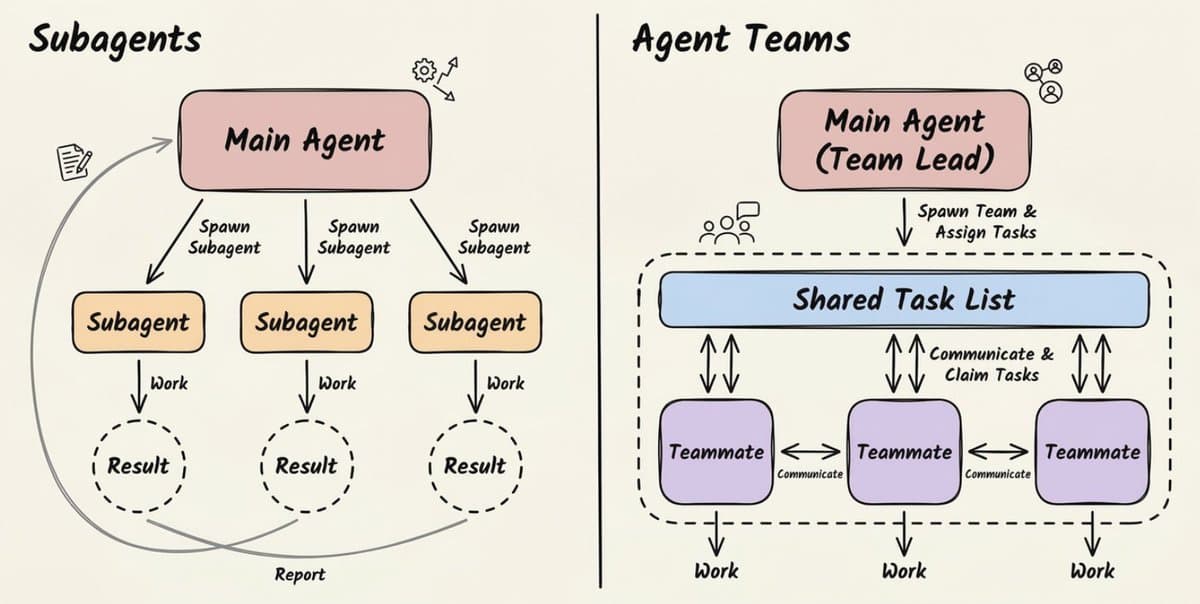
Claude Subagents are designed as isolated, fire-and-forget workers. They operate in parallel without communicating with each other, making them suitable for "embarrassingly parallel" tasks where work can be cleanly partitioned. Examples include batch processing of independent documents, parallel API calls to gather data, or generating multiple variations of a single output.
Claude Agent Teams consist of persistent instances that communicate as peers. This model is necessary for work requiring ongoing negotiation, iterative refinement, or complex handoffs between specialized capabilities. Think of a software development team where a planner, coder, and reviewer need to discuss and pass work back and forth.
Key Design Principle: Split by Context, Not Role
The framework emphasizes a critical architectural rule: split work by context, not by role. Handoffs between agents inherently degrade quality and introduce coordination overhead. Therefore, the optimal split is one where each agent operates on a fully independent context or data partition. If agents must share context or state, they should be designed as a communicating team, not as a sequential pipeline of isolated subagents.
When to Use Multi-Agent Systems
The guidance is pragmatic: start with a single, well-prompted Claude agent. Multi-agent systems only justify their added cost and complexity when one of three specific conditions is met:
- Context Protection: When different parts of a task require mutually exclusive context (e.g., analyzing competing companies where knowledge of one could bias analysis of the other).
- True Parallelism: When task latency is critical and work can be performed simultaneously on independent data units.
- Conflicting Specializations: When a task requires deep expertise in domains that are difficult to prompt into a single agent's context window effectively.
The conclusion is that better prompting, tool use, and chain-of-thought reasoning on a single agent will often outperform an unnecessarily elaborate multi-agent pipeline.