What Happened
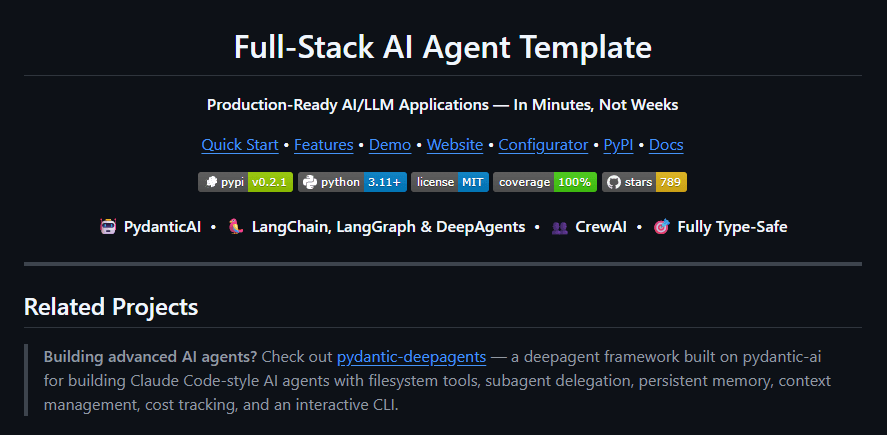
Developer account @_vmlops has announced the release of fastapi-fullstack, a production-ready, open-source template for building and deploying full-stack AI agent applications. The template is designed to eliminate the initial setup complexity for developers looking to ship agent-based systems.
The core offering is a pre-configured stack combining:
- FastAPI as the Python backend.
- Next.js as the React-based frontend.
- A choice of AI agent frameworks: PydanticAI, LangChain/LangGraph, or CrewAI/DeepAgents.
According to the announcement, the template comes with several key production features configured:
- WebSocket streaming for real-time AI responses.
- Authentication system.
- Support for multiple databases.
- 20+ integrations pre-configured.
Installation is via pip: pip install fastapi-fullstack. The project's repository is linked from the announcement post.
Context
Building a production-grade AI application involves stitching together numerous components beyond the core model or agent logic: backend APIs, frontend interfaces, real-time communication, user management, data persistence, and third-party service integrations. This infrastructure work is repetitive and time-consuming, often diverting focus from the unique agent logic.
Templates and starter kits like this aim to standardize the "plumbing" so developers can start with a working, deployable system. The explicit support for multiple agent frameworks (PydanticAI for structured LLM calls, LangGraph for stateful multi-agent workflows, CrewAI for role-based agents) indicates the template is designed to be agnostic to the specific agent architecture a team chooses to implement.
The inclusion of WebSocket streaming is a critical feature for modern AI apps, where LLM responses are typically streamed token-by-token to the UI to improve perceived performance. Having this, along with auth and multi-DB support, configured "out of the box" significantly reduces the initial development hurdle.