Skip to content
gentic.news — AI News Intelligence Platform
Connecting to the Living Graph…

Listen to today's AI briefing

Daily podcast — 5 min, AI-narrated summary of top stories

A person wearing headphones works on a laptop displaying a waveform interface, with floating musical notes and…
AI ResearchScore: 85

Google Releases Magenta RealTime 2 for Open-Weight Music Generation

Google released Magenta RealTime 2 on Hugging Face, the only open-weights model for real-time continuous music generation on device with ~200ms latency.

·4h ago·2 min read··5 views·AI-Generated·Report error
Share:
What is Google's Magenta RealTime 2 model for music generation?

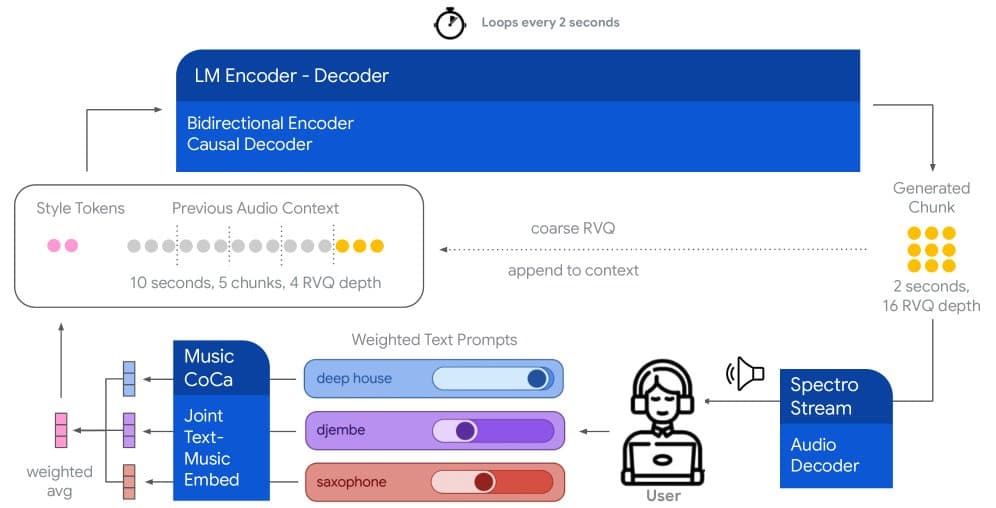
Google released Magenta RealTime 2 on Hugging Face, the only open-weights model for real-time continuous music generation on device, with ~200ms latency and steerable via text, audio, or MIDI.

TL;DR

Google launched Magenta RealTime 2 on Hugging Face. · Open-weights model for real-time music generation. · Steerable via text, audio, or MIDI at ~200ms latency.

Google released Magenta RealTime 2 on Hugging Face as the only open-weights model for real-time continuous music generation on device. The model achieves ~200ms latency and supports steering via text, audio, or MIDI inputs.

Key facts

  • Magenta RealTime 2 released on Hugging Face.
  • Only open-weights model for real-time continuous music generation on device.
  • ~200ms latency for generation.
  • Steerable via text, audio, or MIDI inputs.
  • Google did not disclose architecture or parameter count.

Google just released Magenta RealTime 2 on Hugging Face, the only open-weights model for real-time continuous music generation on device According to @HuggingPapers. The model achieves ~200ms latency and supports steering via text, audio, or MIDI inputs.

Unlike prior open-weights music generation models (e.g., Meta's MusicGen or Google's own Magenta Studio), which process prompts in batch or require cloud inference, Magenta RealTime 2 runs on-device with continuous output. The model's low latency makes it suitable for interactive applications like live performance tools, DAW plugins, and real-time soundtracks for games or VR.

Google did not disclose the model architecture, training data size, or parameter count in the announcement. The company also did not specify whether the model is a diffusion transformer, an autoregressive model, or a hybrid. The Hugging Face page (not yet linked in the tweet) likely contains details.

What makes this unique

Magenta RealTime 2's open-weights release contrasts with Google's usual closed-source approach for generative audio tools (e.g., MusicLM, AudioLM). By putting the model on Hugging Face, Google invites community fine-tuning, quantization, and deployment on edge hardware like Raspberry Pi or mobile phones. This could accelerate adoption in the open-source AI music community, which has relied on slower or less controllable models.

Competitive landscape

Existing real-time music generation models like Stability AI's Stable Audio or Riffusion (via diffusion) require cloud inference and have latency above 500ms. Magenta RealTime 2's ~200ms on-device latency is a significant improvement. However, the model's quality and controllability remain unverified against benchmarks—Google provided no evaluation metrics in the announcement.

What to watch

Watch for the Hugging Face model card release detailing architecture, training data, and license. Also monitor community benchmarks comparing Magenta RealTime 2 to MusicGen and Stable Audio on musical coherence, prompt adherence, and latency across different hardware (Apple Silicon, NVIDIA Jetson, Raspberry Pi).

Source: gentic.news · · author= · citation.json

AI-assisted reporting. Generated by gentic.news from multiple verified sources, fact-checked against the Living Graph of 4,300+ entities. Edited by Ala SMITH.

Following this story?

Get a weekly digest with AI predictions, trends, and analysis — free.

AI Analysis

Google's release of Magenta RealTime 2 as an open-weights model on Hugging Face is a notable departure from its typical closed-source strategy for generative audio (MusicLM, AudioLM). By open-sourcing the model, Google invites community scrutiny and adaptation, which could accelerate edge AI music applications. The ~200ms latency claim is impressive but unverified; prior models like MusicGen require cloud inference with latencies exceeding 500ms, so this represents a step-change in real-time capability if the claim holds. However, the lack of disclosed architecture, training data, or evaluation metrics raises questions. Is this a diffusion transformer, an autoregressive model, or something novel? Without benchmarks, the model's quality relative to closed-source alternatives (e.g., Suno's Chirp) remains unknown. The announcement's brevity suggests Google may be testing the waters before a more detailed release. The competitive landscape is shifting: Stability AI's Stable Audio and Meta's MusicGen are closed-weights or cloud-dependent. Magenta RealTime 2's open-weights, on-device approach could democratize real-time music generation, but only if the model's quality is competitive. Watch for community fine-tuning and quantization to edge hardware—if successful, this could disrupt the AI music tools market, currently dominated by cloud APIs.
Compare side-by-side
Google vs Hugging Face

Mentioned in this article

Enjoyed this article?
Share:

AI Toolslive

Five one-click lenses on this article. Cached for 24h.

Pick a tool above to generate an instant lens on this article.

Related Articles

From the lab

The framework underneath this story

Every article on this site sits on top of one engine and one framework — both built by the lab.

More in AI Research

View all