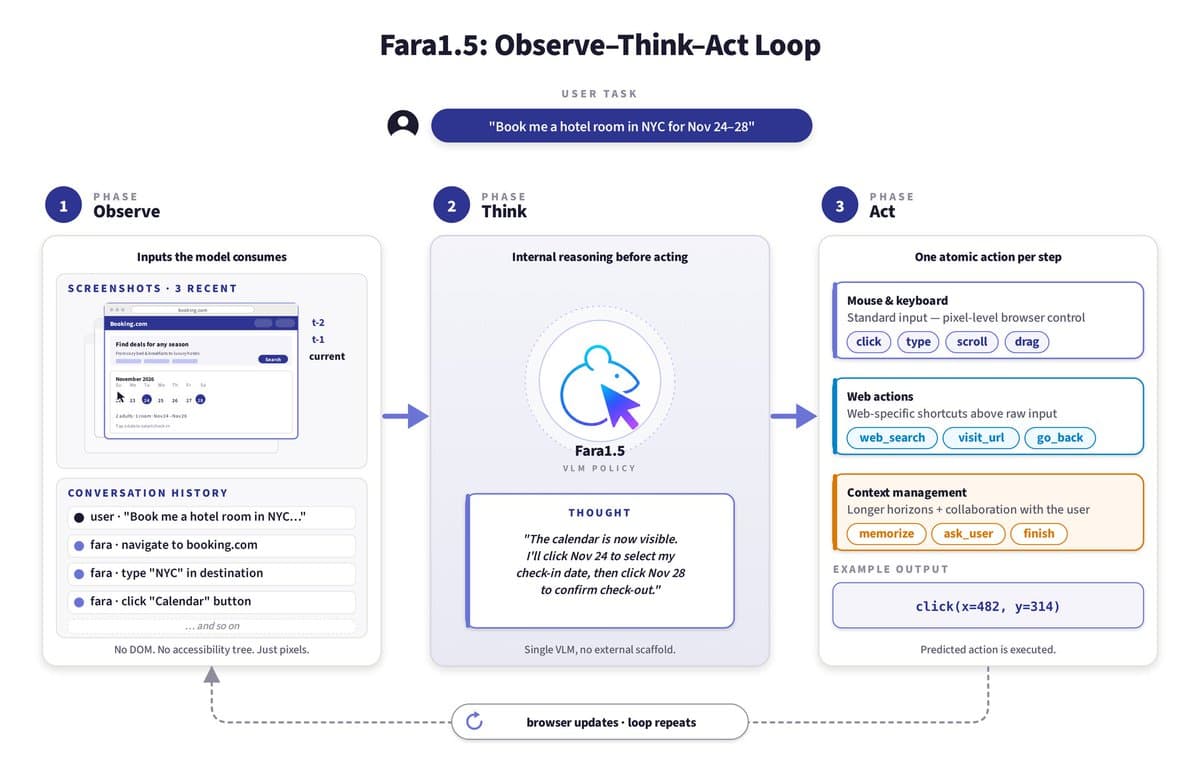
Microsoft released Fara1.5-27B on Hugging Face, a vision-only computer use agent for web browsers. The 27B-parameter model scores 72.3% on the Online-Mind2Web benchmark.
Key facts
- 27B parameter model released on Hugging Face
- 72.3% on Online-Mind2Web benchmark
- Vision-only, no HTML or DOM parsing
- Open-source weights and inference code
Microsoft released Fara1.5-27B on Hugging Face, a vision-only computer use agent for web browsers. The 27B-parameter model scores 72.3% on the Online-Mind2Web benchmark. According to @HuggingPapers
Architecture and Approach
Fara1.5-27B operates solely on visual input — screenshots of the browser — without requiring structured HTML, accessibility trees, or DOM parsing. This mirrors the approach taken by earlier computer-use agents like Apple's Ferret-UI and Anthropic's computer-use mode for Claude, but with a focus on web browsing rather than general UI navigation.
The model is released under an open-source license on Hugging Face, with weights and inference code available. Microsoft did not disclose the training dataset size, compute budget, or training methodology beyond the model card.
Benchmark Context
Online-Mind2Web is an evaluation framework that measures end-to-end task completion on live websites, not static traces. A 72.3% success rate means the model correctly completes roughly 7 out of 10 web browsing tasks from scratch. For comparison, prior state-of-the-art results on this benchmark have hovered around 60-65% for similarly sized models, though direct apples-to-apples comparison is complicated by the dynamic nature of live web tasks.
The vision-only approach avoids the brittleness of HTML-parsing agents that break when websites change their DOM structure. However, it also introduces latency and resolution constraints from screenshot processing.
Implications for Open-Source Agents
Fara1.5-27B joins a growing ecosystem of open-source computer-use agents, including CogAgent (9B, from Tsinghua University) and WebGPT (OpenAI, not open-source). The release makes a competitive web-browsing agent available to researchers and developers without API costs or rate limits.
Microsoft has not published comparative results against closed-source alternatives like Claude's computer-use mode or GPT-4 with vision. The company's blog post says the model targets "research and prototyping use cases" rather than production deployment.
What to watch
Watch for independent replication of the 72.3% score by third parties, and for Microsoft to release a technical report detailing training data and compute. Also track whether the model generalizes to non-English websites or dynamic single-page apps.