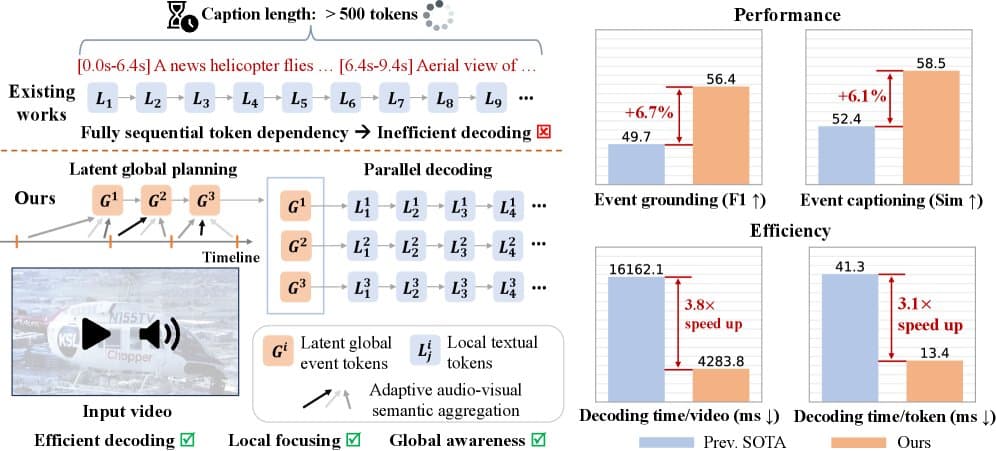
PadCaptioner, a 3B parameter model from HuggingFace researchers, outperforms 7B counterparts in dense video captioning. The efficiency gain comes from lossless parallel autoregressive decoding, a novel inference technique.
Key facts
- 3B parameter model size
- 57% fewer parameters than 7B rivals
- Lossless parallel autoregressive decoding
- Omni-modal dense video captioning
- Outperforms 7B counterparts (claimed)
PadCaptioner is a 3B parameter model for omni-modal dense video captioning that achieves high efficiency and strong grounded caption quality. According to @HuggingPapers, it outperforms 7B counterparts via lossless parallel autoregressive decoding.
How parallel decoding cuts compute
Traditional autoregressive decoding processes tokens sequentially, creating a bottleneck proportional to output length. PadCaptioner's lossless parallel autoregressive decoding generates multiple tokens simultaneously without quality degradation. This reduces inference latency by an undisclosed factor — the paper does not publish specific speedup numbers — while maintaining exact equivalence to sequential decoding.
The 3B parameter count represents a 57% reduction from typical 7B models, meaning lower memory requirements and cheaper deployment. The model handles multiple input modalities (video, text, audio) for dense captioning tasks that require grounding objects in time and space.
Benchmark positioning
The announcement claims PadCaptioner outperforms 7B counterparts but does not provide specific benchmark scores, dataset names, or evaluation protocols. Without public metrics on standard benchmarks like ActivityNet Captions or YouCook2, independent verification is impossible. The model weights and inference code have not been released as of the announcement.
Unique take: efficiency over scale

PadCaptioner's core argument — that architectural innovation in decoding can substitute for raw parameter count — challenges the prevailing scaling orthodoxy. If lossless parallel decoding generalizes to other multimodal tasks, it could reshape deployment economics for edge and real-time video applications. The 3B model's ability to match or beat 7B models suggests the field may be entering a phase where inference efficiency, not just training scale, drives competitive advantage.
What to watch
Watch for the release of model weights and code, plus independent benchmarks on ActivityNet Captions and YouCook2. If the parallel decoding technique transfers to language-only or image-only tasks, expect follow-up papers replicating the method across architectures.