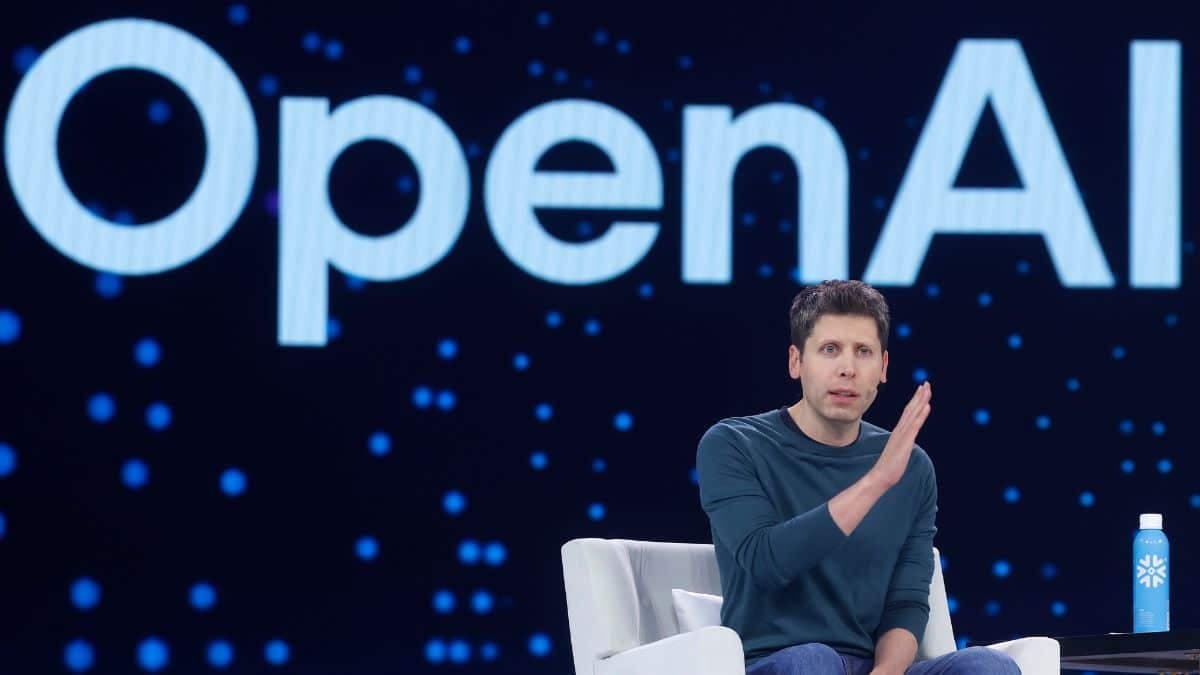
In a brief but telling comment, OpenAI CEO Sam Altman indicated the company is undergoing a significant strategic pivot driven by internal progress. Speaking at an event, Altman stated that OpenAI has reached a point where it has stopped "a bunch of other projects" to focus resources on a development that is "working or about to work so well."
Key Takeaways
- Sam Altman revealed OpenAI has stopped several projects to concentrate on a significant, unforeseen AI advancement.
- This suggests a recent internal development is exceeding expectations.
What Happened

Altman's remarks, shared via a social media post, were candid about the pace of advancement. "We have a few times in our history realized something really important is working or about to work so well that we have to stop a bunch of other projects," he said. He added a key detail on timing: "I did not expect 3 or 6 months ago to be at the point we're at now."
This pattern of halting side projects to concentrate firepower on a core breakthrough is not new for OpenAI. The company famously pivoted resources to develop ChatGPT, leading to its viral launch in November 2022. Altman's framing suggests a similar, internally significant inflection point has been reached more recently.
Context
The comment is intentionally vague, offering no specifics on the nature of the breakthrough—whether it's a new model architecture (like a successor to GPT-4), a fundamental improvement in reasoning, a dramatic reduction in training costs, or a novel AI capability. However, the implication is clear: an internal project has demonstrated such promising results that it warrants a reallocation of the company's entire development portfolio.
This comes amid intense competition in the frontier AI landscape. In recent months, Anthropic launched Claude 3.5 Sonnet, Google DeepMind unveiled Gemini 2.0, and xAI open-sourced Grok-2. OpenAI's last major model release was GPT-4o in May 2024, over two years ago. The pressure to maintain technological leadership is acute.
gentic.news Analysis

Altman's statement is a classic signal in high-stakes R&D: when a project shows exponential promise, you starve other initiatives to feed it. The key takeaway isn't just that something is working—it's that its success was unexpectedly rapid just a quarter or two ago. This suggests a non-linear improvement, possibly in scaling laws, algorithmic efficiency, or a novel capability unlock.
Historically, OpenAI has used this "all-in" strategy for transformative bets. The development of GPT-3 and the subsequent pivot to ChatGPT are prime examples. This new pivot likely follows the company's established pattern of pursuing a few, high-conviction trajectories once early results surpass a critical threshold. The mention of this happening "a few times in our history" directly references those prior strategic consolidations.
For the competitive landscape, this is a warning flare. If OpenAI is deprioritizing other projects, it believes it has a line-of-sight to a capability or product that could significantly widen its moat. Competitors like Anthropic (with its Constitutional AI focus) and Google DeepMind (with its Gemini family) have been closing the perceived gap. Altman's comment is as much an internal rallying cry as it is an external signal of renewed momentum.
Practitioners should watch for two things: a potential acceleration in OpenAI's release cycle (contrary to its recent slower pace), and the possible shape of the breakthrough. Is it raw capability (a GPT-5-class model), agentic reasoning, multimodality, or cost reduction? The project halt suggests the answer is foundational enough to require a company-wide refocus.
Frequently Asked Questions
What did Sam Altman actually say?
He stated that OpenAI has, at a few points in its history, realized something important is working so well that it has to stop other projects. He added that he did not expect to be at this point 3-6 months ago, indicating unexpectedly rapid progress on a key initiative.
What could the OpenAI breakthrough be?
While not specified, potential areas include a next-generation large language model (e.g., GPT-5), a major leap in AI reasoning or planning capabilities, a breakthrough in AI safety or alignment that enables safer deployment of more powerful systems, or a dramatic reduction in the cost of training or running frontier models.
Why would OpenAI stop other projects?
In resource-constrained R&D environments, when one project demonstrates disproportionately high potential for success or impact, it is a common strategic decision to reallocate engineers, compute, and capital to that project to accelerate its development and maximize the chance of a market-defining breakthrough.
How does this affect the AI competitive landscape?
If OpenAI is consolidating resources behind a major advance, it signals an attempt to create a significant new advantage over competitors like Anthropic, Google DeepMind, and xAI. This could pressure those firms to make similar strategic pivots or risk falling behind in the next wave of capability releases.