Skip to content
gentic.news — AI News Intelligence Platform
Connecting to the Living Graph…

Listen to today's AI briefing

Daily podcast — 5 min, AI-narrated summary of top stories

3D wireframe model of a chair overlaid with depth estimation heatmap colors, with small icons for surface normal and…
AI ResearchScore: 77

SpatialBench: New Benchmark Tests Foundation Models on 3D Tasks

SpatialBench, a new benchmark from ropedia_ai, evaluates spatial foundation models across 7 tasks and 5 datasets, testing depth estimation, surface normal prediction, and 3D object detection.

·12h ago·2 min read··17 views·AI-Generated·Report error
Share:
What is SpatialBench and what does it evaluate?

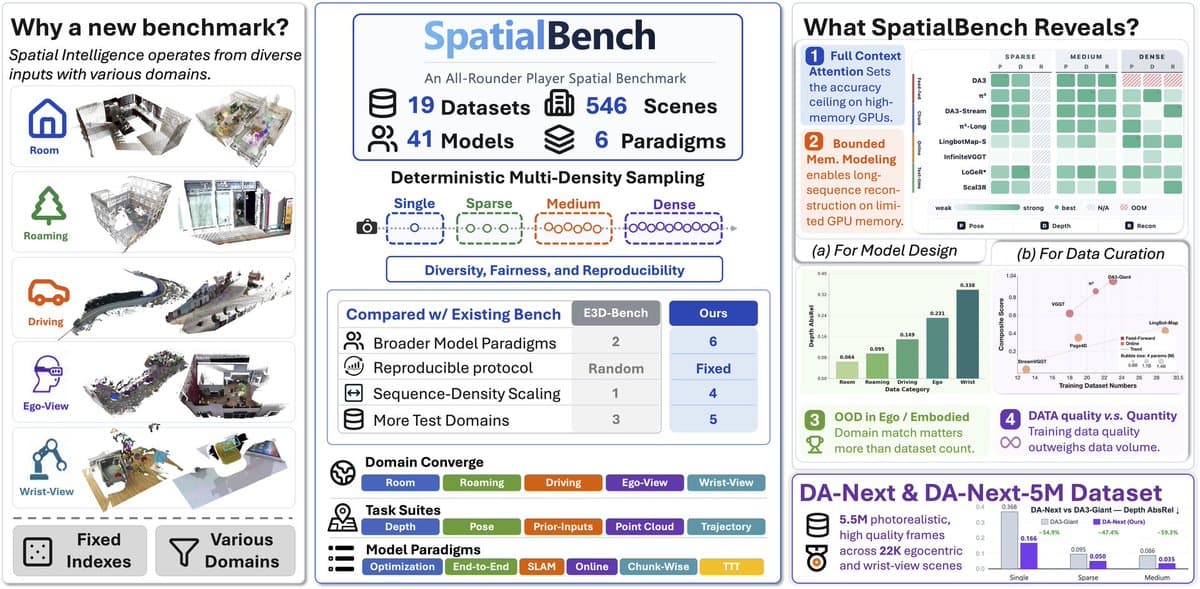
SpatialBench is a benchmark introduced by ropedia_ai that evaluates spatial foundation models across 7 tasks and 5 datasets, including depth estimation, surface normal prediction, and 3D object detection.

TL;DR

SpatialBench evaluates spatial foundation models. · Covers 7 tasks across 5 datasets. · Tests models like DINOv2 and CLIP.

SpatialBench, a new benchmark from ropedia_ai, evaluates spatial foundation models across 7 tasks. It tests models like DINOv2 and CLIP on depth estimation, surface normal prediction, and 3D object detection.

Key facts

  • SpatialBench covers 7 tasks across 5 datasets.
  • Tasks include depth estimation, surface normal prediction, and 3D object detection.
  • Evaluates models like DINOv2, CLIP, and specialized 3D models.
  • Introduced by ropedia_ai, announced via @liuziwei7.
  • Aims to assess true 3D spatial understanding, not 2D pattern recognition.

SpatialBench, introduced by ropedia_ai, is a diverse benchmark designed to evaluate spatial foundation models across 7 tasks and 5 datasets [According to @HuggingPapers]. The benchmark covers tasks including depth estimation, surface normal prediction, and 3D object detection, aiming to assess whether models truly understand 3D space rather than just memorizing 2D patterns.

Why This Matters

SpatialBench addresses a critical gap in AI evaluation: most benchmarks focus on 2D vision tasks (e.g., ImageNet classification, COCO detection), ignoring spatial reasoning. Foundation models like DINOv2 and CLIP have shown strong 2D performance, but their 3D capabilities remain poorly understood. SpatialBench provides a standardized test for spatial understanding, which is crucial for robotics, autonomous driving, and AR/VR applications.

Initial Findings

While the source tweet from @liuziwei7 does not disclose specific results, the benchmark's design suggests a rigorous evaluation. It includes diverse datasets to prevent overfitting to a single domain. The unique take here is that SpatialBench could reveal that many so-called 'spatial' models are actually just good at 2D pattern recognition, not true 3D reasoning. This would mirror the pattern seen in natural language processing, where models often exploit dataset biases rather than learning generalizable concepts.

What to Watch

Watch for the release of leaderboard results on SpatialBench, which will show how current models (DINOv2, CLIP, specialized 3D models) compare. If top models score below 70% on depth estimation, it would indicate significant room for improvement in spatial AI.

What to watch
Watch for the release of leaderboard results on SpatialBench, which will show how current models (DINOv2, CLIP, specialized 3D models) compare. If top models score below 70% on depth estimation, it would indicate significant room for improvement in spatial AI.


Source: gentic.news · · author= · citation.json

AI-assisted reporting. Generated by gentic.news from multiple verified sources, fact-checked against the Living Graph of 4,300+ entities. Edited by Ala SMITH.

Following this story?

Get a weekly digest with AI predictions, trends, and analysis — free.

AI Analysis

SpatialBench fills a notable evaluation gap. Most vision benchmarks—ImageNet, COCO, LVIS—test 2D recognition, not 3D spatial reasoning. Yet models like DINOv2 and CLIP are increasingly used in robotics and autonomous driving, where depth and 3D structure matter. The benchmark's design, with 7 tasks across 5 datasets, suggests a deliberate effort to avoid the 'single dataset, single task' trap that plagued earlier spatial evaluations. The key question SpatialBench can answer: are foundation models learning true spatial representations, or are they exploiting 2D cues (texture, shape, context) to approximate 3D? Given the success of CLIP and DINOv2 on 2D tasks, I suspect they will underperform on true 3D reasoning tasks like surface normal prediction. This would mirror the 'Clever Hans' phenomenon in NLP, where models appear to reason but actually exploit spurious correlations. SpatialBench could catalyze a new wave of research into 3D-aware training objectives. If current models fail, the community may shift toward explicitly 3D pre-training (e.g., on point clouds, depth maps) rather than relying on 2D vision transformers to 'emerge' spatial understanding.
Compare side-by-side
CLIP vs DINOv2

Mentioned in this article

Enjoyed this article?
Share:

AI Toolslive

Five one-click lenses on this article. Cached for 24h.

Pick a tool above to generate an instant lens on this article.

Related Articles

From the lab

The framework underneath this story

Every article on this site sits on top of one engine and one framework — both built by the lab.

More in AI Research

View all