A Unitree G1 humanoid robot was filmed operating autonomously on public sidewalks in New York City, marking a notable public demonstration of real-world bipedal mobility and human-robot interaction.
The video, shared by AI researcher Rohan Paul, shows the robot navigating an urban environment, maintaining balance on uneven pavement, and reportedly interacting with children. The footage represents a shift from controlled lab or stage demos to unscripted operation in a complex, public setting.
What Happened
The core event is a public field test. The Unitree G1 robot was deployed outdoors in New York City, where it was observed:
- Navigating Public Infrastructure: Walking on standard sidewalks, handling potential obstacles like cracks, slopes, and street furniture.
- Demonstrating Dynamic Stability: Maintaining its gait and balance without a safety tether or immediate human intervention visible in the frame.
- Engaging in Social Interaction: The source text states the robot was "playing with children," indicating a level of social AI or teleoperation designed for public engagement.
This is a functional demonstration, not a controlled product launch or a peer-reviewed research breakthrough. Its significance lies in the venue and the apparent robustness of the system.
Context: The Unitree G1 and the Humanoid Race
Unitree, primarily known for its highly dynamic quadruped robots like the Go1 and H1, unveiled the G1 humanoid in April 2024. The G1 is positioned as a lower-cost, highly agile alternative to premium models from Boston Dynamics (Atlas) and Tesla (Optimus).
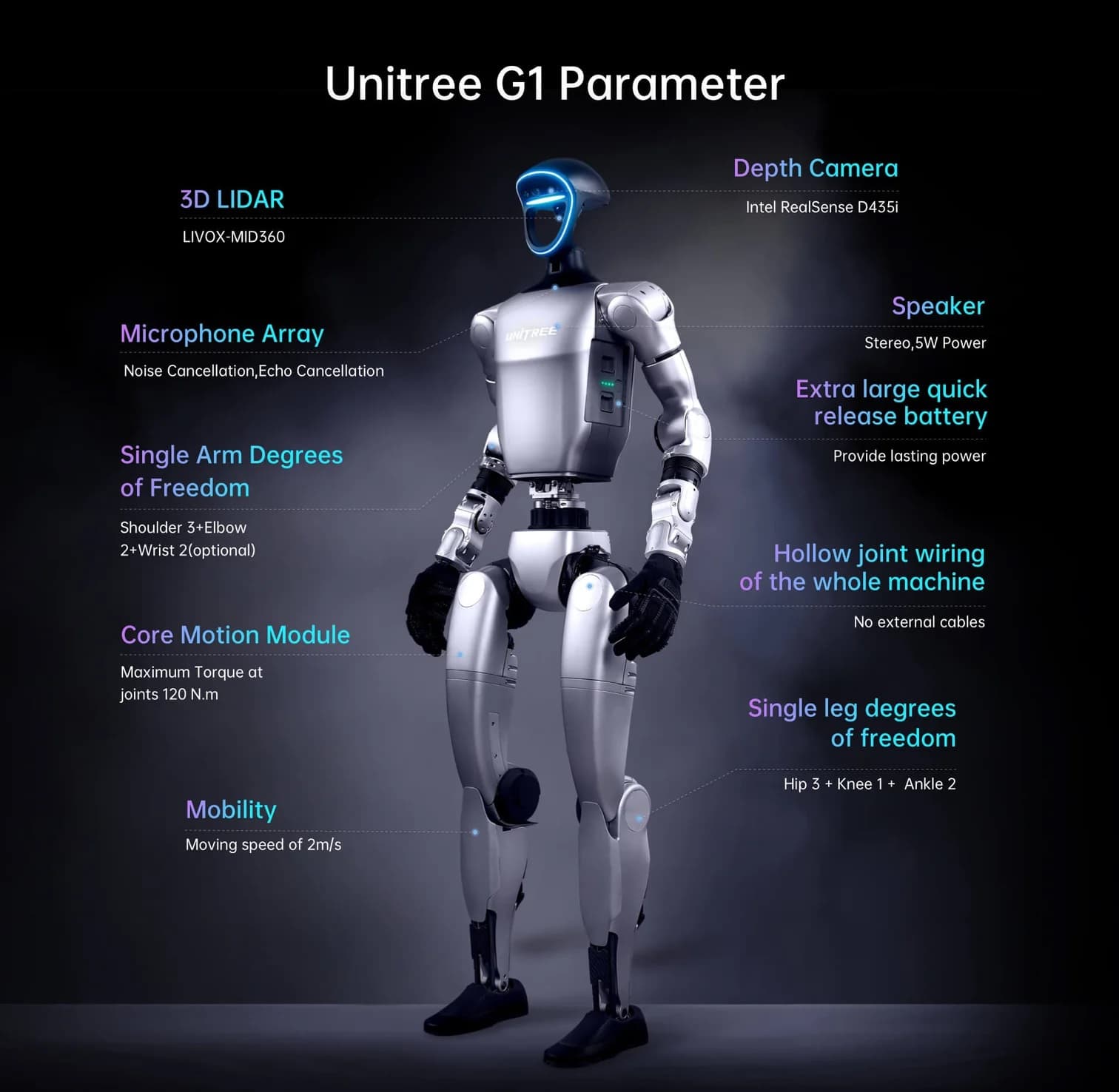
Key technical specs of the G1, from its launch, include:
- Price: Targeted under $100,000.
- Agility: Capable of dynamic movements, getting up from falls, and reportedly a top speed of 2 m/s.
- Payload: Can carry up to 30 kg.
- Actuation: Uses electric actuators, contrasting with hydraulic systems used in some competitors.
The NYC sighting follows a pattern of increasing public demos by humanoid firms. Tesla has shown Optimus performing factory tasks, Boston Dynamics has released highly choreographed agility videos, and companies like Figure have demonstrated end-to-end neural network control. Unitree's move to a busy city street is a distinct stress test focused on environmental unpredictability and public perception.
gentic.news Analysis
This NYC demo is a strategic milestone in the humanoid robotics roadmap, emphasizing real-world validation over laboratory metrics. While the statement "AGI has arrived" is hyperbolic clickbait—the robot is almost certainly running specialized locomotion and interaction models, not a general intelligence—the event is significant for three concrete reasons.
First, it tests the social layer of autonomy. Navigating a lab is a physics problem; navigating a sidewalk where humans, especially children, may approach unpredictably is a socio-technical challenge. This demo implicitly tests human reaction and basic interactive protocols, a necessary step for any future commercial deployment in human spaces. It follows the trend we noted in our coverage of Figure AI's partnership with BMW, where real-world integration into human environments is the new benchmark.
Second, it underscores Unitree's go-to-market strategy. By leveraging its expertise in cost-effective, electric actuation from the quadruped space, Unitree is pushing the G1 as a practical, affordable platform. This public stress test serves as a powerful marketing tool to differentiate from competitors who primarily show videos from controlled environments. It aligns with the broader industry trend of shifting from research prototypes to commercialization, a trend highlighted by the massive $675 million Series B raised by Figure AI in February 2024.
Finally, the location is deliberate. A successful demo in New York—with its dense crowds, media scrutiny, and regulatory awareness—generates disproportionate visibility and credibility. It's a signal to investors, potential partners, and the public that the technology is maturing beyond the garage. The next critical watchpoint will be the publication of any quantitative data from this test, such as mean time between falls, interaction success rates, or detailed sensor logs, to move the conversation from spectacle to engineering.
Frequently Asked Questions
What is the Unitree G1 robot?
The Unitree G1 is a humanoid robot developed by Chinese robotics company Unitree. Unveiled in April 2024, it is designed to be a lower-cost, highly agile humanoid platform using electric actuators, with a target price below $100,000. It is known for its dynamic movement capabilities, including getting up from falls and carrying payloads.
Was the Unitree robot in NYC fully autonomous?
The video does not provide technical details on the level of autonomy. It likely operates using a combination of onboard perception and control algorithms for locomotion, but the interaction with children could involve elements of teleoperation or pre-scripted social behaviors. Full, unsupervised general-purpose autonomy (AGI) is not demonstrated or claimed by the manufacturer.
Why is testing a robot on a public street significant?
Testing on a public street is a major step up in difficulty from lab or factory floor demos. It requires the robot to handle unpredictable terrain, obstacles, and human behavior in real-time. Successfully navigating this environment is a strong indicator of the system's robustness and a necessary proof point for any future application in human-centric spaces like retail, hospitality, or public services.
How does the Unitree G1 compare to Boston Dynamics' Atlas or Tesla's Optimus?
The G1 is positioned as a more affordable, electrically-actuated alternative. Boston Dynamics' Atlas is a research platform focused on extreme agility using hydraulic power. Tesla's Optimus is designed for scalable manufacturing and autonomy. The G1 competes on price and practical mobility, as demonstrated by this public street test, whereas Atlas showcases peak performance and Optimus emphasizes AI integration and mass production.