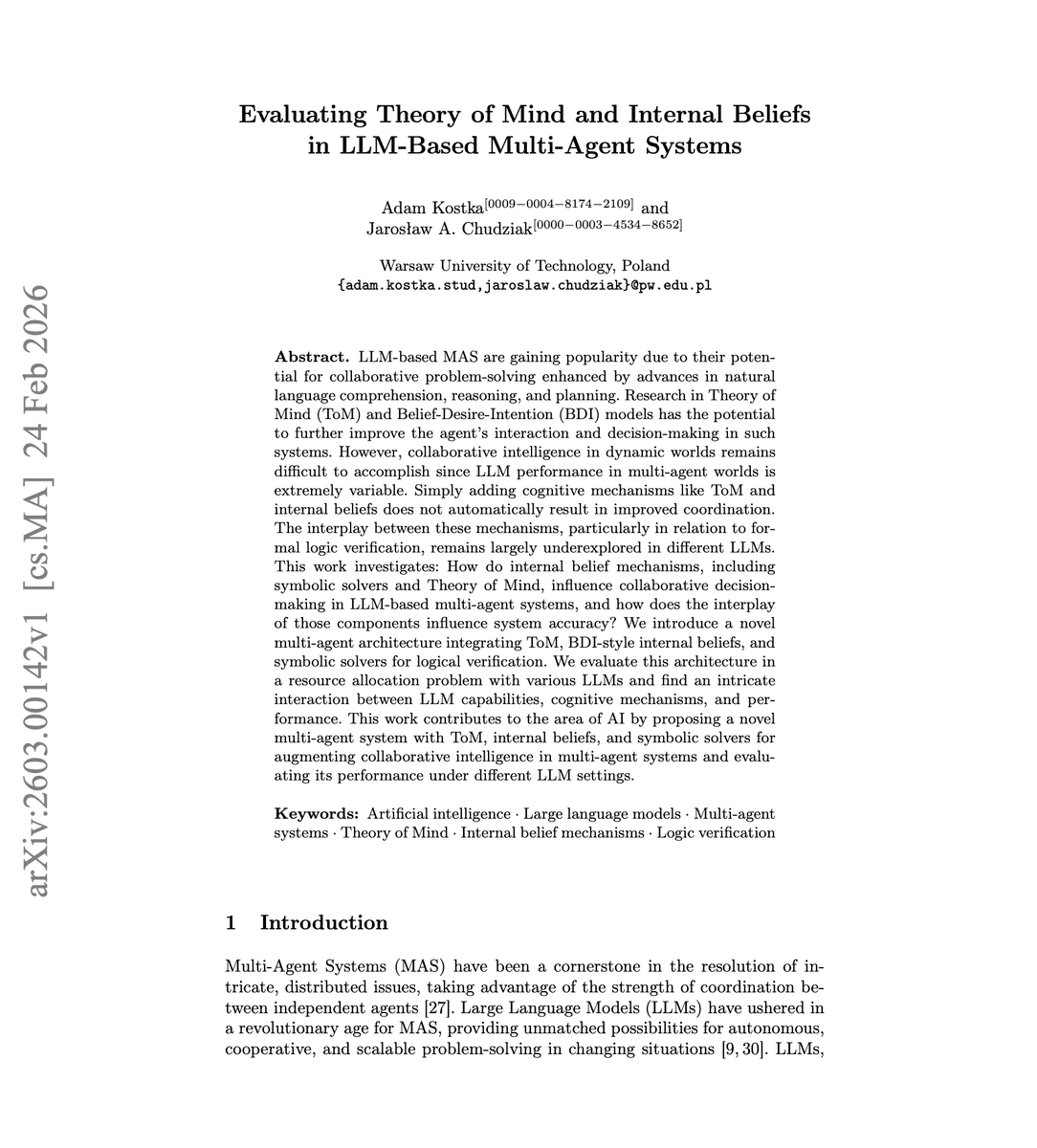
As artificial intelligence systems evolve from single models to complex multi-agent architectures, researchers face a fundamental challenge: how do we get AI agents to effectively coordinate when they need to understand each other's beliefs, intentions, and mental states? A groundbreaking study published in "Theory of Mind in Multi-agent LLM Systems" reveals that the answer is far more complex than simply adding cognitive mechanisms to large language models.
The Architecture: Blending Cognitive Science with AI
The research introduces a sophisticated multi-agent architecture that combines three key components: Theory of Mind (ToM), Belief-Desire-Intention (BDI) models, and symbolic solvers for logical verification. This represents a significant departure from traditional approaches that treat LLMs as isolated entities.
Theory of Mind refers to the ability to attribute mental states—beliefs, intents, desires, knowledge—to oneself and others, and to understand that others have beliefs, desires, and intentions that are different from one's own. In human psychology, this capability develops in early childhood and is fundamental to social interaction.
Belief-Desire-Intention models provide a formal framework for representing and reasoning about agents' mental states. Beliefs represent what an agent thinks is true about the world, desires represent what the agent wants to achieve, and intentions represent the plans the agent commits to executing.
Symbolic solvers add a layer of logical verification, allowing the system to check for consistency in beliefs and intentions across agents, potentially identifying contradictions or coordination failures before they manifest in behavior.
The Surprising Findings: No Guaranteed Benefits
The most striking finding from the research is that "cognitive mechanisms like ToM don't automatically improve coordination." This challenges a fundamental assumption in multi-agent AI research: that giving agents the ability to model each other's mental states would naturally lead to better collaborative outcomes.
Instead, the researchers discovered "a complex interdependency where cognitive mechanisms like ToM don't automatically improve coordination. Their effectiveness depends heavily on underlying LLM capabilities."
This suggests that simply adding ToM capabilities to existing LLM architectures may be insufficient or even counterproductive if the base models lack the necessary reasoning capabilities to effectively utilize these cognitive mechanisms.
The Capability Dependency Problem
The research highlights what might be called the "capability dependency problem" in multi-agent AI systems. The effectiveness of advanced cognitive architectures appears to be constrained by the fundamental capabilities of the underlying language models.
This creates a layered challenge for AI developers:
- Base model capabilities: The raw reasoning, understanding, and generation abilities of individual LLMs
- Cognitive architecture: The frameworks for representing and reasoning about mental states
- Coordination mechanisms: The protocols and strategies for collaborative decision-making
When there's a mismatch between these layers—for example, when sophisticated ToM architectures are built on top of LLMs with limited reasoning capabilities—the system may fail to achieve its coordination goals, or even perform worse than simpler approaches.
Implications for Multi-Agent System Design
The research carries significant implications for how we design and deploy multi-agent AI systems:
Architectural Decisions: Developers must carefully consider whether to implement ToM and other cognitive mechanisms based on the specific capabilities of their underlying LLMs. The paper emphasizes that "knowing when and how to add these mechanisms is key to building reliable multi-agent systems."
Evaluation Frameworks: Traditional evaluation metrics for single-agent systems may be insufficient for multi-agent scenarios. The research suggests we need new ways to measure coordination effectiveness, belief alignment, and the quality of mental state modeling.
Training Approaches: The findings raise questions about whether LLMs should be trained specifically for multi-agent coordination tasks, potentially developing specialized capabilities for mental state reasoning that go beyond general language understanding.
Real-World Applications and Challenges
Multi-agent systems with ToM capabilities have numerous potential applications:
Autonomous Systems: Self-driving car fleets that need to coordinate movements while understanding each vehicle's intentions and constraints.
Business Automation: AI agents representing different departments or stakeholders in complex negotiations or planning processes.
Healthcare Coordination: Multiple AI systems managing different aspects of patient care while maintaining awareness of each other's actions and constraints.
Scientific Research: Collaborative AI systems that can divide complex research problems while maintaining awareness of each agent's findings and approaches.
However, the research also highlights significant challenges:
- Scalability: As the number of agents increases, the complexity of mental state modeling grows exponentially.
- Uncertainty: Real-world scenarios often involve incomplete or contradictory information about others' mental states.
- Deception: Agents might intentionally misrepresent their beliefs or intentions, creating additional layers of complexity.
Future Research Directions
The paper opens several important avenues for future research:
Capability-Aware Architectures: Developing systems that can dynamically adjust their cognitive mechanisms based on the detected capabilities of participating agents.
Hybrid Approaches: Combining neural approaches (like LLMs) with symbolic reasoning systems in ways that complement their respective strengths.
Training for Coordination: Exploring whether LLMs can be specifically trained or fine-tuned for multi-agent coordination tasks, potentially developing specialized ToM capabilities.
Human-AI Interaction: Extending the research to mixed human-AI teams, where AI agents need to model both other AI agents and human participants.
Conclusion: A More Nuanced Approach to AI Coordination
This research represents a significant step toward more sophisticated multi-agent AI systems, but also serves as a cautionary tale about the complexity of achieving true coordination. The finding that Theory of Mind capabilities don't automatically improve coordination challenges simplistic approaches to multi-agent system design and points toward a more nuanced understanding of how cognitive mechanisms interact with underlying model capabilities.
As AI systems become increasingly collaborative and interconnected, understanding these interdependencies will be crucial for building reliable, effective multi-agent architectures. The work reminds us that in AI, as in human psychology, understanding others' minds is a complex capability that depends on fundamental cognitive foundations.
Source: "Theory of Mind in Multi-agent LLM Systems" research paper and analysis by Omar Sar.