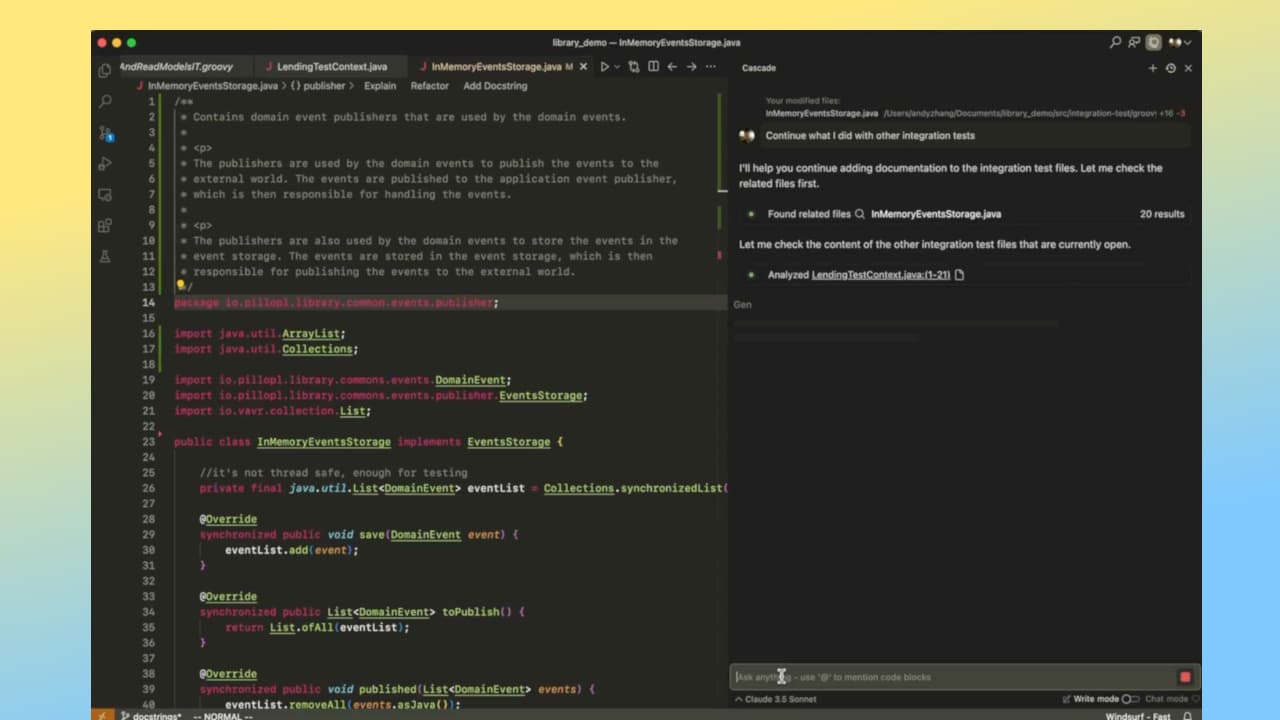
Windsurf AI, an AI-powered code editor, has introduced a simple but powerful feature: the ability to clone any public GitHub repository directly from a command. This allows its underlying AI to ingest the entire codebase for context, enabling it to answer specific questions about the project and use relevant code snippets when helping users build new features or debug issues.
The feature was highlighted by developer Simon Willison, who used it to "solve a minor friction" in his workflow. Instead of manually cloning a repo, navigating its structure, and then asking an AI tool questions with fragmented context, users can now instruct Windsurf with a command like clone simonw/datasette from within the editor.
Key Takeaways
- Windsurf AI now lets users clone a GitHub repository directly within the tool.
- This allows its AI to answer questions about the repo and use its code snippets to assist in building new artifacts.
What the Feature Does

Once a repository is cloned, Windsurf's AI model—which is understood to be a fine-tuned or context-augmented version of a large language model like GPT-4 or Claude—gains access to the project's full file structure and code. This transforms the interaction from a generic coding assistant to a project-specific expert.
Key capabilities enabled by this feature include:
- Project-Aware Q&A: Developers can ask questions like "How does authentication work in this project?" or "Where is the database connection configured?" and get answers based on the actual repository code.
- Contextual Code Generation: When asked to write a new function or feature, the AI can reference existing patterns, import statements, and utility functions from the cloned repo, ensuring consistency with the project's style and architecture.
- Reduced Friction: It eliminates the need to manually provide file paths or copy-paste large code blocks to give the AI context, streamlining the "context-gathering" phase of AI-assisted development.
Technical Implications and Workflow Integration
This feature represents a practical implementation of the "codebase as context" paradigm that is becoming central to AI developer tools. The technical challenge isn't just about cloning a repo (a simple git command), but about efficiently indexing, chunking, and retrieving relevant code snippets to stay within an LLM's context window while maintaining low latency.
Windsurf's approach suggests it is likely building or integrating a retrieval-augmented generation (RAG) system specifically for code. When a user asks a question, the system probably:
- Parses and indexes the cloned repository.
- Performs semantic search to find code files and functions relevant to the query.
- Injects the most relevant snippets into the LLM prompt alongside the user's instruction.
This is a step beyond basic chat-with-your-code tools, as it's integrated directly into the editor's command palette and AI interaction flow.
The Competitive Landscape for AI Coding Assistants

The AI coding assistant space is fiercely competitive, with major players like GitHub Copilot, Amazon Q Developer, and Tabnine offering deep IDE integration. Windsurf is positioning itself as a full AI-native editor, not just a plugin. This "clone repo" feature is a differentiator targeting a specific developer pain point: onboarding into a new codebase or working across multiple projects.
Other tools require you to manually open a project folder or rely on less precise global context. By making repository ingestion an explicit, simple command, Windsurf is betting on a workflow where AI context is dynamically loaded per task, rather than being statically tied to the currently open workspace.
gentic.news Analysis
This move by Windsurf is a tactical strike in the AI developer tools war, focusing on context management—a critical bottleneck for the usefulness of coding LLMs. As we've covered in our analysis of Cline and Cursor, the next frontier for these tools isn't just raw code generation, but deep, project-aware assistance. The ability to seamlessly pull in any open-source library or project as a reference frame directly addresses the "out-of-context" problem that plagues generic AI suggestions.
This development aligns with a broader trend we're tracking: the shift from single-snippet generation to multi-repository, multi-modal coding sessions. Tools are evolving to handle not just the file you're editing, but related documentation, issue threads, and now, entire external codebases. Windsurf's feature is a natural progression following GitHub's own Copilot Workspace, which aims to understand broader project goals.
For practitioners, the key takeaway is the explicit context loading paradigm. Instead of hoping the AI guesses the right framework or library, developers can now tell it exactly which codebase to use as a reference. This significantly improves accuracy and reduces the back-and-forth of correcting wrong assumptions. The limitation, of course, is that this currently works for public repos; the real enterprise value will be unlocked when this works seamlessly with private, internal repositories and monorepos.
Frequently Asked Questions
How do I use the clone feature in Windsurf AI?
Within the Windsurf AI editor, you can likely use a command palette (Cmd/Ctrl + K) and type a command such as clone username/repository-name. The tool will then fetch the public GitHub repository and index it for the AI's context.
Does Windsurf AI's clone feature work with private repositories?
Based on the initial announcement highlighting public GitHub repos, the feature likely supports public repositories by default. Support for private repos would require GitHub authentication and is a common next step for such tools, but has not been confirmed for this initial release.
How is this different from GitHub Copilot?
GitHub Copilot primarily provides inline code suggestions based on the currently open files and your overall project context. Windsurf's feature allows you to dynamically pull in the context of an external repository that is not part of your current project, making the AI an instant expert on that other codebase for Q&A or pattern reference.
What AI model does Windsurf AI use?
Windsurf AI has not publicly specified the exact underlying LLM powering its assistant. It is likely using a state-of-the-art model like GPT-4, Claude 3, or a fine-tuned variant, augmented with a retrieval system to pull in code from the cloned repository.