Alibaba introduces MIPI, a new RL objective that directly optimizes the inference policy. The two-step MIPU framework targets the hidden training-inference mismatch that degrades LLM post-training.
Key facts
- MIPI directly optimizes the inference policy, not the training policy.
- MIPU framework uses two-step model-based RL optimization.
- Addresses hidden mismatch in standard RL post-training.
- No benchmark results disclosed in the announcement.
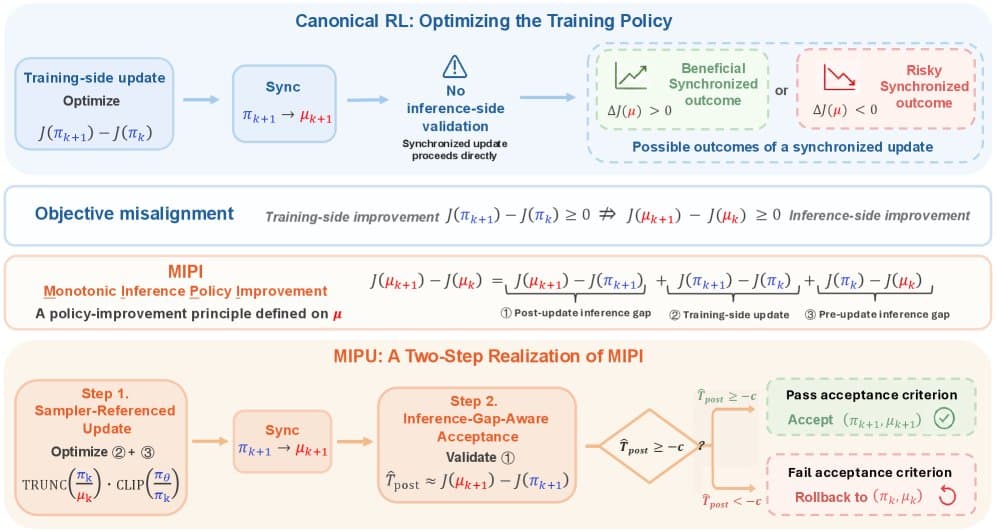
Alibaba researchers have proposed a new reinforcement learning objective called MIPI (Model-based Inference Policy Improvement) that directly optimizes the inference policy rather than the training policy, according to a post on X by @HuggingPapers (@HuggingPapers). The work addresses a fundamental flaw in standard RL-based post-training for large language models: models are optimized using a policy during training, but at inference time they deploy a different policy (e.g., greedy decoding, beam search, or sampling with different hyperparameters).
Standard RL post-training methods like PPO or GRPO optimize the policy used during training (typically a stochastic policy that samples from the model's output distribution). However, at inference, models often use deterministic decoding strategies or different sampling parameters. This mismatch means the objective being optimized does not match the actual behavior during deployment, creating what the researchers call a "mirage" that limits post-training gains.
How MIPU works

The MIPU framework operates in two steps. First, it learns a model of the environment (the inference process) using data collected from the model's inference-time behavior. Second, it uses this learned model to optimize the inference policy directly via a model-based RL approach, without needing to simulate the full inference process each time. This decouples the optimization from the training-time policy, aligning the objective with how the model will actually be used.
The approach is related to prior work on decision-time planning and model-based RL in language models, such as AlphaGo-style Monte Carlo tree search, but MIPI generalizes the idea to arbitrary inference policies. The researchers claim this leads to more stable training and better downstream performance, though specific benchmark results were not disclosed in the announcement.
Implications for LLM post-training
If validated, MIPI could change how practitioners approach RL fine-tuning. Current methods implicitly assume the training and inference policies are identical, which is rarely true in production. By explicitly optimizing the inference policy, MIPI may reduce the gap between validation metrics and real-world performance. The work also highlights a broader trend: researchers are increasingly scrutinizing the assumptions underlying standard RLHF and post-training pipelines.
What to watch
Watch for benchmark results from Alibaba comparing MIPI against standard PPO/GRPO on reasoning tasks like MATH or code generation. If MIPI shows consistent gains, expect rapid adoption in RLHF pipelines and potential integration into open-source frameworks like TRL or Axolotl.