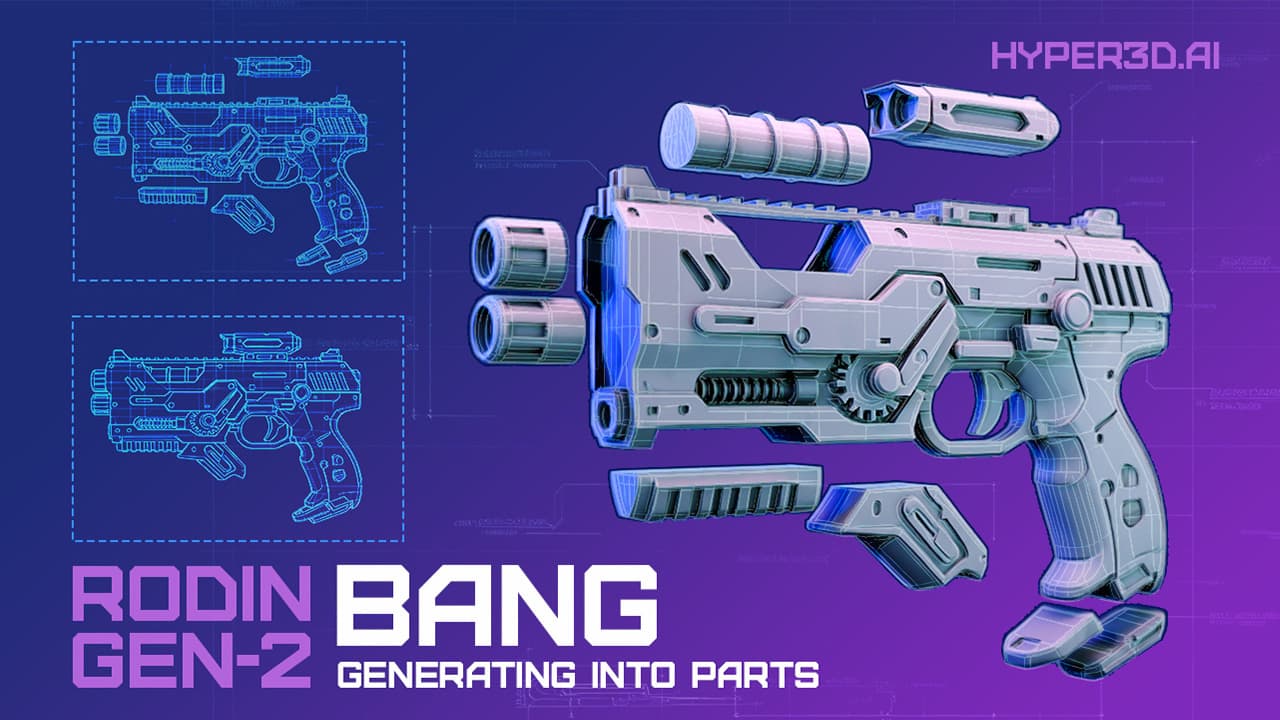
DeemosTech announced Rodin Gen-2.5 on X, claiming the world's first 10-million-polygon generative 3D AI. The model outputs 1 million polygons in 4 seconds, including skin microstructural detail.
Key facts
- 10 million polygon output per generation.
- 1 million polygons in 4 seconds.
- First GenAI to claim skin microstructures.
- No training dataset or hardware disclosed.
DeemosTech announced Rodin Gen-2.5 via X on an unspecified date, claiming the model is the 'world's 1st 10 MILLION polygon #3D GenAI' [According to @rohanpaul_ai]. The tweet states the model can generate 1 million polygons in 4 seconds and that the output includes 'skin microstructures'—a level of detail previously unreachable by generative 3D models.
The unique take: This is not just a resolution jump—it is a claim about fidelity to real-world physical surfaces. Skin microstructures (e.g., pores, fine wrinkles) are notoriously hard to model even in hand-crafted 3D assets; a generative model achieving this suggests either a vastly improved training dataset (possibly including high-resolution 3D scans) or a novel representation that captures high-frequency detail without exploding polygon count. If true, it closes the gap between generative 3D and production-grade assets for games, VFX, and digital humans.
However, the announcement is thin on technical specifics. DeemosTech did not disclose the training dataset size, model architecture (e.g., whether it uses a transformer, NeRF, or hybrid approach), inference hardware requirements (GPU type, memory), or how the 10M-polygon output compares to prior Rodin versions (Gen-2.0 claimed 1M polygons in 2024). No benchmark comparisons to other high-poly generative models (e.g., Meshy, Luma AI, or NVIDIA's GET3D) were provided. The company did not release a paper or demo video showing the 10M-polygon output.
Comparison to prior art: Most generative 3D models today cap at 1-2 million polygons. Rodin Gen-2.0, released in 2024, generated 1M polygons in 10 seconds. Gen-2.5 claims a 10x resolution increase and 2.5x speed improvement—but without reproducible benchmarks, the claim remains unverified. Skin microstructures are computationally expensive; achieving them in a generative context would require either a very large latent space or a hierarchical generation approach (e.g., coarse mesh → displacement map).
Implications: If validated, Rodin Gen-2.5 could enable real-time generation of production-quality 3D assets for digital humans, medical visualization, and high-end gaming. However, the lack of technical disclosure and the single-source announcement (a tweet) warrant skepticism. The model's training data provenance—whether it uses licensed or publicly scraped data—is also unclear, which could raise IP concerns in the 3D asset industry.
What to watch

Watch for a technical paper or demo video from DeemosTech showing the 10M-polygon output. Also track whether the company releases a public API or open-source weights—and whether competitors (Meshy, Luma) respond with similar resolution claims within 90 days.