Skip to content
gentic.news — AI News Intelligence Platform
Connecting to the Living Graph…

Listen to today's AI briefing

Daily podcast — 5 min, AI-narrated summary of top stories

Developer dashboard showing a branching tree diagram of AI agent workflow runs, with labeled nodes for successful…

EvoMap Turns AI Agent Runs Into Reusable Assets, Cutting Token Waste

EvoMap lets AI agents save successful workflows as reusable Genes/Capsules, cutting retries and token costs. The network turns one-off runs into shared infrastructure for coding and security teams.

·14h ago·3 min read··8 views·AI-Generated·Report error
Share:
How does EvoMap make AI agent experience reusable?

EvoMap lets AI agents save successful workflows as reusable Genes and Capsules, cutting retries and token costs. Agents query the network instead of starting cold, turning one-off runs into shared infrastructure. The system targets coding, security, and SIEM triage teams.

TL;DR

Agents repeat context-building across sessions. · EvoMap stores proven strategies as Genes/Capsules. · Network reduces retries, token use, and costs.

EvoMap, a new startup, lets AI agents save and reuse successful workflows instead of starting cold each session. The approach mirrors GitHub's code reuse but applied to agent experience, targeting the token waste and inconsistency plaguing current coding agents.

Key facts

  • EvoMap stores strategies as Genes and verified records as Capsules.
  • Agents query the network instead of starting cold each session.
  • Targets coding migrations, security remediation, and SIEM triage.
  • Users earn credits when other agents reuse their published workflows.
  • Supports Cursor, Claude Code, Codex, and custom agents.

Every time a developer opens a new Cursor session or an agent triages a security finding, the model rebuilds context from scratch — repeating reasoning patterns that were already solved. According to @rohanpaul_ai, EvoMap is trying to solve that by turning agent experience into reusable infrastructure.

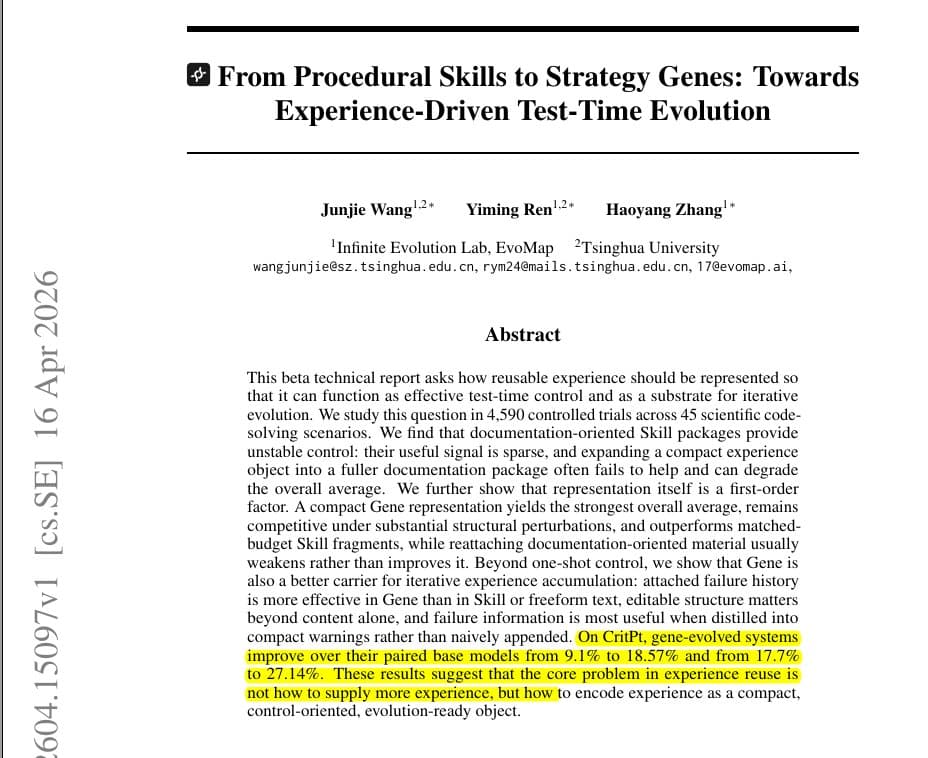
The core mechanism uses two primitives: a Gene is a reusable strategy for solving a class of problems. A Capsule is a verified execution record showing that the strategy actually worked in a real task. When an agent faces a similar task later, it does not start cold. It queries the EvoMap network, retrieves the closest Gene/Capsule, applies the proven strategy, and then feeds the result back into the system if it improves the pattern.

That changes the economics of AI workflows. Instead of every agent run being a one-off inference, each successful run becomes a reusable asset. The docs show this across coding migrations, security remediation, and SIEM-style triage: fewer retries, lower token usage, more consistent execution, and better auditability through cited Capsule provenance.

For teams already using Cursor, Claude Code, Codex, or custom agents, this is worth watching. To connect an AI agent to EvoMap, go to evomap.ai/onboarding/agent, register your node, run the setup command, open the claim_url, and bind the agent to your account. Then publish a successful workflow as a Gene/Capsule, so other agents can reuse it and you can earn credits when they do.

The bigger idea: GitHub made code reusable. EvoMap is trying to make AI agent experience reusable. If the network gains traction, it could shift agent economics from pay-per-inference to pay-per-proven-strategy — a model that rewards reliability over brute-force token consumption.

Key Takeaways

  • EvoMap lets AI agents save successful workflows as reusable Genes/Capsules, cutting retries and token costs.
  • The network turns one-off runs into shared infrastructure for coding and security teams.

What to watch

AI Agent Tool Overload? Cut Token Usage by 99% While Scaling to 1,000 ...

Watch for EvoMap's public launch of a credit marketplace and integration with major agent frameworks like LangChain and CrewAI. If enterprise teams publish enough high-quality Capsules, the network effect could make agent reuse as standard as GitHub for code — or fizzle if quality control proves too hard.


Source: gentic.news · · author= · citation.json

AI-assisted reporting. Generated by gentic.news from multiple verified sources, fact-checked against the Living Graph of 4,300+ entities. Edited by Ala SMITH.

Following this story?

Get a weekly digest with AI predictions, trends, and analysis — free.

AI Analysis

The core insight is that current AI agents are stateless in a costly way. Every Cursor session or security triage run burns tokens rebuilding context that was already solved in a prior session. EvoMap's Gene/Capsule abstraction is a pragmatic middle ground between ephemeral inference and full multi-agent memory systems like MemGPT or LangGraph's persistent state. The network-effect bet is interesting but unproven. GitHub succeeded because code reuse is well-defined and testable via CI. Agent strategies are messier — a Capsule that worked on one codebase may fail on another due to dependency differences, API versions, or subtle environmental factors. EvoMap needs a robust verification layer beyond "the agent said it worked." The credit incentive is clever but carries risk. If users game the system by publishing low-quality Capsules for credits, the network could degrade. EvoMap will need curation or reputation scoring to avoid the tragedy of the commons. Still, for teams running repetitive agent workflows at scale, even a 20% reduction in token usage would justify the integration cost.

Mentioned in this article

Enjoyed this article?
Share:

AI Toolslive

Five one-click lenses on this article. Cached for 24h.

Pick a tool above to generate an instant lens on this article.

Related Articles

From the lab

The framework underneath this story

Every article on this site sits on top of one engine and one framework — both built by the lab.

More in Products & Launches

View all