Key Takeaways
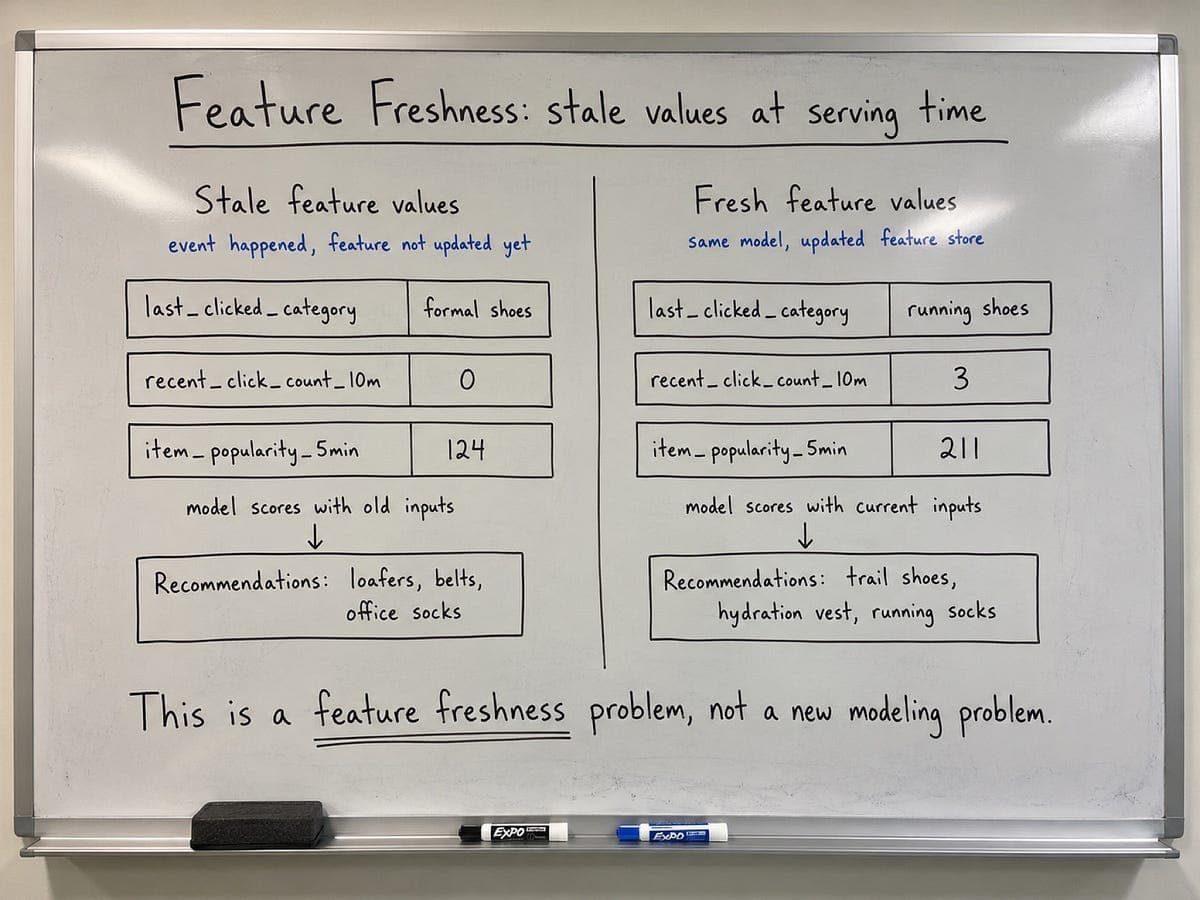
- Jie Li's article reveals that stale features—outdated user signals—can degrade recommender performance by 20-30% in offline metrics, often misdiagnosed as model problems.
- The piece urges teams to prioritize feature freshness monitoring alongside model tuning.
What Happened
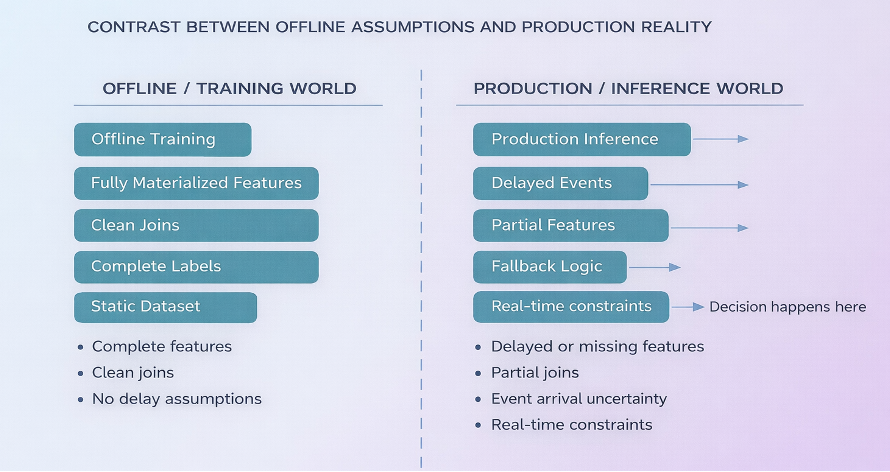
In a detailed Medium post, machine learning engineer Jie Li exposes a common but underappreciated production bug in recommender systems: feature freshness. The core argument is that even a well-trained model can fail in production if the features it relies on are stale—meaning they reflect user behavior from hours or days ago rather than the most recent interactions.
Li explains that teams often spend weeks tuning model architectures, hyperparameters, and training pipelines, only to see disappointing online metrics. The knee-jerk reaction is to blame the model. But the real culprit may be that a feature like user_last_click_timestamp or product_recent_views is being served from a batch job that runs every 12 hours, while users are generating new signals every second.
Technical Details
Feature freshness is measured as the latency between when a user action occurs and when that action is reflected in the model's input features. Li breaks down common sources of staleness:
- Batch pipelines: Features computed nightly are 12-24 hours stale by definition.
- Logging delays: User events may be buffered or queued before reaching the feature store.
- Feature store sync issues: Real-time features may not propagate quickly enough to all serving instances.
- Caching layers: Aggressive caching can serve outdated feature values to the model.
Li reports that in experiments, using features that are just 1 day old (vs. real-time) caused a 20-30% drop in offline AUC for a typical ranking model. Online metrics like click-through rate and conversion rate are even more sensitive, as stale features fail to capture recent user intent shifts.
Retail & Luxury Implications
For retail and luxury e-commerce, recommender systems are the backbone of personalization—from homepage feeds to product recommendations to email campaigns. Feature freshness is particularly acute in this domain:
- Flash sales and limited drops: Luxury brands like Supreme or Nike's SNKRS app create intense, time-sensitive demand. A user who browsed 5 minutes ago has a very different intent than one who browsed yesterday.
- Seasonal collections: When a new collection drops, old browsing behavior (e.g., from last season) is actively misleading. Stale features could show a user a coat they liked in winter when it's now spring.
- Abandoned cart recovery: Using stale cart features means the model might recommend items the user already purchased elsewhere.
Li's advice applies directly: retail teams should measure feature staleness as a KPI, invest in real-time feature pipelines (using tools like Kafka, Flink, or Redis), and build monitoring dashboards that alert when features exceed freshness thresholds.
Business Impact

If a luxury retailer's recommender is seeing a 20% drop in conversion rate despite model improvements, the first diagnostic step should be feature freshness. Fixing a stale pipeline can recover that performance without any model retraining—a massive ROI for a relatively simple infrastructure fix.
Implementation Approach
- Audit current feature pipelines: Map each feature to its update frequency and typical staleness.
- Set freshness SLAs: Define acceptable staleness for different feature categories (e.g., user signals < 1 minute, product metadata < 1 hour).
- Instrument monitoring: Add staleness metrics to existing model monitoring dashboards.
- Prioritize critical features: Real-time signals for click, add-to-cart, and purchase events often have the highest impact.
- Consider streaming infrastructure: For high-traffic sites, move from batch to streaming feature computation.
Governance & Risk Assessment
- Maturity: This is a well-known issue in production ML, but Li's article provides a clear framework for diagnosis.
- Privacy: Real-time features must respect user consent and data retention policies.
- Bias: Stale features can systematically disadvantage new users (who have no recent history) or items with sparse interaction data.
gentic.news Analysis
Jie Li's article is a refreshingly practical contribution to the recommender systems literature. While much of the field focuses on model architecture (transformers, graph neural networks, etc.), Li reminds us that infrastructure quality directly impacts model performance—and that the gap between offline and online metrics is often not a modeling problem at all.
For retail and luxury AI teams, this is a call to action. The most sophisticated personalization model in the world will underperform if it's fed stale signals. The fix is not a new algorithm but better data engineering: real-time feature pipelines, freshness monitoring, and a culture that treats feature staleness as a first-class production metric.
We recommend that teams add feature freshness to their MLOps checklists and run periodic audits, especially before major campaigns or drops where timeliness is critical. The cost of implementing streaming features is often far lower than the revenue lost to stale recommendations.
Source: medium.com