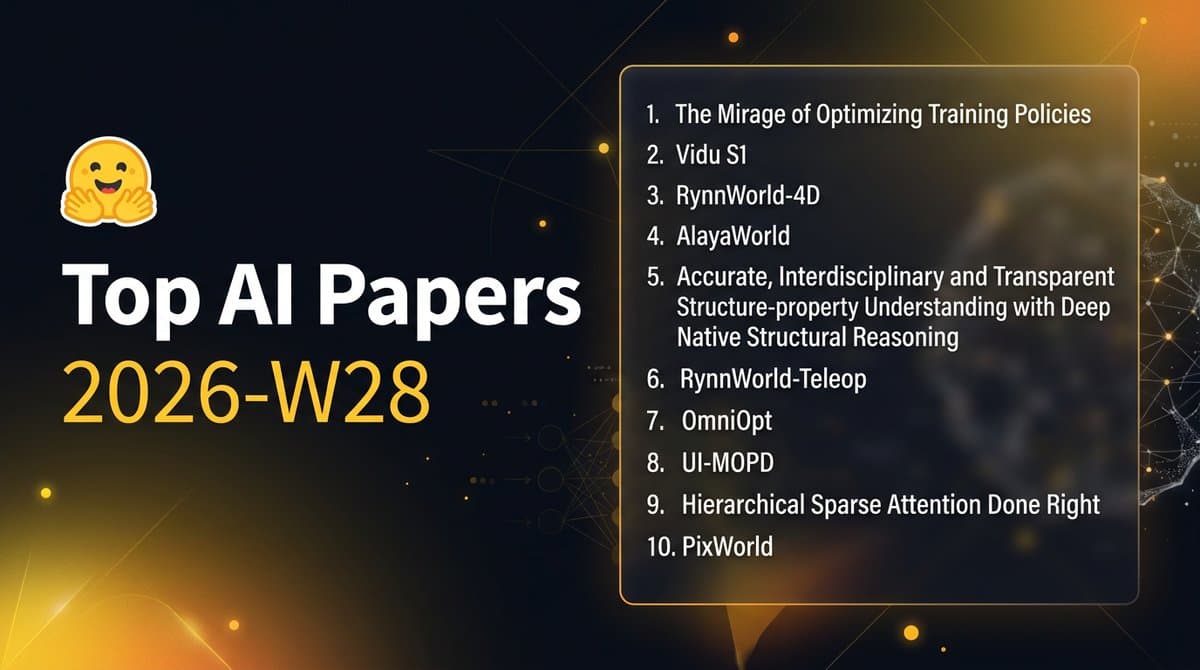
Hugging Face's most-upvoted papers July 6-12 challenge LLM RL dogma. 'The Mirage of Optimizing Training Policies' argues monotonic inference policies are the real objective.
Key facts
- Top paper argues training-time RL optimization is a mirage.
- Vidu S1 enables real-time interactive video generation.
- AlayaWorld targets long-horizon playable video worlds.
- RynnWorld-4D introduces 4D world models for robotics.
- OmniOpt benchmarks modern optimizers with taxonomy and geometry.
Hugging Face's weekly paper rankings for July 6-12 reveal a clear signal: the community is prioritizing fundamental rethinks of LLM training and multimodal world generation. The top paper, 'The Mirage of Optimizing Training Policies,' argues that optimizing training-time RL policies is a mirage. The authors propose monotonic inference policies as the true objective for LLM reinforcement learning, suggesting that current RLHF approaches may be optimizing the wrong metric. This aligns with growing skepticism about the efficacy of heavy training-time optimization in favor of inference-time compute scaling.
Real-Time and World Models Dominate
Vidu S1 introduces a model for real-time interactive video generation, enabling user-driven control during generation—a significant step beyond static text-to-video. AlayaWorld targets long-horizon and playable video world generation, pushing beyond short clips toward persistent, interactive environments. RynnWorld-4D presents 4D embodied world models for robotic manipulation, integrating time as a dimension for more realistic simulation. RynnWorld-Teleop extends this with an action-conditioned world model for digital teleoperation, potentially lowering the barrier for robotic data collection.
Optimizer Taxonomy and GUI Agents
OmniOpt provides a taxonomy, geometry, and benchmarking of modern optimizers, offering a structured comparison of Adam, Lion, and others. UI-MOPD proposes multi-platform on-policy distillation for continual GUI agent learning, addressing the challenge of maintaining performance across changing interfaces. Hierarchical Sparse Attention Done Right explores infinite context modeling, a critical area as context windows grow. PixWorld unifies 3D scene generation and reconstruction in pixel space, avoiding explicit 3D representations.
According to @HuggingPapers, the list reflects community voting, not editorial curation. The papers span RL theory, video generation, robotics, optimization, and attention mechanisms, indicating broad interest in both foundational and applied AI.
What to watch

Watch for follow-up work on monotonic inference policies, especially whether they translate into practical RLHF improvements. Also track if Vidu S1's interactive video approach gets integrated into game engines or simulation platforms, and whether AlayaWorld's long-horizon generation achieves real-time performance.